Wednesday, 14 April 2021

Reading journal: Simone de Beauvoir

The cover of Force of Circumstance by Simone de Beauvoir, the 3rd volume of her autobiography · Lisa Stefan


I am halfway through Force of Circumstance, the 3rd volume of Simone de Beauvoir's autobiography (№ 26). The idea was to finish it before sharing a new reading list. Beauvoir's life story is interesting but this volume has its flaws: Sometimes she's too concerned with setting the record straight and often it feels as if Jean-Paul Sartre is the main subject. Obviously, their lives intertwined, but I'm interested in her story, in her writing, not the content of Sartre's political articles in Les Temps Modernes or the plot of his plays. Speaking of politics. The book has plenty, sometimes to the point of being tedious or exhausting. Depending on my mood. On a positive note, Beauvoir travels all over the world and is a keen observer of people and landscapes. Those narratives, her books, and how they were received makes this volume worth reading, so far.

Bookmarks & journal notes

Books I recently bought:
  Philip Roth: The Biography by Blake Bailey
  The Radetzky March by Joseph Roth

... added to my wish list:
  A Splendid Intelligence: The Life of Elizabeth Hardwick by Cathy Curtis

... added to my TBR:
  Hannah Arendt by Samantha Rose Hill
  This Little Art by Kate Briggs
  Endpapers: A Family Story of Books, War, Escape and Home by Alexander Wolff

... want to read again:
  The Master and Margarita by Mikhail Bulgakov

Bookish joy:
  Recently the 2021 International Booker Prize longlist was announced, containing the authors and translators of 13 books published in the UK or Ireland. I have yet to read any of them but was pleased to see among them In Memory of Memory by Russian poet and writer Maria Stepanova. It was translated by Sasha Dugdale. It so happens that in a recent blog entry I featured the US cover. Later in April, they announce the shortlist and in June the winner.

Recommended podcast:
  The 135th Backlisted episode was superb. They featured the novel The Fish Can Sing (1957) by the Icelandic writer Halldór Laxness (1902-1998), who received the 1955 Nobel Prize. Its Icelandic title is 'Brekkukotsannáll', which literally translates 'The Annals of Brekkukot [Hill cottage]'. This time the guest on the podcast was the British novelist and poet Derek Owusu. If you happen to understand Icelandic you can listen to Laxness himself reading his novel on RÚV, the Icelandic National Broadcasting Service.

image by me, appeared on Instagram 19/03/21


Friday, 26 March 2021

Playwright Thomas Bernhard and white Austria

The cover of 'Heldenplatz' by playwright Thomas Bernhard · Lisa Stefan


If you follow me on Instagram you know that I usually don't write long captions, nor do I copy nor share them on the blog. Sometimes I use the same pics. Yesterday, however, I wrote about my experience in Austria and would like to keep these reflections on the blog. You can look at this as a peek into my next reading list, which includes the play Heldenplatz by the Austrian writer Thomas Bernhard. I will probably write about it later, in a Reading journal entry. That said, here is yesterday's caption with added links:

Thomas Bernhard (1931-1989) is an Austrian novelist and playwright that I still haven't read. For my next reading list, I bought a Suhrkamp edition of his play Heldenplatz, which he wrote on the 50th anniversary of the 'Anschluss', the annexation of Austria by Hitler's Germany [the Anschluss took place on 12 March 1938]. Anti-Semitism is the play's major theme.

Austria is my adopted country and I believe literature is one of the best ways to learn about the history and culture of a nation. By that, I'm referring to the things the history books usually leave out. Most of my time in Austria has been spent in this pandemic, which has limited my chances to be out and about; to meet people.

The Austrians I have met are all very friendly. However, what I cannot help noticing is that in magazines this country is depicted as White. Whether it's done intentionally, I cannot say. As I'm white, I have no experience of racism, but I have sat in waiting rooms and leafed through Austrian magazines, which present an idyllic view of a rich country with beautiful landscapes and white people. Lots of white people. I have searched and counted: In one magazine I found a group photo with one Asian woman and in another a small one with a black man. I wonder if the Austrians themselves even notice this.

Anyway, Bernhard's play, which some Austrians found hard to swallow, is one way for me to practise my German during the pandemic.

(Bloomsbury has published an English translation of the play Heldenplatz by Meredith Oakes.)

Adding to yesterday's reflections, I do realise that Austrians are in the majority, about 80%, but in light of history and increased immigration, I would have expected growing awareness. I have lived in several European countries and perhaps there I didn't notice this white image in magazines. Yet, I don't think so. I don't remember this kind of evident whiteness. By the way, I found an interesting article from 2018 on the website of The Irish Times, called Vienna is ranked world’s ‘most liveable city’, but for whom? (with the subtitle: For some of my immigrant friends here, the welcome has been far from warm). It focuses on the situation in Vienna and its author paints a completely different picture than a white one, of a multinational community to which the magazines I have leafed through do not seem to make an attempt to appeal.

Well, spring has sprung with sun and seventeen degrees so there is no reason to complain about the Austrian weather.

image by me, appeared on Instagram 25/03/21


Monday, 15 March 2021

№ 26 reading list: Beauvoir, Handke and Lowell

My № 26 reading list includes works by Beauvoir, Handke and Lowell · Lisa Stefan


First, the book lover's confession: I have this tendency to go through periods where I read too many books at once, which is probably a form of addiction. Perhaps such periods depict restlessness and escapism, and blaming the pandemic has come in handy. Since last autumn there has been a lockdown in Austria, but with spring arriving - the vaccine too, hopefully - it's time for spring cleaning, to reduce the piles of books. It's going well. I have already read most of the books on the new reading list, which I intended to share in February, but I have been saving one: the 3rd volume of Simone de Beauvoir's autobiography. I conditioned myself to complete certain books before meeting up with her again, this time in post-war France. The volume spans the period 1945 to 1963, when Beauvoir wrote, among others, her feminist work The Second Sex and the novel The Mandarins.

№ 26 reading list:

1  Suppose a Sentence  · Brian Dillon
2  Unfinished Business: Notes of a Chronic Re-reader  · Vivian Gornick
3  Force of Circumstance  · Simone de Beauvoir
4  Wunschloses Unglück  · Peter Handke [German]
5  Mutter Courage und ihre Kinder  · Bertolt Brecht [German]
6  The Rings of Saturn  · W.G. Sebald
7  Three Rings: A Tale of Exile, Narrative, and Fate  · Daniel Mendelsohn
8  Life Studies  · Robert Lowell
9  Letters Summer 1926  · Boris Pasternak, Marina Tsvetayeva and Rainer
Maria Rilke

Translated by: 3) Force of Circumstance: Richard Howard

As I once promised, I have included on the list Brecht's masterpiece Mutter Courage und ihre Kinder, which translates Mother Courage and Her Children (one of many editions available in English). Recently, I was browsing in an Icelandic digital archive, which gives access to articles in newspapers and periodicals, when I came across a theatre critique from 1965. At Christmas that year, Brecht's play was performed at The National Theatre of Iceland and the critic was far from impressed. If you can read Icelandic you will learn that it was mainly the director's fault.

Featuring the Austrian writer Peter Handke on a reading list without saying a few words about him is unthinkable. He received the 2019 Nobel Prize in Literature, which by many within literary circles was considered a controversial decision. Handke's career starts in the sixties but suddenly in the nineties, he becomes controversial when his writings about the wars in former Yugoslavia start appearing. Without hesitation he criticised the media coverage of what was taking place in the Balkans, the language applied to describe events. A turning point was an article by Handke that appeared in the German newspaper Süddeutsche Zeitung in 1996, a travelogue about Serbia with a "provocative headline" written by the editors (Icelandic source).

It certainly didn't help Handke's cause when he visited Slobodan Milosevic in prison when the former president was being tried by The International Criminal Court in The Hague. And to make matters worse he attended and spoke at his funeral in Serbia in 2006. However, many argue that nothing in Handke's writings justifies the attacks against him, which allows one to conclude that those who have been the loudest have, in fact, not read his works.

Nobel laureate, Austrian writer Peter Handke, photographed by A. Mahmoud · Books & Latte
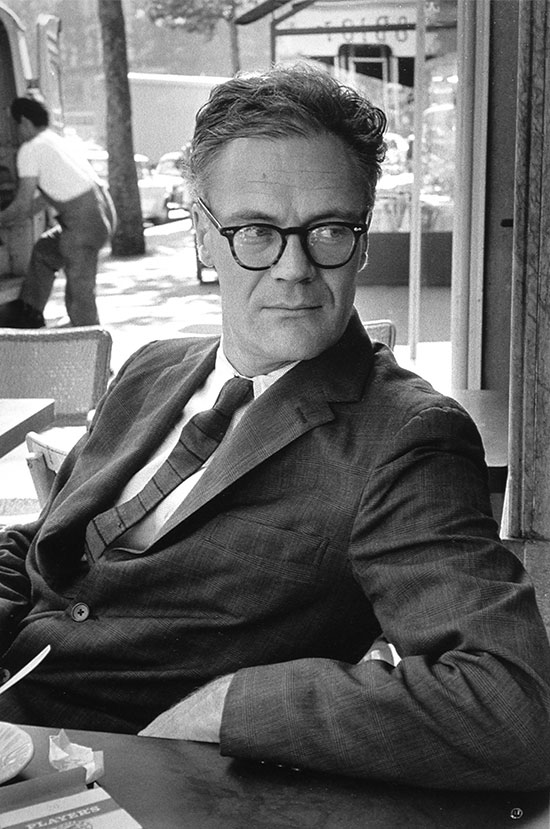
Poet Robert Lowell · Books & Latte

Left: Austrian writer and Nobel laureate Peter Handke;
right: American poet Robert Lowell

Handke's book on the reading list, Wunschloses Unglück, was published in 1972. It's a short, well-written, semi-autobiographical book, prompted by his mother's suicide. Its English title is A Sorrow Beyond Dreams. I recently bought a German edition of Handke's book Der kurze Brief zum langen Abschied (Short Letter, Long Farewell, published by NYRB) which I will soon include on a reading list. If you speak Icelandic you may be interested in three links I shared in this same entry on my Icelandic blog. They include interesting discussions about Handke and his works on RÚV, the Icelandic National Broadcasting Service.

It is worth mentioning that Handke, in collaboration with the German director Wim Wenders, wrote the screenplay for the 1987 film Der Himmel über Berlin (Wings of Desire), including the poem Lied vom Kindsein, which Bruno Ganz recites at its start.

My reading lists do not often feature poetry, but at Christmas a friend in Iceland gave me a Faber & Faber edition of Life Studies by Robert Lowell. It was first published in 1959 and contains confessional poems, e.g. Skunk Hour (dedicated to poet Elizabeth Bishop) and Waking in the Blue, and the prose memoir 91 Revere Street. This groundbreaking collection won Lowell the National Book Award for Poetry. I see myself reading it again and again.

top image by me | writers: 01: Peter Handke by A. Mahmoud via The Nobel Prize | 02: Robert Lowell via Put This On