Showing posts with label simone de beauvoir. Show all posts

Wednesday, 14 April 2021

Reading journal: Simone de Beauvoir

The cover of Force of Circumstance by Simone de Beauvoir, the 3rd volume of her autobiography · Lisa Stefan


I am halfway through Force of Circumstance, the 3rd volume of Simone de Beauvoir's autobiography (№ 26). The idea was to finish it before sharing a new reading list. Beauvoir's life story is interesting but this volume has its flaws: Sometimes she's too concerned with setting the record straight and often it feels as if Jean-Paul Sartre is the main subject. Obviously, their lives intertwined, but I'm interested in her story, in her writing, not the content of Sartre's political articles in Les Temps Modernes or the plot of his plays. Speaking of politics. The book has plenty, sometimes to the point of being tedious or exhausting. Depending on my mood. On a positive note, Beauvoir travels all over the world and is a keen observer of people and landscapes. Those narratives, her books, and how they were received makes this volume worth reading, so far.

Bookmarks & journal notes

Books I recently bought:
  Philip Roth: The Biography by Blake Bailey
  The Radetzky March by Joseph Roth

... added to my wish list:
  A Splendid Intelligence: The Life of Elizabeth Hardwick by Cathy Curtis

... added to my TBR:
  Hannah Arendt by Samantha Rose Hill
  This Little Art by Kate Briggs
  Endpapers: A Family Story of Books, War, Escape and Home by Alexander Wolff

... want to read again:
  The Master and Margarita by Mikhail Bulgakov

Bookish joy:
  Recently the 2021 International Booker Prize longlist was announced, containing the authors and translators of 13 books published in the UK or Ireland. I have yet to read any of them but was pleased to see among them In Memory of Memory by Russian poet and writer Maria Stepanova. It was translated by Sasha Dugdale. It so happens that in a recent blog entry I featured the US cover. Later in April, they announce the shortlist and in June the winner.

Recommended podcast:
  The 135th Backlisted episode was superb. They featured the novel The Fish Can Sing (1957) by the Icelandic writer Halldór Laxness (1902-1998), who received the 1955 Nobel Prize. Its Icelandic title is 'Brekkukotsannáll', which literally translates 'The Annals of Brekkukot [Hill cottage]'. This time the guest on the podcast was the British novelist and poet Derek Owusu. If you happen to understand Icelandic you can listen to Laxness himself reading his novel on RÚV, the Icelandic National Broadcasting Service.

image by me, appeared on Instagram 19/03/21


Monday, 15 March 2021

№ 26 reading list: Beauvoir, Handke and Lowell

My № 26 reading list includes works by Beauvoir, Handke and Lowell · Lisa Stefan


First, the book lover's confession: I have this tendency to go through periods where I read too many books at once, which is probably a form of addiction. Perhaps such periods depict restlessness and escapism, and blaming the pandemic has come in handy. Since last autumn there has been a lockdown in Austria, but with spring arriving - the vaccine too, hopefully - it's time for spring cleaning, to reduce the piles of books. It's going well. I have already read most of the books on the new reading list, which I intended to share in February, but I have been saving one: the 3rd volume of Simone de Beauvoir's autobiography. I conditioned myself to complete certain books before meeting up with her again, this time in post-war France. The volume spans the period 1945 to 1963, when Beauvoir wrote, among others, her feminist work The Second Sex and the novel The Mandarins.

№ 26 reading list:

1  Suppose a Sentence  · Brian Dillon
2  Unfinished Business: Notes of a Chronic Re-reader  · Vivian Gornick
3  Force of Circumstance  · Simone de Beauvoir
4  Wunschloses Unglück  · Peter Handke [German]
5  Mutter Courage und ihre Kinder  · Bertolt Brecht [German]
6  The Rings of Saturn  · W.G. Sebald
7  Three Rings: A Tale of Exile, Narrative, and Fate  · Daniel Mendelsohn
8  Life Studies  · Robert Lowell
9  Letters Summer 1926  · Boris Pasternak, Marina Tsvetayeva and Rainer
Maria Rilke

Translated by: 3) Force of Circumstance: Richard Howard

As I once promised, I have included on the list Brecht's masterpiece Mutter Courage und ihre Kinder, which translates Mother Courage and Her Children (one of many editions available in English). Recently, I was browsing in an Icelandic digital archive, which gives access to articles in newspapers and periodicals, when I came across a theatre critique from 1965. At Christmas that year, Brecht's play was performed at The National Theatre of Iceland and the critic was far from impressed. If you can read Icelandic you will learn that it was mainly the director's fault.

Featuring the Austrian writer Peter Handke on a reading list without saying a few words about him is unthinkable. He received the 2019 Nobel Prize in Literature, which by many within literary circles was considered a controversial decision. Handke's career starts in the sixties but suddenly in the nineties, he becomes controversial when his writings about the wars in former Yugoslavia start appearing. Without hesitation he criticised the media coverage of what was taking place in the Balkans, the language applied to describe events. A turning point was an article by Handke that appeared in the German newspaper Süddeutsche Zeitung in 1996, a travelogue about Serbia with a "provocative headline" written by the editors (Icelandic source).

It certainly didn't help Handke's cause when he visited Slobodan Milosevic in prison when the former president was being tried by The International Criminal Court in The Hague. And to make matters worse he attended and spoke at his funeral in Serbia in 2006. However, many argue that nothing in Handke's writings justifies the attacks against him, which allows one to conclude that those who have been the loudest have, in fact, not read his works.

Nobel laureate, Austrian writer Peter Handke, photographed by A. Mahmoud · Books & Latte
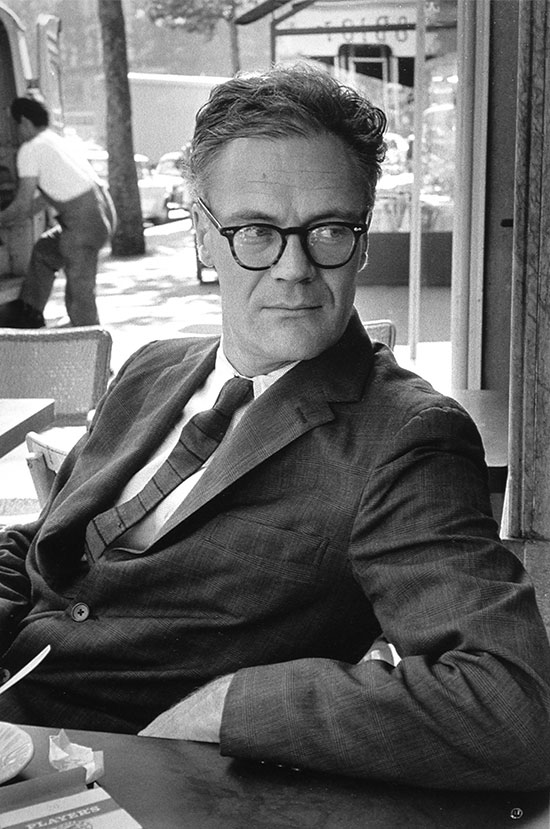
Poet Robert Lowell · Books & Latte

Left: Austrian writer and Nobel laureate Peter Handke;
right: American poet Robert Lowell

Handke's book on the reading list, Wunschloses Unglück, was published in 1972. It's a short, well-written, semi-autobiographical book, prompted by his mother's suicide. Its English title is A Sorrow Beyond Dreams. I recently bought a German edition of Handke's book Der kurze Brief zum langen Abschied (Short Letter, Long Farewell, published by NYRB) which I will soon include on a reading list. If you speak Icelandic you may be interested in three links I shared in this same entry on my Icelandic blog. They include interesting discussions about Handke and his works on RÚV, the Icelandic National Broadcasting Service.

It is worth mentioning that Handke, in collaboration with the German director Wim Wenders, wrote the screenplay for the 1987 film Der Himmel über Berlin (Wings of Desire), including the poem Lied vom Kindsein, which Bruno Ganz recites at its start.

My reading lists do not often feature poetry, but at Christmas a friend in Iceland gave me a Faber & Faber edition of Life Studies by Robert Lowell. It was first published in 1959 and contains confessional poems, e.g. Skunk Hour (dedicated to poet Elizabeth Bishop) and Waking in the Blue, and the prose memoir 91 Revere Street. This groundbreaking collection won Lowell the National Book Award for Poetry. I see myself reading it again and again.

top image by me | writers: 01: Peter Handke by A. Mahmoud via The Nobel Prize | 02: Robert Lowell via Put This On


Tuesday, 9 June 2020

Reading journal: Beauvoir & Kafka

Book covers, from my reading journal · Lisa Stefan


I thought it best to sneak in a reading journal entry before sharing more book covers. The book cover entries are tempting because I don’t have to grab my camera and I would like to have some covers on the blog for future reference. If you were worried about the coronavirus pandemic preventing the publication of books, I think you can breathe calmly. Plenty of books are about to hit the shelves and let's hope the content is as promising as the covers.

Reading journal, № 14 reading list, 2 of 7:

· Letters to Friends, Family & Editors by Franz Kafka. This is the first collection of letters by Kafka that I read and own. I was in no hurry to finish it so once I had read enough letters to get a feel for his voice, I read a letter or two in bed. The letters show the reader different sides of Kafka, from his student years in Prague in the early 1900s to his final months at a sanatorium near Vienna in 1924, where he died from tuberculosis. In letters to friends, he is less formal, of course, especially when writing to Max Brod who collected Kafka’s letters after his death, and it is through these personal letters that we see his health deteriorating. A more formal tone characterises the letters to his editors where he discusses manuscripts and even book design and fonts before publication. Perhaps those are more appealing to scholars.

The women in his life, Felice Bauer, Milena Jesenská-Polak, Julie Wohryzek, and Dora Dymant, appear on the pages, but the letters to Felice and Milena are available in separate editions: Letters to Felice (I recently shared the book cover) and Letters to Milena. The one thing that bothered me during the reading relates to the book's layout: The notes are at the back instead of appearing in footnotes, which would have been more convenient for the reader. This was especially annoying when reading many letters in a setting and constantly having to look up the notes. [Schocken; translated by Richard and Clara Winston]

· The Prime of Life by Simone de Beauvoir – autobiography, 2nd vol. It's been a while since I finished this one, which covers the years 1929 to 1944, and lately I have been gliding over sections where I had left a mark on the margin. I liked this volume more than the first but have to add that in the first chapters Beauvoir was sometimes too keen on sharing details: It sometimes felt as if she had to mention and describe every person that crossed her path. It happened less as the story progressed and the second world war drew nearer.

On three pages (319-321) spanning the period from 1937 to 1938, war is coming and clearly, the situation has started to affect her mental well-being:
Indeed, I now passed through one of the most depressing periods of my whole life. I refused to admit that war was even possible, let alone imminent. But it was no use my playing the ostrich; the growing perils all around crushed me beneath their weight.

If the Spanish tragedy dismayed us, events in Germany scared us stiff. In September, at Nuremberg, before an audience of 300,000 Nazis and something like a million visitors, Hitler delivered his most aggressive speech yet.

For my own part I was still trying to delude myself, and refusing to face the facts. But the future had begun to open up under my very feet, and produced in me a sick feeling akin to real anguish. No doubt that is why I retain only a misty recollection of this entire year. Nor can I remember anything of outstanding interest in my private life.
Matisse cover: Used copy of The Prime of Life by Simone de Beauvoir - autobiography, Vol. 2 · Lisa Hjalt


When the Germans invade Poland, on 1 September 1939, her narrative becomes a diary that ends on 14 July 1940. On 14 September, for example, she goes to the cinema and reads Portrait of a Lady by Henry James in bed. She doesn’t write daily and nothing at all after the fall of Paris, on 14 June 1940. Despite the war, there is no shortage of discussion of literature and philosophy on the pages, and it should be noted that the book is dedicated to Jean-Paul Sartre, who was her soulmate. It's truly interesting to read about life in France, about Paris in wartime; about visits to Café de Flore, on the corner of Boulevard Saint-Germain and Rue Saint-Benoît, which she and Sartre frequented ('It was our own special resort. We felt at home there; it sheltered us from the outside world.'). In this volume the reader witnesses the birth of the author, but in 1943 her first novel, She Came to Stay (original title L’Invitée) was published. During the war, she also worked on other books such as the philosophical essay Pyrrhus et Cinéas and two novels: The Blood of Others (Le Sang des autres) and All Men Are Mortal (Tous les hommes sont mortels). [Penguin; translated by Peter Green]

It is worth noting that some of Beauvoir's letters, published later, contradict the narrative of her autobiography. Finally, a few words about my copy which I hold dear. It was bought used, released in 1976, and is now so worn that it is falling apart. Gracing its cover is one of artist Matisse's blue cut-outs, Blue Nude with Flowing Hair, 1952.

images by me, appeared on Instagram 08/03/2018 and 11/07/2017


Friday, 23 March 2018

№ 14 reading list: non-fiction in spring

№ 14 reading list: non-fiction in spring · Lisa Stefan


A fool's errand to the University Library is the reason for my sharing the № 14 reading list later than intended. I went there to borrow the books by Martin Amis and Joan Didion - I wanted to photograph the entire stack of books - but I forgot the paper one needs to collect the library card. I still haven't had time to go back but thought it best to share the list before I finish reading the other books on it, all non-fiction. Every now and then I leaf through the notebook containing the books I want to read (I'm constantly adding more titles) and try to prioritise; Amis's The War Against Cliché is one of those books and I wanted to reread Didion's The White Album. Some may ask why waste time rereading books when there are so many unread. Well, I believe some books demand rereading. I haven't read everything by Didion, but let's say it's on my list. The publishing house Diogenes provided the German book on the list and for that I would like to thank them. It's a delightful read, with stories related to bookshops (see further below).

№ 14 reading list:
1  The Prime of Life  by Simone de Beauvoir
2  Letters to Friends, Family & Editors  by Franz Kafka
3  The White Album  by Joan Didion
4  The War Against Cliché  by Martin Amis
5  Der schönste Ort der Welt: Von Menschen in Buchhandlungen  [German]
6  Þúsund kossar  by Jón Gnarr [Icelandic, 'Thousand Kisses']
7  Orðið á götunni  by Margrét Bjarnadóttir [Icelandic]


To embrace my inner bibliophile, and to improve my German, I was grateful to receive a book from the Diogenes Verlag to add to the list: Der schönste Ort der Welt: Von Menschen in Buchhandlungen. In English the title reads: 'The Most Beautiful Place in the World: From People in Bookshops'. It contains twenty bookshop stories collected by Martha Schoknecht, narrated by authors Mark Twain, Penelope Fitzgerald, Gustave Flaubert, Patricia Highsmith, and Ingrid Noll, to name a few. For those of you who have read, and hopefully loved, Helene Hanff's 84 Charing Cross Road (for more, see my blog entry), I was delighted to find in the book some of the letters she wrote to and received from the Marks & Co. booksellers in London. She is just as wonderful and funny in German.

As someone who admits to often judging a book by its cover, I have to comment on the book design. Whenever I enter a bookshop here in Germany I cannot help but swoon over the white paperbacks published by Diogenes. The cover of this book is especially beautiful: a vibrant and colourful painting, Union Square Bookstore, by artist Patti Mollica.

Bookshop stories, Der schönste Ort der Welt: Von Menschen in Buchhandlungen, published by Diogenes · Lisa Stefan
Bookshop stories, Der schönste Ort der Welt, published by Diogenes

A note on the Icelandic books: The first is Jóga's memoir, who is a well-known massager in Iceland and, among other things, ran a popular and unique clothing boutique in Reykjavik. As a young woman, she was seriously injured in a car accident in the US, followed by a legal battle that changed her life drastically. The book is written by her husband Jón Gnarr, a famous actor and comedian; from 2010-2014 he was the Mayor of Reykjavik. The second book is quite an interesting piece of work by Margrét Bjarnadóttir (who happens to be the sister of a dear friend, who gave me the two books). During the period May 2009 to December 2013, she collected phrases that she overheard on the street, at cafés, etc. Each page has one entry. Usually, it's just a short sentence or a question, and this makes it such a fun read and philosophical.


Friday, 24 February 2017

A year in reading - part 1

My reading journal - part 1 · Lisa Stefan


Here it is, the blog entry I have wondered whether to write or not, the one with comments on a few books that appeared on my 2016 reading lists. First I thought of writing these notes in a comment under the list in question but later thought it best to keep them separate. I see no reason to repeat comments that I have already made on certain books, or to comment here on the ones I reread; I only read books again if I like them or if they hold a special place in my heart.

Speaking of rereading books: Scottish author Ali Smith was recently featured in the 'By the Book' column (NYT), where she said something that reasoned with me:
[A] rereading can feel like a first-time read in itself, which is another great thing about books and time; we think we know them, but as we change with time, so do they, with us. (Sunday Book Review, 12 Feb. 2017)
I saw this feature a couple of days ago and noticed that she mentioned the book Pale Fire by Vladimir Nabokov. If you follow me on Instagram you may have noticed the cover in a photo I shared last Sunday. It so happens that I borrowed the book at the library on Saturday and it will be on my next reading list.


Below are some of my ideas about books that appeared on my № 1, 2 and 3 reading lists. I included design books on my first list but later decided to only include novels, auto/biographies, travel books, etc. Let me add that it's not my intention to steer you away from the books I unfavourably comment on, or those I didn't finish. Our literary tastes are different, and so are our cultural and social backgrounds, and I certainly don't want to appear as an authority on what to read and not to read. However, I know that I have blog readers who are using my lists as a guide to books, which is why I think it is only fair to mention those that perhaps didn't live up to my expectations.

№ 1 reading list (2 of 8):

· The Shadow of the Sun by Ryszard Kapuscinski. I read a few chapters before putting it away, only because Africa by John Reader has been on my list for some time and I wanted to read it before reading other Africa-related books on my to-read list. Polish journalist Kapuscinski covered Africa for decades and I believe that one day I will pick up his book again and finish it.
· The Great Railway Bazaar by Paul Theroux. The biggest disappointment of my 2016 reads. Started brilliantly with an observant and humorous Theroux - I could hardly put it down. At some point, his tone becomes annoying, as if all he can do is complain. I lost both my interest and patience and tossed it. A travel writer that doesn't inspire me to travel has no place in my bookish heart.

№ 2 reading list (1 of 6):

· Off the Road by Carolyn Cassady. I lost my patience and gave up. Way too revealing and not in a good way. The times were different but it astonished me how she allowed Neal to disrespectfully treat her right from the start of their relationship. The first chapters are a good lesson in how not to pick a husband.
[Another from the list: Testament of Youth by Vera Brittain (see separate blog entry).]


№ 3 reading list (2 of 6):

· Memoirs of a Dutiful Daughter by Simone de Beauvoir. The first volume of her autobiography, in which she covers her early life, her childhood in Paris and her Sorbonne years. My only fault was her serious narrative; her tone of voice was too intellectual for a child but fitted better as she grew older. The other volumes will appear on my reading lists in the future.
· Prayers for the Stolen by Jennifer Clement. In my opinion, overrated. In the beginning, the narrator is a young girl which means an easy read with a simple vocabulary, and there is plenty of humour (the mother is priceless!). The author lost me when I reached the last third or fourth part of the book (when the girl leaves home); the narrative became sloppy somehow. This was one of those books that I really wanted to like and be able to recommend but it left me rather disappointed.

'Part 2' is coming soon, with comments on a few books from the № 4, 5 and 6 reading lists.

[Update: click here for part 2.]


Thursday, 28 July 2016

№ 3 reading list: late summer

№ 3 reading list: Patti Smith, Simone de Beauvoir ... · Lisa Stefan


I felt it was time for another reading list, for late summer. I haven't finished the Virginia Woolf books on my last one; I don't read her letters and diary entries in one go. My new list contains two books I wanted to read again, Love in the Time of Cholera, which I had only read in Icelandic, and The Sheltering Sky (earlier this summer I watched Bertolucci's film again and had to re-read the book). I'm loving Patti's memoir, Just Kids. Her writing style is pure joy. This is my late summer list:

1  Just Kids  by Patti Smith
2  Love in the Time of Cholera  by Gabriel García Márquez
3  My Life on the Road  by Gloria Steinem
4  Memoirs of a Dutiful Daughter  by Simone de Beauvoir
5  The Sheltering Sky  by Paul Bowles
6  Prayers for the Stolen  by Jennifer Clement

I just finished Gloria Steinem's memoir My Life on the Road and, oh my, was I disappointed. I hadn't read any reviews and had the feeling I was about to read a thought-provoking masterpiece, given her calibre and the publicity of this book, a NYT bestseller. Don't get me wrong, her message is very important but the book has large sections of chaotic and surprisingly bad writing. What a shame! I was expecting more from an experienced writer and editor like Steinem. (Something must have gone wrong during the editing. I'm guessing there were too many yes-people involved.)

There is no chronological order (fine by me) but such memoirs demand a well-constructed text to help one connect the dots. Sometimes it reads like a memoir, sometimes like an article, and sometimes like a PowerPoint document with a bullet list. It's filled with anecdotes, random moments in her life, that are disorganised. I often wanted to toss it but I think I continued reading in the hope it would get better. For those who have read it, I have to mention the taxi driver chapter: Apart from teaching one the importance of really listening to people, it was pure agony. There are little gems in between, e.g. a beautiful passage about a friend who died of cancer, but I'm sorry to say that I cannot recommend this book. Just watch interviews and lectures with Steinem online if you want to learn about her pivotal role. There are plenty and they will leave you much more inspired.
№ 3 reading list: late summer · Lisa Stefan


It is wonderful to be re-reading Gabriel García Márquez, which I'm reading in English for the first time. I'm starting with Love in the Time of Cholera and moving on to One Hundred Years of Solitude. I got the former at the library but I was thinking about buying this beautiful hardback edition of the latter.

And, yes, go Hillary Clinton!