Showing posts with label translations. Show all posts

Monday, 3 July 2023

No One Prayed Over Their Graves · Khaled Khalifa

The cover of No One Prayed Over Their Graves by Khaled Khalifa (FSG)


This July, FSG is publishing an English translation of the novel No One Prayed Over Their Graves by the Syrian writer Khaled Khalifa. Its setting is a Syrian village near Aleppo destroyed by a flood that transforms the lives of two friends. The translator is Leri Price, who also translated Death Is Hard Work, a 2019 National Book Awards finalist.

One of my weaknesses is beautiful book covers, hence this blog category, and more than once have I been fooled. I have yet to learn my lesson and hardly ever will. Is there a better combination than a good book and a good cover? I have never read this one and cannot judge its content, but the photo caught my attention, as did the title design. I have never travelled to Syria or the Middle East, but there is something about the skylines of Middle Eastern cities, the mosques and the minarets that characterise them. This is likely the city of Aleppo, as it used to be. Khalifa was born in its vicinity but now lives in Damascus. His books are banned in his homeland. He was interviewed in The Guardian this weekend.

No One Prayed Over Their Graves
By Khaled Khalifa
Hardcover, 416 pages
ISBN: 9780374601935
FSG


Monday, 9 January 2023

№ 34 reading list: Annie Ernaux

On my № 34 reading list, A Man's Place by Annie Ernaux · Lisa Stefan


Happy New Year! I decided to start the blog year with a new reading list which will also be the final one in this format. I'm thinking about giving the lists a break or turning them into round-ups where I recommend some of the books that I have read. Part of me will miss this format because it disciplines me to know what I will be reading a few weeks ahead. At the same time, it takes away the spontaneity when I get a new book that I want to start reading right away, but feel as if I first have to finish the books on my current reading list - a luxury problem, I know. Another reason for the change is that I would like to read more in German to get a better grasp of the language.

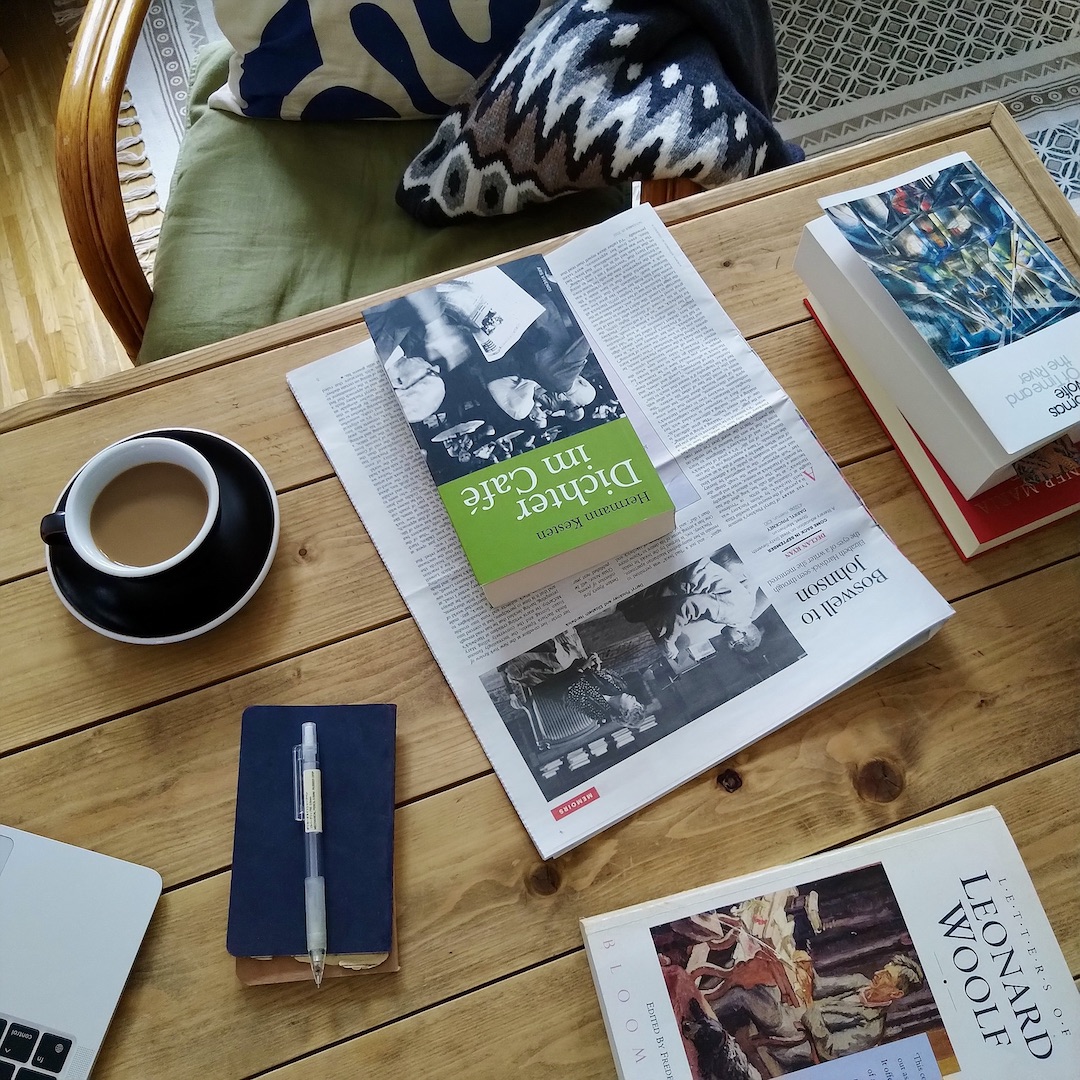
№ 34 reading list:

1  A Man's Place  · Annie Ernaux
2  Of Time and the River  · Thomas Wolfe
3  Letters of Leonard Woolf  · edited by Frederic Spotts
4  Útsýni  · Guðrún Eva Mínervudóttir [Icelandic]
5  Dichter im Café  · Hermann Kesten [German]

Translated by: 1) A Man's Place: Tanya Leslie

Last year the French writer Annie Ernaux received the Nobel Prize in Literature. Her book on the list, La Place in French, is about her relationship with her barely educated father and the gap that gradually forms between them as her education takes her onto the pathway to the middle class. A recurrent theme throughout the narrative is the importance he attributed to language: she describes an incident where he needs to sign some documents in the presence of a notary. The shame he experiences when he realises that the has misspelt a short phrase is way out of proportion. In this compact book of only 100 pages, Ernaux sometimes pauses to tell us a few words about the writing of it or to share her thoughts related to a certain memory. I read the English translation published by Fitzcarraldo Editions, which has already made 8 books by Ernaux available in English.

Books & coffee on a December morning (№ 34 reading list) · Lisa Stefan
A December morning with books & coffee

I fell for Annie Ernaux when I read The Years (№ 20) for the first time, a kind of memoir that vividly captures a certain period in history, remarkably narrated without the personal pronoun I. Last autumn I bought the German translation, Die Jahre, so I could read the book yet again with the English translation as support. I have also read I Remain in Darkness, which is about her mother who died from Alzheimer's. Reading it sometimes felt like being punched in the stomach because of the raw and revealing writing.

If you are interested in Ernaux I can recommend an episode of the TLS podcast (min. 27:40), broadcast after the Nobel Prize announcement. The writer Lauren Elkin was a guest and mentioned e.g. Ernaux's interest in the theories of the French sociologist Pierre Bourdieu. I first became familiar with his ideas when studying Museology and now I keep him in mind when reading Ernaux.

On my № 34 reading list: A new Icelandic novel, Útsýni, by Guðrún Eva Mínervudóttir · Lisa Stefan
A coffee moment in January with a new Icelandic novel by Mínervudóttir,
a Christmas present from a dear friend

images mine, appeared on Instagram 28/11/22; 01/01/23; 02/12/22


Friday, 18 November 2022

№ 33 reading list: Keegan and COVID symptoms

On my № 33 reading list: Small Things Like These by the Irish writer Claire Keegan · Lisa Stefan


I have been holding off sharing this reading list because, instead of using Instagram pics, I wanted to use my camera to photograph the books with a cup of coffee and fresh flowers, perhaps. But I haven't been in the mood. Five weeks ago, I caught a mild version of COVID. I mainly slept due to exhaustion. The worst part is that I lost my sense of taste - 5 weeks without the taste of coffee! - and all books seemed boring. Should I take back the mild-version part? Let’s look at the books on the list, as I have yet to finish only one.

№ 33 reading list:

1  Pain  · Zeruya Shalev
2  Small Things Like These  · Claire Keegan
3  Night  · Elie Wiesel
4  Nemesis  · Philip Roth
5  Sapiens: A Brief History of Humankind  · Yuval Noah Harari

Translated by: 1) Pain: Sondra Silverston; 3) Night: Marion Wiesel

Claire Keegan's book, nominated this year for the Booker Prize, is a little gem set in an Irish town in 1985. It deals with a delicate subject: how the Irish Catholic Church got away with using young, pregnant girls as labour in convents and taking away their newborns after birth. Keegan says all that needs to be said, making the content of her 116 pages richer than many longer works of fiction. (I can recommend the film The Magdalene Sisters (2002; Peter Mullan), which deals with the same subject.) Another short but rich book on the list is the one by Elie Wiesel, a Holocaust survivor and winner of the Nobel Peace Prize in 1986. He shares his experience in the concentration camps, Auschwitz and Buchenwald, and the reading is often painful. For years I have avoided reading the book; until now, I lacked the courage to pick it up.

In Nemesis, Philip Roth imagines a polio epidemic in his home town Newark in 1944, threatening the lives of children. Given that we are still dealing with the COVID pandemic, I wasn’t sure this was the right time to read about an epidemic breaking out. But it was fine. The book is well written (it won the 2011 Booker International) but perhaps a little too short for my taste. In the third part, we have reached 1971, and the narrator gives only a brief account of events since the outbreak. In this part, something was missing, and the sudden ending left me needing more.

I am wary of hyped books and tend to avoid books everyone seems to be reading at a given time and referring to as must-reads. Sapiens by Israeli historian Yuval Noah Harari, translated into many languages, falls into that category. Yet, something kept pulling me, so I bought it for my son, thinking I could borrow it one day. I have now leisurely read the first part of four, and the book is promising. Harari’s approach is multidisciplinary; his writing flows easily.

The cover of Pain by Zeruya Shalev, on my reading list · Lisa Stefan
Pain is a novel by the Israeli writer Zeruya Shalev

I have a strange relationship with contemporary fiction. I keep up with news from the publishing world but rarely get excited about new novels. When I’m excited, it could be the book cover enticing me. The reading often leaves me disappointed, even frustrated or impatient. I decided to read Pain by Zeruya Shalev after reading a short interview with the French-Moroccan writer Leïla Slimani, in which she praised Shalev's writing. Pain is about an Israeli woman who survived a terrorist attack ten years prior but still is dealing with the consequences. It starts well but soon becomes one of those novels that I finish only to be able to express my opinion. Shalev’s writing has plenty of decent strokes, no doubt, but let's just say that I won't be rushing to the nearest bookshop for more. That is entirely on me.

I mentioned boring books above. One of those was supposed to be on the list, In Patagonia, a travelogue classic by Bruce Chatwin, but I gave up after a few chapters. At first, I thought my all-books-seem-boring COVID symptom was why I found the book uninteresting. But as I continued the reading when no longer bedridden, the writing style did nothing for me and its short chapters, more like anecdotes than chapters, felt too disjointed for my taste. I have said before that life is too short and precious for books that don't make the reading heart beat faster.

images mine, appeared on Instagram 31/08/22 and 14/09/22


Tuesday, 22 March 2022

№ 30 reading list: Proust in spring

My № 30 reading list: stack of books; Marcel Proust, Lydia Davis, Siri Hustvedt · Lisa Stefan


Spring has arrived and it's time to update the blog with a new reading list. I shared the last one in January but in my defence, I'm more active on my Instagram account with book-related content. For over a decade I have wanted to read Marcel Proust’s masterpiece In Search of Lost Time (À la recherche du temps perdu) and recently bought the 1st volume of 4 by Everyman’s Library. The novel has seven parts and this volume contains Swann's Way (Du côté de chez Swann), which most are familiar with, and the first part of Within a Budding Grove (À l'ombre des jeunes filles en fleurs). I’m only a few pages in and am already captivated by the narrative voice and the rich prose. Proust in spring will be a gratifying pastime.

№ 30 reading list:

1  Essays Two  · Lydia Davis
2  Swann's Way  · Marcel Proust
3  What I Loved  · Siri Hustvedt
4  Der Untergeher  · Thomas Bernhard [German]
5  The Makioka Sisters  · Jun'ichirō Tanizaki [rereading]

Translated by: 1) Swann's Way: C. K. Scott Moncrieff and Terence Kilmartin;
5) The Makioka Sisters: Edward G. Seidensticker

Reading Essays Two spurred me on to read Proust. Lydia Davis translated the latest available English edition of Swann's Way and discusses the project in some of the essays. (The Moncrieff translation I’m reading is older but has been updated.) These essays are my first Davis and I’m also reading Siri Hustvedt’s fiction for the first time. A fun fact: Hustvedt has been married to American writer Paul Auster (4 3 2 1, The New York Trilogy) for forty years who before was married to Davis.

I have mentioned before that each time I’m disappointed with a book and decide to toss it I reread one of my favourite books. On my last list, I had My Brilliant Friend by Elena Ferrante, the first book of her Neapolitan Quartet. I truly made an effort but gave up on Chapter 20. Neither the plot nor the characters appealed to me, and the style felt repetitive. To make it up to me I decided to reread The Makioka Sisters, a Japanese classic by Tanizaki. Before going to sleep, it's comforting to spend some time in the company of the Sisters.

Richard Diebenkorn, Untitled, 1981

image by me | Diebenkorn art via Richard Diebenkorn Foundation on Instagram


Sunday, 20 June 2021

№ 27 reading list: Erpenbeck, Stepanova and Roth

My № 27 reading list includes works by Erpenbeck and Stepanova, and Philip Roth's biography · Lisa Stefan


In an April blog entry, I promised a new reading list after finishing the third volume of Simone de Beauvoir's autobiography. I broke that promise because shortly after I was offered an unexpected assignment. Despite being busy, I have maintained a good reading routine that begins in the very early hours with my cup of coffee: I have finished Jenny Erpenbeck's book, I'm more than halfway through both Maria Stepanova and Philip Roth's biography, and I have started the others on the list. Two years ago The Years by Annie Ernaux became one of my all-time favourites and recently when I gave a friend a copy, I knew I had to reread it.

№ 27 reading list:

1  Philip Roth: The Biography  · Blake Bailey
2  In Memory of Memory  · Maria Stepanova
3  Not a Novel: Collected Writings and Reflections  · Jenny Erpenbeck
4  The Radetzky March  · Joseph Roth
5  Heldenplatz  · Thomas Bernhard [German]
6  Himnaríki og helvíti  · Jón Kalman Stefánsson [Icelandic]
7  The Years  · Annie Ernaux [rereading]

Translated by: 2) In Memory of Memory: Sasha Dugdale; 3) Not a Novel: Kurt Beals;
4) The Radetzky March: Joachim Neugroschel; 7) The Years: Alison L. Strayer

If you follow books news you must have read about the fate of the much-anticipated biography of Philip Roth. Following sexual assault claims against its author Bailey, the publisher, W. W Norton & Company, first halted the shipping of the book and eventually pulled it (Bailey, who has not been convicted in a court of law, has already found a new publisher). I pre-ordered the book long before this happened and believe I would have ordered it anyway, as I'm fully capable of separating the art from the artist. The book is well researched and written (Roth handpicked Bailey to write it) but I do admit that my mind sometimes goes Why do I need to know this? when I come across details of Roth's sexual encounters.

Not a Novel was my first by Erpenbeck, who is one of the major contemporary novelists in Germany. It's an English translation of her non-fiction, but not a complete one: it only contains a fragment of the original, Kein Roman, which is twice as long. I enjoyed the reading but parts felt slightly repetitive and after finishing I was left with this sense of a gap. I don't believe this shorter English edition does justice to the original and once my German improves I will definitely read the latter.

The cover of Philip Roth: The Biography by Blake Bailey (W. W. Norton) · Lisa Stefan
The cover of Philip Roth: The Biography by the now-infamous Blake Bailey

Five years have passed since I shared my first reading list. As I select the books carefully, there have been few disappointments. On my last list was a short essay collection by Vivian Gornick that I cannot recommend: Unfinished Business: Notes of a Chronic Re-reader. The introduction appealed to me, and probably raised my expectations, but as I read on it became clear that Gornick and I are very different readers. She is character-oriented and seems very occupied with failed fictional relationships. Her approach tested my patience. A certain paradox revealed itself to me: Gornick is an active feminist but the tone of voice in these essays didn't give me the sense of a strong woman. There was one piece I liked, about the Italian writer Natalia Ginzburg, who is still on my TBR (list of to-be-reads). On that list are still a few Gornicks but honestly, I now feel little desire to prioritise them.

Peonies and a stack of book on my desk · Lisa Stefan


The COVID-19 lockdown in Austria has finally been lifted after constant extensions since last autumn. We still have to wear FFP2 masks and there are some restrictions, e.g. a negative test or a vaccination certificate is needed to enter cafés and restaurants. I got my first vaccination dose recently and get the second one in a few weeks and will then be able to get my latte fix whenever I want. That's all I ask for. Until then life continues to be rather lockdowny - I may have coined a word.

images mine, the 2nd and 3rd appeared on Instagram 22/04/21 and 15/06/21


Wednesday, 17 February 2021

In Memory of Memory · Maria Stepanova

The cover of In Memory of Memory by Maria Stepanova (New Directions) · Books & Latte


This patterned book cover makes my heart beat faster: In Memory of Memory by the Russian poet Maria Stepanova has just been published in English by New Directions, an American publishing house. The idea of the book came about after Stepanova found a box with photographs, letters, diaries and souvenirs in the apartment of a deceased aunt in Russia. It led her to take a closer look at her Jewish family history. The book, a mixture of essays, fiction, memoirs, travelogues and historical sources, has been getting positive media coverage.

In regards to In Memory of Memory, I feel as if I’m spoilt for choice because the UK edition is published by Fitzcarraldo Editions. I like their tasteful book design: All books are high quality paperbacks with cover flaps; non-fiction is white with a blue font on the cover and fiction blue with white (blog readers may remember these editions from reading lists where I included works by the French Annie Ernaux). I honestly do not know which edition to buy. Is it greedy to have both?

In Memory of Memory
By Maria Stepanova
Translated by Sasha Dugdale
Paperback, 448 pages
ISBN: 9780811228831
New Directions


Friday, 19 June 2020

№ 23 reading list: The Dolphin Letters

A stack of books: № 23 reading list: The Dolphin Letters · Lisa Stefan


I cannot remember when I first heard of Elizabeth Hardwick - it must have been in relation to her essay collection Seduction and Betrayal (1974) - but it wasn't until 2018 that I read her work. Last year I was excited about the publication of The Dolphin Letters, 1970-1979, a collection of letters exchanged between Hardwick and her ex, poet Robert Lowell (d. 1977), and their friends. To give you a little backstory: The title refers to Lowell's poem collection that earned him his second Pulitzer Prize in 1974. What made it controversial was that Lowell not only used Hardwick's letters, written to him in a state of emotional distress, but also changed them to fit his narrative. I thought it would take a few weeks to read through 500 pages of correspondence but found myself unable to put the book down and finished it in a few days. When I was done I went back to page 1 and started all over again, reading one or two letters before bedtime.

№ 23 reading list:

1  Sleepless Nights · Elizabeth Hardwick
2  The Dolphin Letters, 1970-1979: Elizabeth Hardwick, Robert
Lowell, and Their Circle  edited by Saskia Hamilton
3  How to Write an Autobiographical Novel · Alexander Chee
4  A Tale of Love and Darkness · Amos Oz
5  Mislæg gatnamót · Þórdís Gísladóttir [Icelandic poetry]
6  To Kill a Mockingbird · Harper Lee [rereading]
7  Museums as Cultures of Copies  edited by Brita Brenna, Hans
Dam Christensen and Olav Hamran

Translated by: 4) A Tale of Love and Darkness: Nicholas de Lange

I would like to thank Routledge for the museum studies textbook on the list, which consists of 17 chapters by leading scholars in the field. It will enable me to keep up with my studies this summer without any deadlines.

Back to The Dolphin Letters, 1970-1979: If you already know the backstory and are intrigued then you may want to watch writer and critic Hilton Als in conversation with Saskia Hamilton, who edited the letter collection and added useful footnotes. What made this event even more memorable is actress Kathleen Chalfant's citation of three letters by Hardwick. In my copy I have marked many sections, one where Hardwick describes a certain mood in a letter to Lowell on January 13, 1976, when they were back on friendly terms:
... and strangely enough I do feel like writing just now and have fallen into a mood of reading books, thinking, idling about–all that puts one into the frame that makes writing possible and the life of literature beautiful and thrilling.
On the reading list is also Hardwick's Sleepless Nights (1979), a slim novel, partly autofiction, which I have also finished. I think I benefited from reading it after her personal letters, in which one learns about its writing process.
A stack of books: № 23 reading list · Lisa Stefan


Tuesday, 9 June 2020

Reading journal: Beauvoir & Kafka

Book covers, from my reading journal · Lisa Stefan


I thought it best to sneak in a reading journal entry before sharing more book covers. The book cover entries are tempting because I don’t have to grab my camera and I would like to have some covers on the blog for future reference. If you were worried about the coronavirus pandemic preventing the publication of books, I think you can breathe calmly. Plenty of books are about to hit the shelves and let's hope the content is as promising as the covers.

Reading journal, № 14 reading list, 2 of 7:

· Letters to Friends, Family & Editors by Franz Kafka. This is the first collection of letters by Kafka that I read and own. I was in no hurry to finish it so once I had read enough letters to get a feel for his voice, I read a letter or two in bed. The letters show the reader different sides of Kafka, from his student years in Prague in the early 1900s to his final months at a sanatorium near Vienna in 1924, where he died from tuberculosis. In letters to friends, he is less formal, of course, especially when writing to Max Brod who collected Kafka’s letters after his death, and it is through these personal letters that we see his health deteriorating. A more formal tone characterises the letters to his editors where he discusses manuscripts and even book design and fonts before publication. Perhaps those are more appealing to scholars.

The women in his life, Felice Bauer, Milena Jesenská-Polak, Julie Wohryzek, and Dora Dymant, appear on the pages, but the letters to Felice and Milena are available in separate editions: Letters to Felice (I recently shared the book cover) and Letters to Milena. The one thing that bothered me during the reading relates to the book's layout: The notes are at the back instead of appearing in footnotes, which would have been more convenient for the reader. This was especially annoying when reading many letters in a setting and constantly having to look up the notes. [Schocken; translated by Richard and Clara Winston]

· The Prime of Life by Simone de Beauvoir – autobiography, 2nd vol. It's been a while since I finished this one, which covers the years 1929 to 1944, and lately I have been gliding over sections where I had left a mark on the margin. I liked this volume more than the first but have to add that in the first chapters Beauvoir was sometimes too keen on sharing details: It sometimes felt as if she had to mention and describe every person that crossed her path. It happened less as the story progressed and the second world war drew nearer.

On three pages (319-321) spanning the period from 1937 to 1938, war is coming and clearly, the situation has started to affect her mental well-being:
Indeed, I now passed through one of the most depressing periods of my whole life. I refused to admit that war was even possible, let alone imminent. But it was no use my playing the ostrich; the growing perils all around crushed me beneath their weight.

If the Spanish tragedy dismayed us, events in Germany scared us stiff. In September, at Nuremberg, before an audience of 300,000 Nazis and something like a million visitors, Hitler delivered his most aggressive speech yet.

For my own part I was still trying to delude myself, and refusing to face the facts. But the future had begun to open up under my very feet, and produced in me a sick feeling akin to real anguish. No doubt that is why I retain only a misty recollection of this entire year. Nor can I remember anything of outstanding interest in my private life.
Matisse cover: Used copy of The Prime of Life by Simone de Beauvoir - autobiography, Vol. 2 · Lisa Hjalt


When the Germans invade Poland, on 1 September 1939, her narrative becomes a diary that ends on 14 July 1940. On 14 September, for example, she goes to the cinema and reads Portrait of a Lady by Henry James in bed. She doesn’t write daily and nothing at all after the fall of Paris, on 14 June 1940. Despite the war, there is no shortage of discussion of literature and philosophy on the pages, and it should be noted that the book is dedicated to Jean-Paul Sartre, who was her soulmate. It's truly interesting to read about life in France, about Paris in wartime; about visits to Café de Flore, on the corner of Boulevard Saint-Germain and Rue Saint-Benoît, which she and Sartre frequented ('It was our own special resort. We felt at home there; it sheltered us from the outside world.'). In this volume the reader witnesses the birth of the author, but in 1943 her first novel, She Came to Stay (original title L’Invitée) was published. During the war, she also worked on other books such as the philosophical essay Pyrrhus et Cinéas and two novels: The Blood of Others (Le Sang des autres) and All Men Are Mortal (Tous les hommes sont mortels). [Penguin; translated by Peter Green]

It is worth noting that some of Beauvoir's letters, published later, contradict the narrative of her autobiography. Finally, a few words about my copy which I hold dear. It was bought used, released in 1976, and is now so worn that it is falling apart. Gracing its cover is one of artist Matisse's blue cut-outs, Blue Nude with Flowing Hair, 1952.

images by me, appeared on Instagram 08/03/2018 and 11/07/2017


Friday, 8 May 2020

Letters to Felice · Franz Kafka

The cover of Letters to Felice by Franz Kafka, designed by Peter Mendelsund · Books & Latte


The Schocken Kafka Library is a collection of thirteen books by Franz Kafka (b. 1883) containing his fiction, letters, and diaries. The collection consists of sizeable paperbacks, tastefully designed where the title font has been adapted from Kafka's legible handwriting. Currently, I only have one of them, the letters he wrote to friends, family, and editors, but have added many to my wish list. Letters to Felice (2016) contains over 500 letters he wrote to his girlfriend Felice, whom he got engaged to twice but never married. They met in August 1912 at the home of Kafka's best friend Max Brod and their relationship was mainly an epistolary one, given that he lived in Prague; she in Berlin. We can thank Brod for access to Kafka's writings today. Kafka asked him to burn all unpublished material after his death, but Brod refused. Kafka died of tuberculosis on 3 June 1924, a month before turning 41. Kafka is buried at the New Jewish Cemetery in Prague.

Cover design: Peter Mendelsund

Letters to Felice
By Franz Kafka
Edited by Erich Heller and Jürgen Born
Translated by James Stern and Elisabeth Duckworth
Paperback, 624 pages
ISBN 9780805208511
Schocken Books


Thursday, 19 December 2019

№ 22 reading list: Christmas 2019

My № 22 reading list · Lisa Stefan


Here it is, the reading list I have been promising for some time. It's almost two in one, as I meant to post one in October and one before Christmas. Life just got rather hectic. At some point on this term when trying to balance school and family life I thought of lines in Joan Didion's book, The Year of Magical Thinking, which became my mantra: 'In time of trouble, I had been trained since childhood, read, learn, work it up, go to the literature. Information was control.' Once I looked them up, I knew I had to reread it yet again. Didion's book about grief and everything life can throw at you was my reward during study breaks. Didion grounded me. She kept me studying. Information was control. I need to thank two publishers for books on the list: Eland Books for So It Goes and Fitzcarraldo Editions for I Remain in Darkness. Both are translations that I will be reviewing in the New Year.

№ 22 reading list:
1  Year of the Monkey  by Patti Smith
2  So It Goes  by Nicolas Bouvier
3  I Remain in Darkness  by Annie Ernaux
4  Genius and Ink: Virginia Woolf on How to Read
5  Life with Picasso  by Françoise Gilot and Carlton Lake
6  Look Homeward, Angel  by Thomas Wolfe
7  Essays in Disguise  by Wilfrid Sheed
8  Literary Theory: A Very Short Introduction  by Jonathan Culler
9  The Year of Magical Thinking  by Joan Didion [rereading]

Translated by: 2) So It Goes: Robyn Marsack; 3) I Remain in Darkness: Tanya Leslie.

These past months, when I have found time, I have been reading some of the books on the list and have already finished Life with Picasso and I Remain in Darkness. It was time to include Wilfrid Sheed on a reading list. A long time ago I bought a used copy of this essay collection, after hearing John Williams at the New York Times Book Review praise it on their podcast. Every other week the staff talks about the books they are reading in their spare time and Williams's taste in books comes close to mine, and I usually agree with his views.

This year I'm breaking tradition and not rereading a classic over the holidays. I will, however, be reading Louisa May Alcott's Little Women into the New Year, a tradition I started in Scotland. Last Friday I listened to editor David Remnick's interview with Greta Gerwig on The New Yorker Radio Hour and now I cannot wait to see her film adaptation.


Thursday, 26 September 2019

Glimpses of life in Austria

Traunsee lake, Austria · Lisa Stefan


I haven't made it a habit to share on the blog the images I post on Instagram, but these last months the time for blogging has been limited and a lot has happened: We recently moved to Austria, both our daughters went to university abroad and I decided to switch gears: I started my Master's in Museology, which I'm fortunate to be able to study online at the University of Iceland. Textbooks, lectures and assignments are keeping me busy but I felt the blog needed updating and decided to use images from my archive, of the Traunsee region, a bookshop in Vienna and two study-related still lifes.

This was my first visit to the Traunsee region and I will never forget the moment I first spotted the lake: My heart skipped a beat. The scenery was achingly beautiful. On a sunny Sunday we drove through small villages, enjoyed lunch by the lake in Altmünster, and afterwards headed to Gmunden. Later we were invited to a garden party in Gmunden, where we dined al fresco on the hillside overlooking the lake, with the Traunstein mountain so close it almost felt as if we could reach the hand out and touch it.
'I Remain in Darkness' by Annie Ernaux (Fitzcarraldo) · Lisa Stefan


I love finding books in my mailbox. The staff at Fitzcarraldo Editions sent me a copy of I Remain in Darkness by Annie Ernaux, published last week in the UK (translated by Tanya Leslie). This is how I described the book on Instagram: 'It's the author's account of losing her mother to Alzheimer's disease. This short book is powerful, filled with raw, gut-wrenching emotions. Sometimes I need to take a break from the reading to let a sentence, or one word only, sink in.' The book will be on my next reading list and later I will review it.
Shakespeare & Co., Sterngasse, Vienna · Lisa Stefan


After accompanying our oldest daughter to the Vienna airport one morning, I spent the rest of the day in the city. I hadn't been there in a long time, headed straight for the metro and got out on the Schwedenplatz station. From there I walked a short distance to Sterngasse, a street where Shakespeare & Co. is located, a bookshop that sells English books (independent, not a brand of the one in Paris). It's small, vintage-looking, with a surprisingly good collection.

Shakespeare & Co., Sterngasse, Vienna · Lisa Stefan


After strolling in the vicinity of the bookshop, I headed east along the Fleischmarkt and Postgasse streets. This part of the city was bursting with life, people everywhere sitting outdoors at small cafés and restaurants. Wonderful mood, distinctively European, if that makes sense. I grabbed sushi and found a bench in Stadtpark where I sat in the shadow of a tree and did some people watching. Then I headed south towards the Belvedere Palace and enjoyed its beauty. This time I didn't enter the museum; I have been there before and promised my daughter that I would later go with her to see The Kiss by Gustav Klimt and other paintings.
Grad school life · Lisa Stefan


As I will be busy with my studies, I will not have much time for pleasure reading, and for photographing books, but soon I intend to share a new reading list. I have some ideas about how to keep my blog more alive during my studies and one is starting a new category where I feature book covers.

You may have noticed that I renew and rotate covers in the blog's sidebar and footer. These are new editions that I'm particularly interested in, and sometimes books coming out in paperback for the first time. I would like to give some of these covers a more permanent place on the blog, mainly to praise a beautiful book design. Then there are a few entries that I still owe, mainly Reading journal entries. If you think not much is happening on the blog you can always check my Instagram, where I occasionally share photos of books, mainly.

images by me, appeared on Instagram in August & September 2019