Showing posts with label annie ernaux. Show all posts

Monday, 9 January 2023

№ 34 reading list: Annie Ernaux

On my № 34 reading list, A Man's Place by Annie Ernaux · Lisa Stefan


Happy New Year! I decided to start the blog year with a new reading list which will also be the final one in this format. I'm thinking about giving the lists a break or turning them into round-ups where I recommend some of the books that I have read. Part of me will miss this format because it disciplines me to know what I will be reading a few weeks ahead. At the same time, it takes away the spontaneity when I get a new book that I want to start reading right away, but feel as if I first have to finish the books on my current reading list - a luxury problem, I know. Another reason for the change is that I would like to read more in German to get a better grasp of the language.

№ 34 reading list:

1  A Man's Place  · Annie Ernaux
2  Of Time and the River  · Thomas Wolfe
3  Letters of Leonard Woolf  · edited by Frederic Spotts
4  Útsýni  · Guðrún Eva Mínervudóttir [Icelandic]
5  Dichter im Café  · Hermann Kesten [German]

Translated by: 1) A Man's Place: Tanya Leslie

Last year the French writer Annie Ernaux received the Nobel Prize in Literature. Her book on the list, La Place in French, is about her relationship with her barely educated father and the gap that gradually forms between them as her education takes her onto the pathway to the middle class. A recurrent theme throughout the narrative is the importance he attributed to language: she describes an incident where he needs to sign some documents in the presence of a notary. The shame he experiences when he realises that the has misspelt a short phrase is way out of proportion. In this compact book of only 100 pages, Ernaux sometimes pauses to tell us a few words about the writing of it or to share her thoughts related to a certain memory. I read the English translation published by Fitzcarraldo Editions, which has already made 8 books by Ernaux available in English.
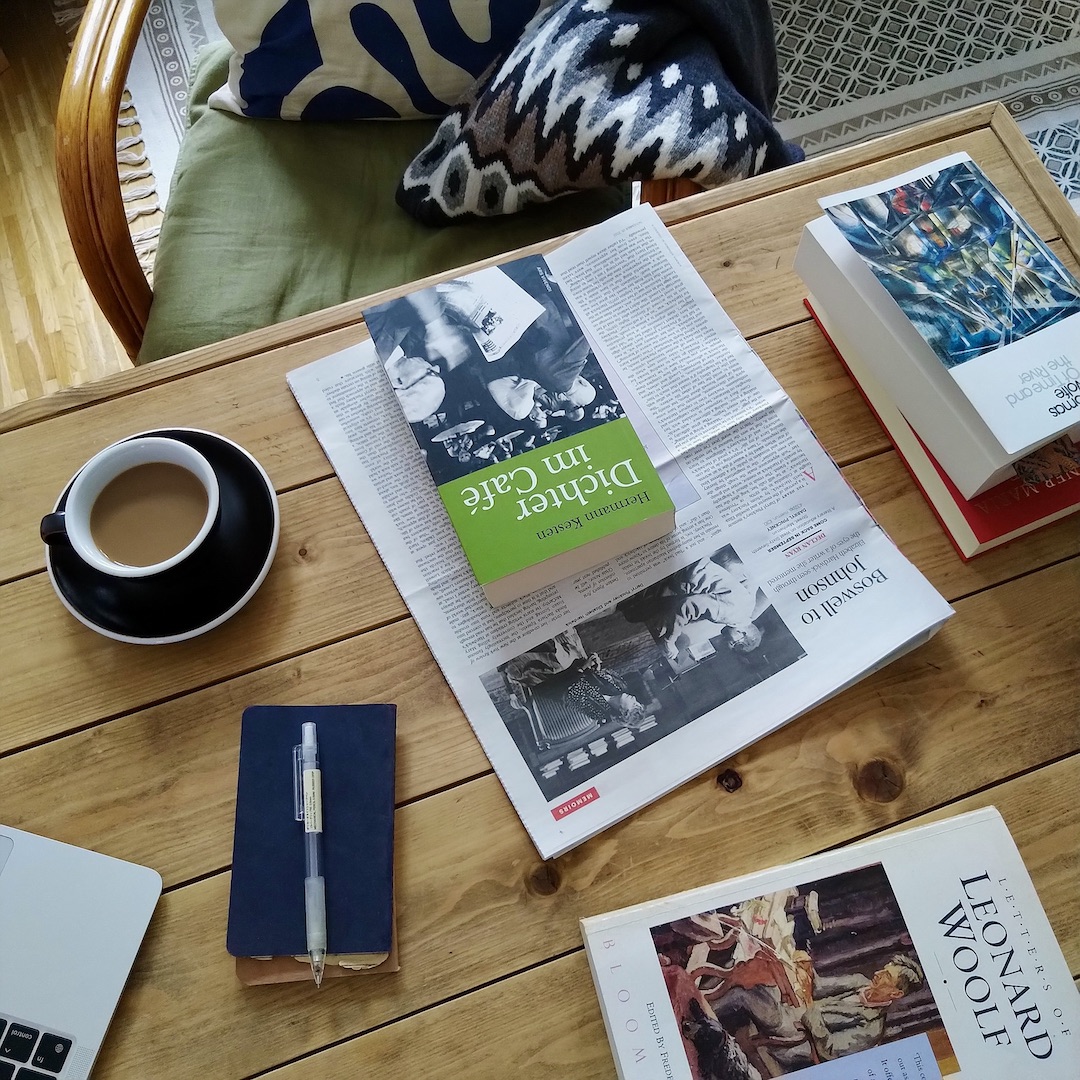
Books & coffee on a December morning (№ 34 reading list) · Lisa Stefan
A December morning with books & coffee

I fell for Annie Ernaux when I read The Years (№ 20) for the first time, a kind of memoir that vividly captures a certain period in history, remarkably narrated without the personal pronoun I. Last autumn I bought the German translation, Die Jahre, so I could read the book yet again with the English translation as support. I have also read I Remain in Darkness, which is about her mother who died from Alzheimer's. Reading it sometimes felt like being punched in the stomach because of the raw and revealing writing.

If you are interested in Ernaux I can recommend an episode of the TLS podcast (min. 27:40), broadcast after the Nobel Prize announcement. The writer Lauren Elkin was a guest and mentioned e.g. Ernaux's interest in the theories of the French sociologist Pierre Bourdieu. I first became familiar with his ideas when studying Museology and now I keep him in mind when reading Ernaux.

On my № 34 reading list: A new Icelandic novel, Útsýni, by Guðrún Eva Mínervudóttir · Lisa Stefan
A coffee moment in January with a new Icelandic novel by Mínervudóttir,
a Christmas present from a dear friend

images mine, appeared on Instagram 28/11/22; 01/01/23; 02/12/22


Sunday, 20 June 2021

№ 27 reading list: Erpenbeck, Stepanova and Roth

My № 27 reading list includes works by Erpenbeck and Stepanova, and Philip Roth's biography · Lisa Stefan


In an April blog entry, I promised a new reading list after finishing the third volume of Simone de Beauvoir's autobiography. I broke that promise because shortly after I was offered an unexpected assignment. Despite being busy, I have maintained a good reading routine that begins in the very early hours with my cup of coffee: I have finished Jenny Erpenbeck's book, I'm more than halfway through both Maria Stepanova and Philip Roth's biography, and I have started the others on the list. Two years ago The Years by Annie Ernaux became one of my all-time favourites and recently when I gave a friend a copy, I knew I had to reread it.

№ 27 reading list:

1  Philip Roth: The Biography  · Blake Bailey
2  In Memory of Memory  · Maria Stepanova
3  Not a Novel: Collected Writings and Reflections  · Jenny Erpenbeck
4  The Radetzky March  · Joseph Roth
5  Heldenplatz  · Thomas Bernhard [German]
6  Himnaríki og helvíti  · Jón Kalman Stefánsson [Icelandic]
7  The Years  · Annie Ernaux [rereading]

Translated by: 2) In Memory of Memory: Sasha Dugdale; 3) Not a Novel: Kurt Beals;
4) The Radetzky March: Joachim Neugroschel; 7) The Years: Alison L. Strayer

If you follow books news you must have read about the fate of the much-anticipated biography of Philip Roth. Following sexual assault claims against its author Bailey, the publisher, W. W Norton & Company, first halted the shipping of the book and eventually pulled it (Bailey, who has not been convicted in a court of law, has already found a new publisher). I pre-ordered the book long before this happened and believe I would have ordered it anyway, as I'm fully capable of separating the art from the artist. The book is well researched and written (Roth handpicked Bailey to write it) but I do admit that my mind sometimes goes Why do I need to know this? when I come across details of Roth's sexual encounters.

Not a Novel was my first by Erpenbeck, who is one of the major contemporary novelists in Germany. It's an English translation of her non-fiction, but not a complete one: it only contains a fragment of the original, Kein Roman, which is twice as long. I enjoyed the reading but parts felt slightly repetitive and after finishing I was left with this sense of a gap. I don't believe this shorter English edition does justice to the original and once my German improves I will definitely read the latter.

The cover of Philip Roth: The Biography by Blake Bailey (W. W. Norton) · Lisa Stefan
The cover of Philip Roth: The Biography by the now-infamous Blake Bailey

Five years have passed since I shared my first reading list. As I select the books carefully, there have been few disappointments. On my last list was a short essay collection by Vivian Gornick that I cannot recommend: Unfinished Business: Notes of a Chronic Re-reader. The introduction appealed to me, and probably raised my expectations, but as I read on it became clear that Gornick and I are very different readers. She is character-oriented and seems very occupied with failed fictional relationships. Her approach tested my patience. A certain paradox revealed itself to me: Gornick is an active feminist but the tone of voice in these essays didn't give me the sense of a strong woman. There was one piece I liked, about the Italian writer Natalia Ginzburg, who is still on my TBR (list of to-be-reads). On that list are still a few Gornicks but honestly, I now feel little desire to prioritise them.

Peonies and a stack of book on my desk · Lisa Stefan


The COVID-19 lockdown in Austria has finally been lifted after constant extensions since last autumn. We still have to wear FFP2 masks and there are some restrictions, e.g. a negative test or a vaccination certificate is needed to enter cafés and restaurants. I got my first vaccination dose recently and get the second one in a few weeks and will then be able to get my latte fix whenever I want. That's all I ask for. Until then life continues to be rather lockdowny - I may have coined a word.

images mine, the 2nd and 3rd appeared on Instagram 22/04/21 and 15/06/21


Thursday, 19 December 2019

№ 22 reading list: Christmas 2019

My № 22 reading list · Lisa Stefan


Here it is, the reading list I have been promising for some time. It's almost two in one, as I meant to post one in October and one before Christmas. Life just got rather hectic. At some point on this term when trying to balance school and family life I thought of lines in Joan Didion's book, The Year of Magical Thinking, which became my mantra: 'In time of trouble, I had been trained since childhood, read, learn, work it up, go to the literature. Information was control.' Once I looked them up, I knew I had to reread it yet again. Didion's book about grief and everything life can throw at you was my reward during study breaks. Didion grounded me. She kept me studying. Information was control. I need to thank two publishers for books on the list: Eland Books for So It Goes and Fitzcarraldo Editions for I Remain in Darkness. Both are translations that I will be reviewing in the New Year.

№ 22 reading list:
1  Year of the Monkey  by Patti Smith
2  So It Goes  by Nicolas Bouvier
3  I Remain in Darkness  by Annie Ernaux
4  Genius and Ink: Virginia Woolf on How to Read
5  Life with Picasso  by Françoise Gilot and Carlton Lake
6  Look Homeward, Angel  by Thomas Wolfe
7  Essays in Disguise  by Wilfrid Sheed
8  Literary Theory: A Very Short Introduction  by Jonathan Culler
9  The Year of Magical Thinking  by Joan Didion [rereading]

Translated by: 2) So It Goes: Robyn Marsack; 3) I Remain in Darkness: Tanya Leslie.

These past months, when I have found time, I have been reading some of the books on the list and have already finished Life with Picasso and I Remain in Darkness. It was time to include Wilfrid Sheed on a reading list. A long time ago I bought a used copy of this essay collection, after hearing John Williams at the New York Times Book Review praise it on their podcast. Every other week the staff talks about the books they are reading in their spare time and Williams's taste in books comes close to mine, and I usually agree with his views.

This year I'm breaking tradition and not rereading a classic over the holidays. I will, however, be reading Louisa May Alcott's Little Women into the New Year, a tradition I started in Scotland. Last Friday I listened to editor David Remnick's interview with Greta Gerwig on The New Yorker Radio Hour and now I cannot wait to see her film adaptation.


Friday, 26 April 2019

№ 20 reading list | Lee Krasner exhibition

№ 20 reading list | Lee Krasner: Living Colour exhibition · Lisa Stefan


I am sitting on the patio, under an awning, taking in the spring, the scent of purple and white lilacs from a corner of the garden. One by one, book podcasts are playing on the tablet. Let's take a look at the reading list. Last year a new translation, by poet Michael Hofmann, of the classic Berlin Alexanderplatz by Alfred Döblin was published by New York Review Books. I like their book design and have added many of their titles to my wish list. I never read the old translation and therefore, have no comparison. It's set in the underworld of Berlin, the Weimer Republic in the 1920s, and the book starts when Franz Biberkopf - shall we say the colourful? - is released from prison, determined to turn his life around. The other book I bought for the list is The Years by Annie Ernaux, which I mentioned in my last entry. The others are from the library.

№ 20 reading list:
1  The Years  by Annie Ernaux
2  Berlin Alexanderplatz  by Alfred Döblin
3  The Wife  by Meg Wolitzer
4  The Mexican Night  by Lawrence Ferlinghetti
5  The Garden Party  by Katherine Mansfield
6  It All Adds Up  by Saul Bellow
7  The Diary of Anaïs Nin 1931-1934 

Translated by: 1) The Years: Alison L. Strayer; 2) Berlin Alexanderplatz: Michael Hofmann

It has been years since I read a volume of Anaïs Nin's diaries and it felt soothing somehow to pick up the one on the list, which starts in 1931. For a long time, I have been meaning to read stories by Katherine Mansfield, having been introduced to her work through Virginia Woolf's diaries and letters. The short story collection The Garden Party starts well and the writing style already appeals to me. Mansfield was only 34 when she died and one can only imagine what she could have accomplished as a writer.


Lee Krasner, Desert Moon, 1955. LACMA. © The Pollock-Krasner Foundation · Books & Latte
Lee Krasner, Desert Moon, 1955

This summer I wouldn't mind taking a cultural trip to London, to see the exhibition Lee Krasner: Living Colour in the art gallery of the Barbican Centre, which opens on 30 May. Lee Krasner (1908–1984) was an American artist, born in Brooklyn; a pioneer of abstract expressionism. The catalogue says that her 'energetic work reflects the spirit of possibility in post-war New York' and the exhibition 'tells the story of a formidable artist, whose importance has too often been eclipsed by her marriage to Jackson Pollock.'

This is the first major presentation of Lee Krasner's art in Europe for more than 50 years, organised by the Barbican Centre, London in collaboration with these museums: Schirn Kunsthalle Frankfurt, Zentrum Paul Klee in Bern and Guggenheim Bilbao. Coinciding with the exhibition is the Thames & Hudson publication of Lee Krasner: Living Colour by Eleanor Nairne.

In October, here in Germany, we can enjoy the art of Lee Krasner when the exhibition opens in the museum Schirn Kunsthalle Frankfurt.

Artist Lee Krasner in her studio. Kasmin Gallery, NY. © 2017 The Pollock-Krasner Foundation · Books & Latte
Artist Lee Krasner in her studio

Lee Krasner, Palingenesis, 1971. Kasmin Gallery, NY. © The Pollock-Krasner Foundation · Books & Latte
Lee Krasner, Palingenesis, 1971

top image by me | Lee Krasner paintings via Barbican Centre: 1) LACMA (Los Angeles County Museum of Art) 2) Kasmin Gallery, NY | Krasner in her studio: Kasmin Gallery via Artsy. © The Pollock-Krasner Foundation.


Saturday, 13 April 2019

Mood board for spring

My spring mood board, Schuyler Samperton Textiles · Lisa Stefan


In a perfect world. No, let's go with better, perfection is boring. In a better world I'm sitting in a rattan chair on the patio, feeling the warmth of the sun through the awning. On the table is a stack of books; notebooks next to my cup of coffee and the French press. Supporting my back, a thick, soft cushion with a cover made of any of the patterned textiles in my image above, which I call: My spring mood board with Annie Ernaux and Schuyler Samperton Textiles.

In reality I'm indoors. That harsh light of early spring still lingers and even though buds have bloomed, promising, sunny days suddenly turned colder (today we had hail). Waiting for spring is not my forte. The good news is that one of my current reads, Annie Ernaux's memoir The Years, translated from French by Alison L Strayer, has been shortlisted for The Man Booker International Prize. Apart from being smitten with my copy, a Fitzcarraldo Editions publication, the narrative voice, written in the third person, intrigues me. I don't remember having read a memoir in the third person. It covers the years 1941 to 2006 'told through the lens of memory, impressions past and present, photos, books, songs, radio, television, advertising, and news headlines.' I haven't finished it yet, but I wouldn't hesitate to recommend it. It's rewarding when a book one has wanted to read not only lives up to its expectations but exceeds them.

Blooming magnolia, Antwerp, spring 2011 · Lisa Stefan
Magnolia in bloom, Antwerp 2011

We lived in Antwerp when I shot the blooming magnolia above. I cherish the photo - it was my first Belgian spring and I still remember the street corner - but it no longer appears on my old blog. An album connected to it seems to have vanished, which is why I decided to create a new link for the blog, with a slightly different layout. I haven't changed the blog name: I still note down my ideas for blog entries over lunch and latte.

Back to the textiles: Schuyler Samperton Textiles is an American brand my readers should recognise. Schuyler is one of my favourite textile designers. On the blog I have featured many designs from her growing collection. I have been waiting for spring to show you the two designs in my top image. Eden is the design at the top: The pale pink fabric is Eden/Sweet Pea, the pale green is Eden/Meadow. Shalimar is the floral fabric with the white background. The sample with the tag is Shalimar/Mist, a blue and green pattern. Shalimar/Cielo is the blue one. All these are 100% linen fabrics.

Dora Carrington, Farm at Watendlath, 1921, Tate · Books & Latte
Dora Carrington, Farm at Watendlath, 1921

The green palette in the painting Farm at Watendlath by artist Dora Carrington fits my spring mood. In 1921 she spent a summer holiday in the Lake District. The little I know about her life is from the film Carrington (1995), which focuses on her relationship with writer Lytton Strachey, and from descriptions in the volumes I have read of Virginia Woolf's diaries. At first she doesn't seem to have made a favourable impression on Woolf, but in August 1920 the tone in her diary is different: 'Carrington is ardent, robust, scatterbrained, appreciative, a very humble disciple, but with enough character to prevent insipidity' (Vol. 2).

I will be back soon with a new reading list.

images by me | Dora Carrington art via Tate