Showing posts with label literary awards. Show all posts

Monday, 9 January 2023

№ 34 reading list: Annie Ernaux

On my № 34 reading list, A Man's Place by Annie Ernaux · Lisa Stefan


Happy New Year! I decided to start the blog year with a new reading list which will also be the final one in this format. I'm thinking about giving the lists a break or turning them into round-ups where I recommend some of the books that I have read. Part of me will miss this format because it disciplines me to know what I will be reading a few weeks ahead. At the same time, it takes away the spontaneity when I get a new book that I want to start reading right away, but feel as if I first have to finish the books on my current reading list - a luxury problem, I know. Another reason for the change is that I would like to read more in German to get a better grasp of the language.

№ 34 reading list:

1  A Man's Place  · Annie Ernaux
2  Of Time and the River  · Thomas Wolfe
3  Letters of Leonard Woolf  · edited by Frederic Spotts
4  Útsýni  · Guðrún Eva Mínervudóttir [Icelandic]
5  Dichter im Café  · Hermann Kesten [German]

Translated by: 1) A Man's Place: Tanya Leslie

Last year the French writer Annie Ernaux received the Nobel Prize in Literature. Her book on the list, La Place in French, is about her relationship with her barely educated father and the gap that gradually forms between them as her education takes her onto the pathway to the middle class. A recurrent theme throughout the narrative is the importance he attributed to language: she describes an incident where he needs to sign some documents in the presence of a notary. The shame he experiences when he realises that the has misspelt a short phrase is way out of proportion. In this compact book of only 100 pages, Ernaux sometimes pauses to tell us a few words about the writing of it or to share her thoughts related to a certain memory. I read the English translation published by Fitzcarraldo Editions, which has already made 8 books by Ernaux available in English.
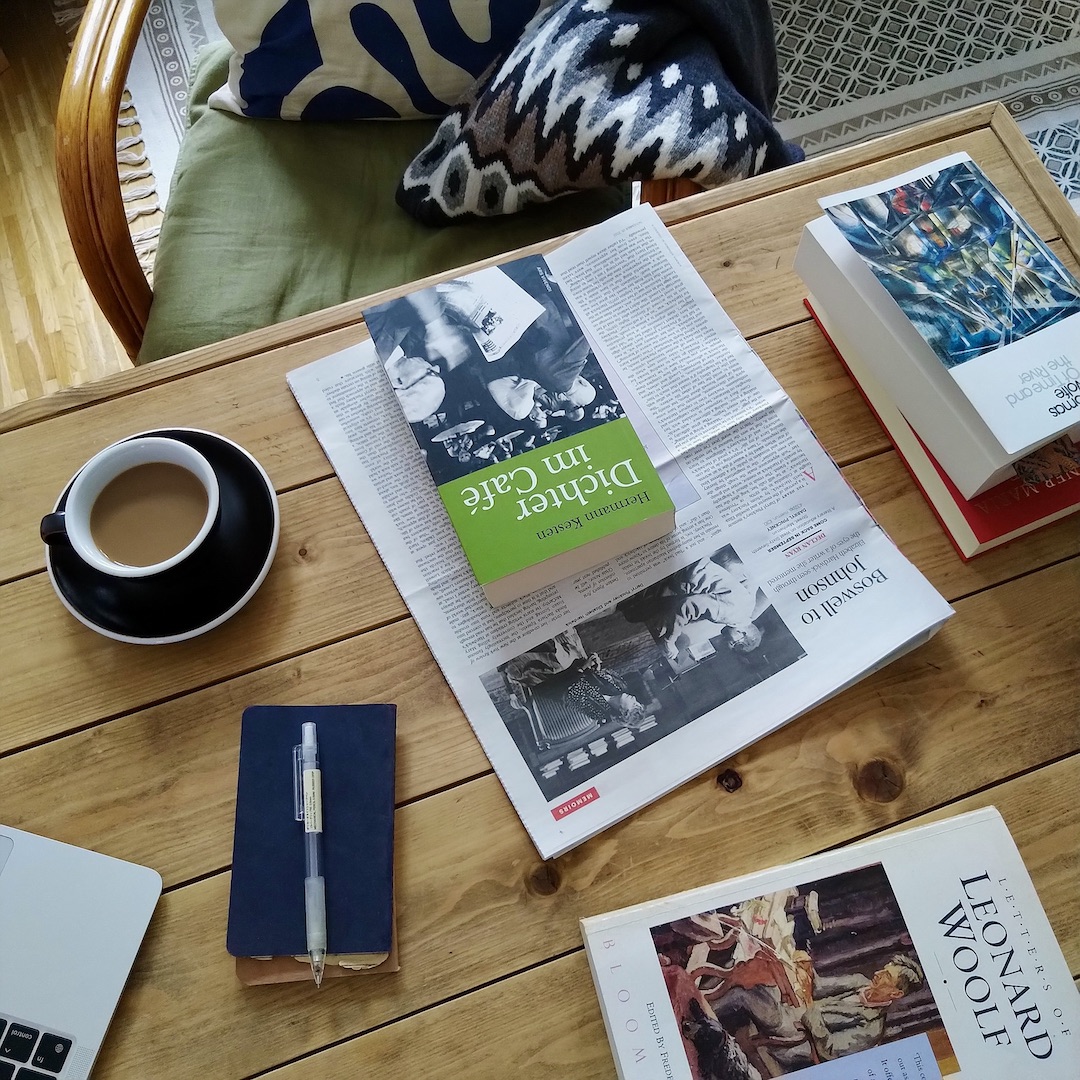
Books & coffee on a December morning (№ 34 reading list) · Lisa Stefan
A December morning with books & coffee

I fell for Annie Ernaux when I read The Years (№ 20) for the first time, a kind of memoir that vividly captures a certain period in history, remarkably narrated without the personal pronoun I. Last autumn I bought the German translation, Die Jahre, so I could read the book yet again with the English translation as support. I have also read I Remain in Darkness, which is about her mother who died from Alzheimer's. Reading it sometimes felt like being punched in the stomach because of the raw and revealing writing.

If you are interested in Ernaux I can recommend an episode of the TLS podcast (min. 27:40), broadcast after the Nobel Prize announcement. The writer Lauren Elkin was a guest and mentioned e.g. Ernaux's interest in the theories of the French sociologist Pierre Bourdieu. I first became familiar with his ideas when studying Museology and now I keep him in mind when reading Ernaux.

On my № 34 reading list: A new Icelandic novel, Útsýni, by Guðrún Eva Mínervudóttir · Lisa Stefan
A coffee moment in January with a new Icelandic novel by Mínervudóttir,
a Christmas present from a dear friend

images mine, appeared on Instagram 28/11/22; 01/01/23; 02/12/22


Wednesday, 14 April 2021

Reading journal: Simone de Beauvoir

The cover of Force of Circumstance by Simone de Beauvoir, the 3rd volume of her autobiography · Lisa Stefan


I am halfway through Force of Circumstance, the 3rd volume of Simone de Beauvoir's autobiography (№ 26). The idea was to finish it before sharing a new reading list. Beauvoir's life story is interesting but this volume has its flaws: Sometimes she's too concerned with setting the record straight and often it feels as if Jean-Paul Sartre is the main subject. Obviously, their lives intertwined, but I'm interested in her story, in her writing, not the content of Sartre's political articles in Les Temps Modernes or the plot of his plays. Speaking of politics. The book has plenty, sometimes to the point of being tedious or exhausting. Depending on my mood. On a positive note, Beauvoir travels all over the world and is a keen observer of people and landscapes. Those narratives, her books, and how they were received makes this volume worth reading, so far.

Bookmarks & journal notes

Books I recently bought:
✔  Philip Roth: The Biography by Blake Bailey
✔  The Radetzky March by Joseph Roth

... added to my wish list:
✔  A Splendid Intelligence: The Life of Elizabeth Hardwick by Cathy Curtis

... added to my TBR:
✔  Hannah Arendt by Samantha Rose Hill
✔  This Little Art by Kate Briggs
✔  Endpapers: A Family Story of Books, War, Escape and Home by Alexander Wolff

... want to read again:
✔  The Master and Margarita by Mikhail Bulgakov

Bookish joy:
✔  Recently the 2021 International Booker Prize longlist was announced, containing the authors and translators of 13 books published in the UK or Ireland. I have yet to read any of them but was pleased to see among them In Memory of Memory by Russian poet and writer Maria Stepanova. It was translated by Sasha Dugdale. It so happens that in a recent blog entry I featured the US cover. Later in April, they announce the shortlist and in June the winner.

Recommended podcast:
▶  The 135th Backlisted episode was superb. They featured the novel The Fish Can Sing (1957) by the Icelandic writer Halldór Laxness (1902-1998), who received the 1955 Nobel Prize. Its Icelandic title is 'Brekkukotsannáll', which literally translates 'The Annals of Brekkukot [Hill cottage]'. This time the guest on the podcast was the British novelist and poet Derek Owusu. If you happen to understand Icelandic you can listen to Laxness himself reading his novel on RÚV, the Icelandic National Broadcasting Service.

image by me, appeared on Instagram 19/03/21


Thursday, 17 December 2020

Reading journal: Mendelsohn and Gornick

The cover of Three Rings by Daniel Mendelsohn; notes from my reading journal · Lisa Stefan


My holiday break has started and these days I carry with me an agreeable stack of books. Not far though, we are in a Coronavirus lockdown in Austria. Some were on my last reading list and I‘m still reading them, others are new ones that will appear on my next two lists. On Monday I received Three Rings: A Tale of Exile, Narrative, and Fate by author, critic and classicist Daniel Mendelsohn. I meant to put it under the tree this year, as a Christmas present to myself, but I started reading it during a coffee break and couldn‘t put it down. It's short and contains three essays, an interesting mix of biographical writing, history and literary criticism, in essence about the writers Erich Auerbach, François Fénelon and W. G. Sebald. If you like books about books this one might appeal to you.

Another book in my stack is an essay collection by Vivian Gornick, Approaching Eye Level. It's my first by her; not the last. It goes down well with coffee and biscotti, as I predicted in my last blog entry.
Coffee & Vivian Gornick's essays; notes from my reading journal · Lisa Hjalt


In the Reading journal entries I have talked about books from a specific reading list but some time ago I felt the need to make changes, to make the journal more random and current. I also needed a category to archive my literary bookmarks. I mentioned once that it was never the idea to comment on all the books on my reading lists. I’m a picky reader and am seldom disappointed with the books on my lists. Sometimes when I truly enjoy a book, all I want to say is I loved this book and nothing else. That, however, hardly calls for a blog entry, using Instagram or Twitter is better.
Books & coffee; notes from my reading journal · Lisa Hjalt


Bookmarks & journal notes

Books I recently bought:
✔  Suppose a Sentence by Brian Dillon
✔  The Rings of Saturn by W. G. Sebald

... added to my wish list:
✔  The Krull House by Georges Simenon

... prioritised on my TBR:
✔  fiction: Oresteia: Agamemnon. Libation-Bearers. Eumenides by Aeschylus
✔  non-fiction: Trieste by Jan Morris

Bookish joy:
✔  The moment when Margaret Busby, chair of the 2020 Booker Prize judges, announced Shuggie Bain had won and its author Douglas Stuart gave an emotional acceptance speech. When Stuart won I literally screamed out loud for joy, even though I still hadn't read his debut novel. I was rooting for him but was afraid that a white male author wouldn't win.

Podcasts I can recommend:
▶  Back to Shuggie Bain: Sam Leith, the literary editor of The Spectator, recently talked to its author Douglas Stuart on their podcast, The Book Club.
▶  And here Leith talks to Natalie Haynes about women in the Greek myths.
▶  In conversation with Eleanor Wachtel of Writers & Company, Martin Amis talks about literary life, loves and losses. A very honest and sincere Amis.
▶  I rejoiced when I saw that Stig Abell, the former editor of the TLS, has a new podcast called Stig Abell's Guide to Reading. (The TLS podcast is not the same without him.) The new podcast accompanies his recently published book Things I Learned on the 6.28: A Guide to Daily Reading. These two episodes are my favourites so far: Modern Literary Fiction with Kit de Waal and English Classics with Sam Leith, the aforementioned editor.

images by me, appeared on Instagram 14/12/20; 12/12/20; 23/11/20


Saturday, 13 April 2019

Mood board for spring

My spring mood board, Schuyler Samperton Textiles · Lisa Stefan


In a perfect world. No, let's go with better, perfection is boring. In a better world I'm sitting in a rattan chair on the patio, feeling the warmth of the sun through the awning. On the table is a stack of books; notebooks next to my cup of coffee and the French press. Supporting my back, a thick, soft cushion with a cover made of any of the patterned textiles in my image above, which I call: My spring mood board with Annie Ernaux and Schuyler Samperton Textiles.

In reality I'm indoors. That harsh light of early spring still lingers and even though buds have bloomed, promising, sunny days suddenly turned colder (today we had hail). Waiting for spring is not my forte. The good news is that one of my current reads, Annie Ernaux's memoir The Years, translated from French by Alison L Strayer, has been shortlisted for The Man Booker International Prize. Apart from being smitten with my copy, a Fitzcarraldo Editions publication, the narrative voice, written in the third person, intrigues me. I don't remember having read a memoir in the third person. It covers the years 1941 to 2006 'told through the lens of memory, impressions past and present, photos, books, songs, radio, television, advertising, and news headlines.' I haven't finished it yet, but I wouldn't hesitate to recommend it. It's rewarding when a book one has wanted to read not only lives up to its expectations but exceeds them.

Blooming magnolia, Antwerp, spring 2011 · Lisa Stefan
Magnolia in bloom, Antwerp 2011

We lived in Antwerp when I shot the blooming magnolia above. I cherish the photo - it was my first Belgian spring and I still remember the street corner - but it no longer appears on my old blog. An album connected to it seems to have vanished, which is why I decided to create a new link for the blog, with a slightly different layout. I haven't changed the blog name: I still note down my ideas for blog entries over lunch and latte.

Back to the textiles: Schuyler Samperton Textiles is an American brand my readers should recognise. Schuyler is one of my favourite textile designers. On the blog I have featured many designs from her growing collection. I have been waiting for spring to show you the two designs in my top image. Eden is the design at the top: The pale pink fabric is Eden/Sweet Pea, the pale green is Eden/Meadow. Shalimar is the floral fabric with the white background. The sample with the tag is Shalimar/Mist, a blue and green pattern. Shalimar/Cielo is the blue one. All these are 100% linen fabrics.

Dora Carrington, Farm at Watendlath, 1921, Tate · Books & Latte
Dora Carrington, Farm at Watendlath, 1921

The green palette in the painting Farm at Watendlath by artist Dora Carrington fits my spring mood. In 1921 she spent a summer holiday in the Lake District. The little I know about her life is from the film Carrington (1995), which focuses on her relationship with writer Lytton Strachey, and from descriptions in the volumes I have read of Virginia Woolf's diaries. At first she doesn't seem to have made a favourable impression on Woolf, but in August 1920 the tone in her diary is different: 'Carrington is ardent, robust, scatterbrained, appreciative, a very humble disciple, but with enough character to prevent insipidity' (Vol. 2).

I will be back soon with a new reading list.

images by me | Dora Carrington art via Tate


Thursday, 13 September 2018

Reading journal 2017: Roy, Mahfouz, Athill ...

My reading journal: Roy, Mahfouz, Athill · Lisa Stefan


I had almost forgotten how much I enjoy September, mainly stolen moments on the patio with books and coffee. Reading under the awning, viewing new books online, or listening to book podcasts, hours can pass without me even noticing it. As long as no one interrupts. Yesterday, two longlists for the 2018 National Book Awards were announced and I was excited about a new category, translated literature. In my notebook I had already written down two books on the list: Disoriental by the French-Iranian Négar Djavadi and Flights by the Polish author Olga Tokarczuk (her book won The Man Booker International Prize). Today they announce the longlists for poetry and non-fiction, and tomorrow for fiction. Those looking for reading ideas may want to take a look. A few words about my 'Reading journal': If I don't like a book that appeared on one of my reading lists don't let it discourage you from reading it. I have my own opinions and tastes, but I'm not interested in telling anyone what to read and not to read. As long as people are reading and books are being published, I'm content.

№ 11 reading list (6 of 9):

· The Ministry of Utmost Happiness by Arundhati Roy. I wish I could tell you that I liked this novel, her first in twenty years, but I didn't even finish it, gave up around page 200. It's political, which doesn't surprise me when the author is a known activist. However, it felt as if she were trying to cast a light on every single social problem in India, as if I were encountering a new one on every page. Perhaps readers who have kept up with Roy's non-fiction and activism are better equipped with understanding what she's trying to convey in this novel. The style felt overloaded and chaotic. From what I read I cannot recommend this novel but I liked her first, The God of Small Things, which won the 1997 Man Booker Prize.

· Palace Walk by Naguib Mahfouz. Unfortunately, because of our move from the UK, I had to return the book to the library before I could finish it (I have about 150 pages left). Nobel Laureate Mahfouz is a wonderful storyteller and this book is the first in his Cairo trilogy. It starts in the city in 1917, where we follow the life of the Al Jawad family. The father is a tyrant who goes from one extreme to the other: at home he uses the teachings of the Koran to control and oppress his family, while at night he abandons his 'beliefs' to discover the pleasures of the city. This book isn't always a fun read and it has its share of Muslim stereotypes. It has pushed many of my buttons and taken me through the entire emotional scale, but I'm definitely going to finish the reading. And I intend to read the other two books, Palace of Desire and Sugar Street.

· The Black Prince by Iris Murdoch. I also had to return this one to the library and I hadn't read that much to be able to talk about it in detail. I will pick up another copy later and perhaps comment on it.

· Gilead by Marilynne Robinson. The prose of this epistolary novel is beautiful. To tell you more about it I think it's best to quote President Obama in a conversation with the author back in 2015:
I first picked up Gilead, one of your most wonderful books, here in Iowa. ... And I’ve told you this—one of my favorite characters in fiction is a pastor in Gilead, Iowa, named John Ames, who is gracious and courtly and a little bit confused about how to reconcile his faith with all the various travails that his family goes through. And I was just—I just fell in love with the character, fell in love with the book.
For the entire conversation, please follow this link: The New York Review of Books. I highly recommend Gilead for readers who are not always looking for a plot or action.

· Waking Lions by Ayelet Gundar-Goshen. I have already told you about the setting of this second novel by the Israeli writer and how it came to me. If it weren't for its introspective passages, which slow things down, it would read like a typical thriller: A doctor driving home from his shift accidentally kills a man with his SUV and flees the scene. When the dead man's wife shows up at his door you know that his life is about to change drastically. I won't say more. (Translated by Sondra Silverston.)

· Instead of a Letter by Diana Athill. This was a rather disappointing memoir, mainly for its uninteresting content, not the writing itself. She spends the first hundred pages or so talking about her childhood and then she goes to Oxford. There are so many pages wasted on an engagement that ended - I failed to sympathise with it - and her sex life in her 20s, which may have shocked some readers in 1962 when the book was originally published. For modern readers, it hardly raises eyebrows. It wasn't until towards the end, in chapter 14 which starts on page 168 (of 224), that the book became interesting: when she stepped into the world of publishing. The final pages of the memoir turn into some kind of a travelogue and the writing feels slightly scattered. I have already started reading her second memoir Stet. It focuses on her life as an editor at André Deutsch (a publishing company no longer operating) and has received much praise. You will find it on my next reading list.

image by me, appeared on Instagram 04/09/2018