Showing posts with label motifs. Show all posts

Saturday, 13 April 2019

Mood board for spring

My spring mood board, Schuyler Samperton Textiles · Lisa Stefan


In a perfect world. No, let's go with better, perfection is boring. In a better world I'm sitting in a rattan chair on the patio, feeling the warmth of the sun through the awning. On the table is a stack of books; notebooks next to my cup of coffee and the French press. Supporting my back, a thick, soft cushion with a cover made of any of the patterned textiles in my image above, which I call: My spring mood board with Annie Ernaux and Schuyler Samperton Textiles.

In reality I'm indoors. That harsh light of early spring still lingers and even though buds have bloomed, promising, sunny days suddenly turned colder (today we had hail). Waiting for spring is not my forte. The good news is that one of my current reads, Annie Ernaux's memoir The Years, translated from French by Alison L Strayer, has been shortlisted for The Man Booker International Prize. Apart from being smitten with my copy, a Fitzcarraldo Editions publication, the narrative voice, written in the third person, intrigues me. I don't remember having read a memoir in the third person. It covers the years 1941 to 2006 'told through the lens of memory, impressions past and present, photos, books, songs, radio, television, advertising, and news headlines.' I haven't finished it yet, but I wouldn't hesitate to recommend it. It's rewarding when a book one has wanted to read not only lives up to its expectations but exceeds them.

Blooming magnolia, Antwerp, spring 2011 · Lisa Stefan
Magnolia in bloom, Antwerp 2011

We lived in Antwerp when I shot the blooming magnolia above. I cherish the photo - it was my first Belgian spring and I still remember the street corner - but it no longer appears on my old blog. An album connected to it seems to have vanished, which is why I decided to create a new link for the blog, with a slightly different layout. I haven't changed the blog name: I still note down my ideas for blog entries over lunch and latte.

Back to the textiles: Schuyler Samperton Textiles is an American brand my readers should recognise. Schuyler is one of my favourite textile designers. On the blog I have featured many designs from her growing collection. I have been waiting for spring to show you the two designs in my top image. Eden is the design at the top: The pale pink fabric is Eden/Sweet Pea, the pale green is Eden/Meadow. Shalimar is the floral fabric with the white background. The sample with the tag is Shalimar/Mist, a blue and green pattern. Shalimar/Cielo is the blue one. All these are 100% linen fabrics.

Dora Carrington, Farm at Watendlath, 1921, Tate · Books & Latte
Dora Carrington, Farm at Watendlath, 1921

The green palette in the painting Farm at Watendlath by artist Dora Carrington fits my spring mood. In 1921 she spent a summer holiday in the Lake District. The little I know about her life is from the film Carrington (1995), which focuses on her relationship with writer Lytton Strachey, and from descriptions in the volumes I have read of Virginia Woolf's diaries. At first she doesn't seem to have made a favourable impression on Woolf, but in August 1920 the tone in her diary is different: 'Carrington is ardent, robust, scatterbrained, appreciative, a very humble disciple, but with enough character to prevent insipidity' (Vol. 2).

I will be back soon with a new reading list.

images by me | Dora Carrington art via Tate


Wednesday, 11 April 2018

Blues & reds by Schuyler Samperton Textiles

Blues and reds by Schuyler Samperton Textiles · Lisa Stefan


When my face is not buried in a book you will probably catch me admiring patterned textiles with fascinating motifs (I often wish I had studied decorative art). This week I learned that new designs are soon being added to the fabric collection of Schuyler Samperton Textiles, which launched last year. I'm waiting with bated breath. On the blog I have already introduced some of her patterns and today I'm showing you my mood board of blues and reds, highlighting the Overlea, Cordoba, and Nellcote fabrics. Also, giving you a glimpse into the interior of Lamb's House in Leith, a House & Garden UK feature from 2016.

First, the textiles. The blue and red floral fabric is Overlea and this colourway is called Vermillion. I intend to decorate a nook in my own home with this particular fabric, after I have finished purchasing certain essentials. I also think it would make a beautiful tablecloth. Marine is the name of its blue colourway, next to the bedroom image. The other folded blue fabric is Cordoba in Indigo; the design has a paisley motif. The striped fabric is Pendleton in Brighton.

The Nellcote fabric is another design that I have already shared and cannot get enough of. The fabric sample with the tag shows its blue colourway, called Montego. You can spot it in Apricot, my personal favourite, in the top-right corner (the blue fabric thereunder is Firefly in Deep End). In previous blog entries featuring Samperton's textile design I have included the Doshi pattern; spotted under the cup of latte is its blue colourway Lake. Please follow the links to view the colourways of each fabric on the website of Schuyler Samperton Textiles.

Lamb's House living room, House & Garden UK · Davide Lovatti | Books & Latte
From the pages of House & Garden UK: Lamb's House living room/Davide Lovatti

The bedroom in my mood board belongs to the restored Lamb's House in Leith (Edinburgh), which was built in 1610. The owners are conservation architects and it so happens that the wife, Kristin Hannesdottir, is a fellow Icelander. I remember falling flat for this space, its textiles and exposed beams, when I first saw the house tour featured in House & Garden UK, beautifully photographed by Davide Lovatti. Here you can also view the living room and Kristin's studio, which has a barrel-vaulted ceiling made of Siberian larch. If you're interested in reading about the restoration and viewing more images, simply follow the link.

Lamb's House studio, House & Garden UK · Davide Lovatti | Books & Latte
The studio of conservation architect Kristin Hannesdottir at Lamb's House/Davide Lovatti

top image by me | credit: House & Garden UK, December 2016 · Davide Lovatti


Wednesday, 17 January 2018

Textiles and Persians

Schuyler Samperton Textiles · Lisa Stefan


If you thought this blog entry was about Persian textiles you have been lured to the blog on false pretences; I'm referring to my Persian cat, who did some serious photobombing the other day when I was photographing patterned fabrics by Schuyler Samperton Textiles. It was a relaxing day, with the sun in hiding but every now and then brightening up our reading nook quite generously, and I had spread books, interior magazines and fabric samples all over the coffee table. There was coffee too.

A certain colour palette had formed in my head and all of a sudden I realised how beautifully it harmonised with the January 2018 cover of The World of Interiors. I picked the fabric samples needed, grabbed the camera, and had shot perhaps four or five photos when my Persian prince appeared on the scene ... and refused to budge (I should have known, he likes sleeping in between my books). I tried to work around him but he kept popping up in the frame. The last photo shows the end result: he had his way and I called it a day.

Schuyler Samperton Textiles · Lisa Stefan
Caledonia, Doshi and Firefly fabrics by Schuyler Samperton Textiles

Back to that colour palette. I chose three designs by Schuyler Samperton Textiles. The floral fabric with the bird motif is called Caledonia, seen here in the colourways Peony (above in the foreground) and Imperial (under the cup). The design with the loosely printed botanical motif is Doshi, in the colourways Hibiscus and Aubergine. Sandwiched between the two is the Firefly in Plum. In blue it's called Deep End.


A Persian prince enters.

The World of Interiors & Schuyler Samperton Textiles · Lisa Stefan
Bedroom image from The World of Interiors, January 2018/Simon Upton

The cover photo of the January 2018 issue of The World of Interiors was lensed by Simon Upton. The magazine visited the home, a transformed warehouse in Milan, of art director Roberto Gerosa. The bedroom is textile heaven.
Persian cat sleeping & Schuyler Samperton Textiles · Lisa Stefan


All's well that ends well.


Tuesday, 12 September 2017

Schuyler Samperton Textiles

Schuyler Samperton Textiles, designs, patterns: Nellcote, Cordoba, Celandine · Lisa Stefan


The world of textile design got richer this year when Schuyler Samperton, a Los Angeles–based interior designer, took the plunge and introduced her own fabric collection under the name of Schuyler Samperton Textiles. With the launch of the fabric line, a dream came true for Samperton, who has been collecting textiles since her teenage years. The word stunning describes my first impression of her collection, which exists of eight fabrics made of 100% linen, available in various colourways. For two months I have been admiring the details of her patterns and asking myself, Where do I even begin to share this beauty?

Schuyler Samperton Textiles, design: Nellcote petunia
Nellcote/Petunia by Schuyler Samperton Textiles

You may have seen some of the fabrics by Schuyler Samperton Textiles on my Instagram account this summer, but for the first blog post I landed on the Nellcote/Apricot in a leading role, a bohemian pattern that to me depicts a certain playfulness. (The detail above shows the colour Petunia.)

The Nellcote/Apricot is the fabric and colour I would like to use for a cushion or two in our new living room, after we have purchased a new sofa - I'm moving soon, about to start packing! I have been playing with ideas and every time this is the pattern that feels right, plus its colours match well with the textiles I already have and the ones I have my eyes on.

Schuyler Samperton Textiles, design: Doshi persimmon
Schuyler Samperton Textiles, designs: Nellcote, Caledonia, Celandine · Lisa Stefan

Left: The Doshi fabric in Persimmon. Right: In foreground, Nellcote/Apricot;
top, Caledonia/Mandarin; bottom-left, Celandine/Sunset

Of the eight designs, the Doshi fabric is the one with a loosely printed pattern, a simple botanical motif. You can easily use any of its five colourways to draw out another colour, resulting in a beautifully decorated space. For this post I chose the Doshi/Persimmon but I also have a crush on a blue version, Doshi/Lake. The floral fabric also seen in my image above is Celandine/Sunset.

Some other time I would like to feature the Caledonia design in more detail on the blog. It's the floral fabric with the butterfly in my image above, in the colour Mandarin. This fabric also has a bird motif.
Schuyler Samperton Textiles, designs: Nellcote, Cordoba, Celandine · Lisa Stefan


Another Schuyler Samperton design I'm fond of using in my new home is the Cordoba fabric with a paisley motif, seen folded in the colour Spice in my image above, and in detail below (also spotted in Indigo under the ceramic vase). I have yet to decide between the Cordoba/Spice and Cordoba/Dahlia.

I will be featuring more fabrics later. In the meantime you can view the full range of fabrics on the website of Schuyler Samperton Textiles, where you will also find a list of showrooms.

Schuyler Samperton Textiles, design: Cordoba spice
Cordoba/Spice by Schuyler Samperton Textiles

A few years back I featured the work of Schuyler Samperton on the blog. The suzani lovers out there may perhaps remember this particular post where, among others, I shared an image of a West Hollywood bedroom (scroll down), belonging to a residence she designed. She studied art history and decorative arts at Trinity College, NYU and Parsons School of Design, and for four years she worked for American interior designer Michael S. Smith. Her interior design projects are accessible online. Throughout September I will be adding some of my favourite Schuyler Samperton spaces to the Lunch & Latte Tumblr page.


Textile and interior designer Schuyler Samperton. © Schuyler Samperton Textiles/Alexandre Jaras


Monday, 10 April 2017

A talk with textile designer Lisa Fine

A talk with textile designer Lisa Fine · Lisa Stefan


The late American photographer Ansel Adams once said: 'You don't make a photograph just with a camera. You bring to the act of photography all the pictures you have seen, the books you have read, the music you have heard, the people you have loved.' His words apply to any kind of creative art and I used them to start an email conversation with textile designer Lisa Fine. On the blog I have described her as a designer with a sense of history; I stick to my words. She has a knack for colours, for patterns, and it feels as if each fabric by Lisa Fine Textiles tells a story. She was born and raised in Mississippi. Today she lives in New York with her dogs and travels widely, often to India and other exotic places. Miniature paintings have inspired her career, and so has painter Henri Matisse.

Wherever possible, also in direct quotes, I have added links to e.g. short essays on museum websites that I found interesting and educational. Except for the Matisse paintings, all the images were chosen by me.

[Fabrics by Lisa Fine Textiles shown in my top image (click each for info): Cairo, Kashgar,
Luxor, Malabar, Malula, Mandalay, Pasha, and Rajkot. For books, see further below]

Persian miniature: Mir Sayyid 'Ali, Night-time in a City, c. 1540, Tabriz, Iran, Safavid Period · Books & Latte
Persian miniature: Mir Sayyid 'Ali, Night-time in a City, c. 1540, Tabriz, Iran, Safavid Period

To go back to Adams's words, what has left its mark on Lisa Fine (given how much she has discovered through her work and travels).
LF: My life is very much about people, however, books and art not only inspire and teach but are the best refuge.

My favorite painter is Matisse. I love his mix of color and pattern, especially in his orientalist portraits. Irving & Fine [collaboration with textile designer Carolina Irving] peasant blouses were very much inspired by his work. I also love the Fauvism movement.
Her other two favourite artists are Kees Van Dongen and Amedeo Modigliani.

Henri Matisse, Zorah on the Terrace, 1912 · Books & Latte
Henri Matisse, Zorah on the Terrace, 1912

She doesn't have a favourite Matisse painting but said: 'I love his Moroccan period most, especially the portraits.' Later I found his work Zorah on the Terrace in my inbox with the words: 'Love Moroccan portraits.' The other two by Matisse followed, the one below with the words: 'Love odalisque series.'

Saturday, 1 April 2017

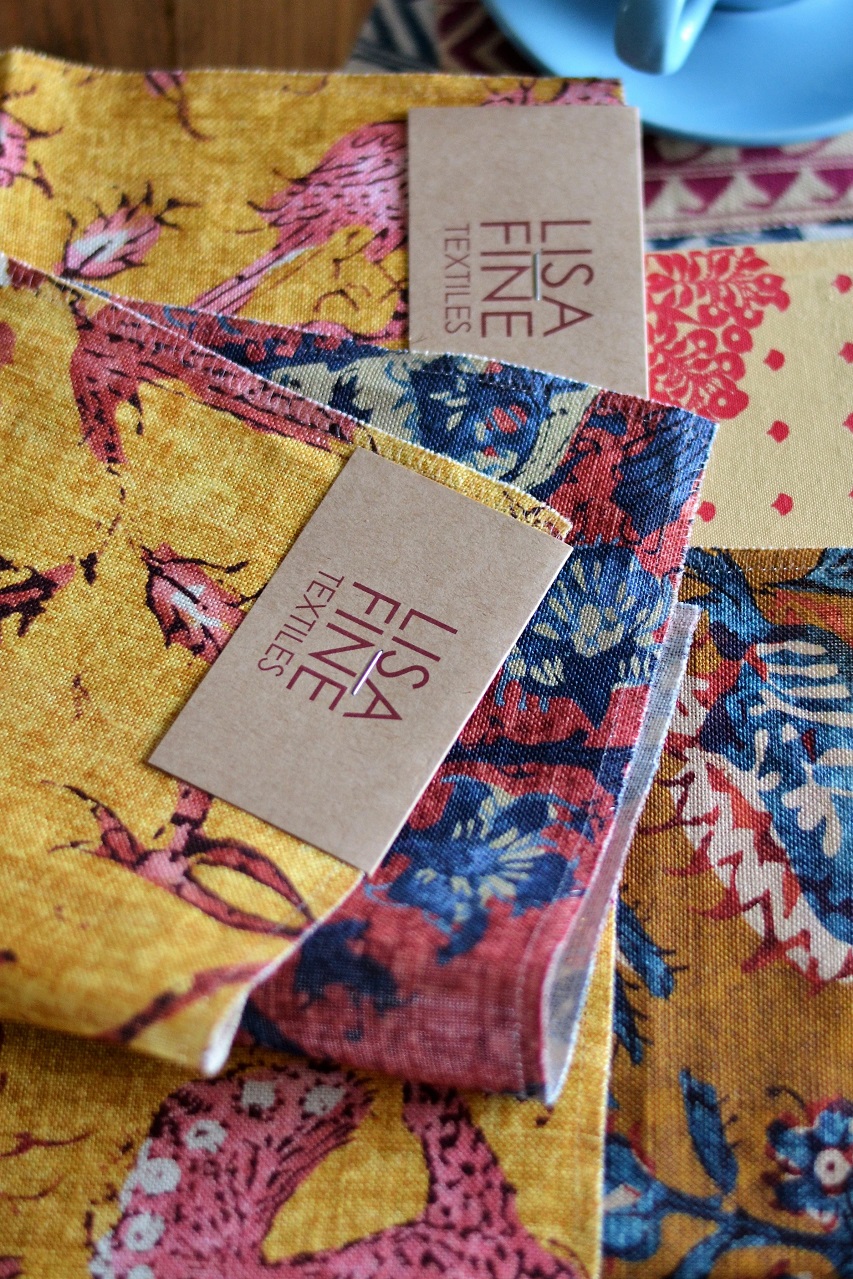
Colourful fabrics by Lisa Fine Textiles

Colourful fabrics by Lisa Fine Textiles · Lisa Stefan


Motifs, patterns, textiles, colours. Having recently received a batch of samples from Lisa Fine Textiles, I have spent my latte moments with hand-printed, colourful fabrics and textile books spread all over my desk, as captured in my images. Here we have three designs she introduced last year, Kalindi, Cochin and Ayesha Paisley, which are a beautiful addition to her exotic collection, inspired by her travels. Soon I will be sharing with you a little chat I had with Lisa Fine herself through email, about books, art and other inspirations.

Fabric: Cochin by Lisa Fine Textiles · Lisa Stefan
Cochin by Lisa Fine Textiles, colour in foreground: rose

Of these three designs, the floral fabric Cochin is the one that has won my heart and soul, especially the colour rose with a saffron background. The pattern is hand-printed on 90% natural linen blended with 10% nylon, available in four colours: rose, cinnabar (the red and blue one - see image above, top-right), burnt sugar, and saffron (with pink flowers). Many of Lisa Fine's designs bear an Indian name. Cochin is the colonial name of the Indian city Kochi, situated on the southwest coast in the state of Kerala.

Fabric: Ayesha Paisley by Lisa Fine Textiles · Lisa Stefan
Ayesha Paisley, colour in foreground: ruby

The Ayesha Paisley fabric is hand-printed on 100% natural linen, available in four colours: ruby, sapphire, coral, and spinel (I don't have a sample of the last one).

Fabric: Ayesha Paisley by Lisa Fine Textiles · Lisa Stefan
Ayesha Paisley, in the foreground: sapphire

Colourful fabrics by Lisa Fine Textiles · Lisa Stefan
In foreground: Kalindi in every available colour (under my cup are two samples of the fabric Luxor)

The Kalindi fabric has a floral pattern with dots, hand-printed on 90% natural linen blended with 10% nylon. It's available in five rich colours: monsoon (the light blue one), indigo, saffron, dusty rose, and lipstick. I'm assuming the fabric is named after the Kalindi River in the state of West Bengal in eastern India.

To view the full range of fabrics, visit the website of Lisa Fine Textiles.
Colourful fabrics by Lisa Fine Textiles · Lisa Stefan


Perhaps some readers are in the mood for a new look in one of their spaces or even thinking about redesigning their home. In an interview that appeared in Lonny a few years ago, when her guest flat on the Left Bank in Paris was featured in the magazine, Lisa Fine gave a solid advice: 'Never be a victim of trends. If modern is in style and you love Victorian, go Victorian. Style is an expression of yourself and not what fashion dictates' (Inspiration India, Dec/Jan 2010). In the same feature she shared a few design tips and this one could help you start: 'Similar to how many designers will start with a rug and then build a room, choose a fabric to inspire the space and work from there.' My choice of fabric would be clear.


Thursday, 15 September 2016

The Little Book of Hygge by Meik Wiking

Book review: The Little Book of Hygge by Meik Wiking · Lisa Stefan


Last weekend I got a copy of The Little Book of Hygge: The Danish Way to Live Well, which explains the Danish concept of 'hygge'. The author is Meik Wiking from The Happiness Research Institute in Copenhagen, whose job it is to research what makes people happy. It's published by Penguin and comes in a neat format, not too big, which makes it quite thick, 288 pages. It's readable and fun and beautifully designed, filled with photographs and illustrations of Scandinavian motifs. Wiking thoroughly explains the idea of hygge and how the Danes, the happiest nation according to studies, know the art of creating an intimate atmosphere. He uses researches and charts to support his case, but the book never feels dry or academic. He strikes a balance between facts and figures with a flowing, light, and often humorous text.

Before sitting down to tell you about the book it felt fitting to create an atmosphere of hygge. I made hot chocolate and a delicious bread roll before lighting the fireplace.
The Little Book of Hygge by Meik Wiking · Lisa Stefan


For an Icelander the concept of hygge isn't unfamiliar. Danish culture is similar to ours and we learn the language at school (or any other Nordic language of choice). In Iceland we would probably use the word cosy to explain hygge but it doesn't quite grasp the idea. This is the way Wiking explains it:
Hygge is about an atmosphere and an experience, rather than about things. It is about being with the people we love. A feeling of home. A feeling that we are safe, that we are shielded from the world and allow ourselves to let our guard down. (p. 6)
Most Danes connect hygge with autumn and winter but the warmer months aren't excluded from hygge. I found it interesting that Wiking compares the Danes with the Dutch, who have a similar concept called 'gezelligheid'. The difference, however, is that the majority of the Dutch associate it with going out, to a café or a bar, while the majority of the Danes associates hygge with the feeling of home.

Having lived in Denmark, I have many fond memories. I also happen to have Danish ancestors: On one branch of my family tree is a Danish great-grandmother and on another branch is a great-great-grandfather. I often notice that foreigners view Denmark as some kind of utopia and seem to think that it's free from the social problems other countries deal with. I was glad to see Wiking mentioning this view. When you live in Denmark you definitely become aware of a certain sense of community, which I cannot quite explain, and you realise that the welfare of its citizens is important.

The Little Book of Hygge by Meik Wiking · Lisa Stefan


How do the Danes create hygge and what makes them happy? Wiking mentions many factors, such as cosy homes and togetherness, inviting friends over to enjoy food and drink. Candles and the correct lighting are very important - 85% Danes connect candles with hygge. The Christmas month is particularly hyggelig (adjective). I have lived in a few countries and it's my opinion that no other nation knows how to better create the perfect Christmas mood. Copenhagen is my dream city in December and nothing compares to strolling its cobblestone streets, seeing the candles in the windows and experiencing the ideal Christmas spirit. Wiking devotes a chapter to Christmas and when talking about the food he mentions risalamande, which is one of our Christmas traditions. I have already shared the recipe of this Danish rice and almond pudding with cherry sauce on the blog.

One thing in the book caught my attention because it's something I have often thought about. Wiking refers to a survey that shows gratitude having an impact on happiness. The results show that being grateful not only increases happiness, but also makes us more helpful, more forgiving, and less materialistic (p. 280). This is what Wiking has to say about hygge and gratitude:
Hygge may help us to be grateful for the everyday because it is all about savouring simple pleasures. Hygge is making the most of the moment, but hygge is also a way of planning for and preserving happiness. Danes plan for hyggelige times and reminisce about them afterwards. (p. 281)
Book review: The Little Book of Hygge by Meik Wiking · Lisa Stefan


During the reading I was convinced that my daily life has hygge in abundance - perhaps it's in my blood - but if I have to mention one thing that I do every day it would be enjoying a cup of quality coffee and reading a book. Each time my choice of hygge-corner in the house simply depends on my mood.

If you feel that you need hygge in you life I highly recommend getting a copy of this book. It's full of ideas.

The Little Book of Hygge: The Danish Way to Live Well
By Meik Wiking
Penguin Life
Hardcover, 288 pages, illustrated
Buy here