Showing posts with label fabrics. Show all posts

Wednesday, 11 April 2018

Blues & reds by Schuyler Samperton Textiles

Blues and reds by Schuyler Samperton Textiles · Lisa Stefan


When my face is not buried in a book you will probably catch me admiring patterned textiles with fascinating motifs (I often wish I had studied decorative art). This week I learned that new designs are soon being added to the fabric collection of Schuyler Samperton Textiles, which launched last year. I'm waiting with bated breath. On the blog I have already introduced some of her patterns and today I'm showing you my mood board of blues and reds, highlighting the Overlea, Cordoba, and Nellcote fabrics. Also, giving you a glimpse into the interior of Lamb's House in Leith, a House & Garden UK feature from 2016.

First, the textiles. The blue and red floral fabric is Overlea and this colourway is called Vermillion. I intend to decorate a nook in my own home with this particular fabric, after I have finished purchasing certain essentials. I also think it would make a beautiful tablecloth. Marine is the name of its blue colourway, next to the bedroom image. The other folded blue fabric is Cordoba in Indigo; the design has a paisley motif. The striped fabric is Pendleton in Brighton.

The Nellcote fabric is another design that I have already shared and cannot get enough of. The fabric sample with the tag shows its blue colourway, called Montego. You can spot it in Apricot, my personal favourite, in the top-right corner (the blue fabric thereunder is Firefly in Deep End). In previous blog entries featuring Samperton's textile design I have included the Doshi pattern; spotted under the cup of latte is its blue colourway Lake. Please follow the links to view the colourways of each fabric on the website of Schuyler Samperton Textiles.

Lamb's House living room, House & Garden UK · Davide Lovatti | Books & Latte
From the pages of House & Garden UK: Lamb's House living room/Davide Lovatti

The bedroom in my mood board belongs to the restored Lamb's House in Leith (Edinburgh), which was built in 1610. The owners are conservation architects and it so happens that the wife, Kristin Hannesdottir, is a fellow Icelander. I remember falling flat for this space, its textiles and exposed beams, when I first saw the house tour featured in House & Garden UK, beautifully photographed by Davide Lovatti. Here you can also view the living room and Kristin's studio, which has a barrel-vaulted ceiling made of Siberian larch. If you're interested in reading about the restoration and viewing more images, simply follow the link.

Lamb's House studio, House & Garden UK · Davide Lovatti | Books & Latte
The studio of conservation architect Kristin Hannesdottir at Lamb's House/Davide Lovatti

top image by me | credit: House & Garden UK, December 2016 · Davide Lovatti


Wednesday, 17 January 2018

Textiles and Persians

Schuyler Samperton Textiles · Lisa Stefan


If you thought this blog entry was about Persian textiles you have been lured to the blog on false pretences; I'm referring to my Persian cat, who did some serious photobombing the other day when I was photographing patterned fabrics by Schuyler Samperton Textiles. It was a relaxing day, with the sun in hiding but every now and then brightening up our reading nook quite generously, and I had spread books, interior magazines and fabric samples all over the coffee table. There was coffee too.

A certain colour palette had formed in my head and all of a sudden I realised how beautifully it harmonised with the January 2018 cover of The World of Interiors. I picked the fabric samples needed, grabbed the camera, and had shot perhaps four or five photos when my Persian prince appeared on the scene ... and refused to budge (I should have known, he likes sleeping in between my books). I tried to work around him but he kept popping up in the frame. The last photo shows the end result: he had his way and I called it a day.

Schuyler Samperton Textiles · Lisa Stefan
Caledonia, Doshi and Firefly fabrics by Schuyler Samperton Textiles

Back to that colour palette. I chose three designs by Schuyler Samperton Textiles. The floral fabric with the bird motif is called Caledonia, seen here in the colourways Peony (above in the foreground) and Imperial (under the cup). The design with the loosely printed botanical motif is Doshi, in the colourways Hibiscus and Aubergine. Sandwiched between the two is the Firefly in Plum. In blue it's called Deep End.


A Persian prince enters.

The World of Interiors & Schuyler Samperton Textiles · Lisa Stefan
Bedroom image from The World of Interiors, January 2018/Simon Upton

The cover photo of the January 2018 issue of The World of Interiors was lensed by Simon Upton. The magazine visited the home, a transformed warehouse in Milan, of art director Roberto Gerosa. The bedroom is textile heaven.
Persian cat sleeping & Schuyler Samperton Textiles · Lisa Stefan


All's well that ends well.


Tuesday, 12 September 2017

Schuyler Samperton Textiles

Schuyler Samperton Textiles, designs, patterns: Nellcote, Cordoba, Celandine · Lisa Stefan


The world of textile design got richer this year when Schuyler Samperton, a Los Angeles–based interior designer, took the plunge and introduced her own fabric collection under the name of Schuyler Samperton Textiles. With the launch of the fabric line, a dream came true for Samperton, who has been collecting textiles since her teenage years. The word stunning describes my first impression of her collection, which exists of eight fabrics made of 100% linen, available in various colourways. For two months I have been admiring the details of her patterns and asking myself, Where do I even begin to share this beauty?

Schuyler Samperton Textiles, design: Nellcote petunia
Nellcote/Petunia by Schuyler Samperton Textiles

You may have seen some of the fabrics by Schuyler Samperton Textiles on my Instagram account this summer, but for the first blog post I landed on the Nellcote/Apricot in a leading role, a bohemian pattern that to me depicts a certain playfulness. (The detail above shows the colour Petunia.)

The Nellcote/Apricot is the fabric and colour I would like to use for a cushion or two in our new living room, after we have purchased a new sofa - I'm moving soon, about to start packing! I have been playing with ideas and every time this is the pattern that feels right, plus its colours match well with the textiles I already have and the ones I have my eyes on.

Schuyler Samperton Textiles, design: Doshi persimmon
Schuyler Samperton Textiles, designs: Nellcote, Caledonia, Celandine · Lisa Stefan

Left: The Doshi fabric in Persimmon. Right: In foreground, Nellcote/Apricot;
top, Caledonia/Mandarin; bottom-left, Celandine/Sunset

Of the eight designs, the Doshi fabric is the one with a loosely printed pattern, a simple botanical motif. You can easily use any of its five colourways to draw out another colour, resulting in a beautifully decorated space. For this post I chose the Doshi/Persimmon but I also have a crush on a blue version, Doshi/Lake. The floral fabric also seen in my image above is Celandine/Sunset.

Some other time I would like to feature the Caledonia design in more detail on the blog. It's the floral fabric with the butterfly in my image above, in the colour Mandarin. This fabric also has a bird motif.
Schuyler Samperton Textiles, designs: Nellcote, Cordoba, Celandine · Lisa Stefan


Another Schuyler Samperton design I'm fond of using in my new home is the Cordoba fabric with a paisley motif, seen folded in the colour Spice in my image above, and in detail below (also spotted in Indigo under the ceramic vase). I have yet to decide between the Cordoba/Spice and Cordoba/Dahlia.

I will be featuring more fabrics later. In the meantime you can view the full range of fabrics on the website of Schuyler Samperton Textiles, where you will also find a list of showrooms.

Schuyler Samperton Textiles, design: Cordoba spice
Cordoba/Spice by Schuyler Samperton Textiles

A few years back I featured the work of Schuyler Samperton on the blog. The suzani lovers out there may perhaps remember this particular post where, among others, I shared an image of a West Hollywood bedroom (scroll down), belonging to a residence she designed. She studied art history and decorative arts at Trinity College, NYU and Parsons School of Design, and for four years she worked for American interior designer Michael S. Smith. Her interior design projects are accessible online. Throughout September I will be adding some of my favourite Schuyler Samperton spaces to the Lunch & Latte Tumblr page.


Textile and interior designer Schuyler Samperton. © Schuyler Samperton Textiles/Alexandre Jaras


Monday, 10 April 2017

A talk with textile designer Lisa Fine

A talk with textile designer Lisa Fine · Lisa Stefan


The late American photographer Ansel Adams once said: 'You don't make a photograph just with a camera. You bring to the act of photography all the pictures you have seen, the books you have read, the music you have heard, the people you have loved.' His words apply to any kind of creative art and I used them to start an email conversation with textile designer Lisa Fine. On the blog I have described her as a designer with a sense of history; I stick to my words. She has a knack for colours, for patterns, and it feels as if each fabric by Lisa Fine Textiles tells a story. She was born and raised in Mississippi. Today she lives in New York with her dogs and travels widely, often to India and other exotic places. Miniature paintings have inspired her career, and so has painter Henri Matisse.

Wherever possible, also in direct quotes, I have added links to e.g. short essays on museum websites that I found interesting and educational. Except for the Matisse paintings, all the images were chosen by me.

[Fabrics by Lisa Fine Textiles shown in my top image (click each for info): Cairo, Kashgar,
Luxor, Malabar, Malula, Mandalay, Pasha, and Rajkot. For books, see further below]

Persian miniature: Mir Sayyid 'Ali, Night-time in a City, c. 1540, Tabriz, Iran, Safavid Period · Books & Latte
Persian miniature: Mir Sayyid 'Ali, Night-time in a City, c. 1540, Tabriz, Iran, Safavid Period

To go back to Adams's words, what has left its mark on Lisa Fine (given how much she has discovered through her work and travels).
LF: My life is very much about people, however, books and art not only inspire and teach but are the best refuge.

My favorite painter is Matisse. I love his mix of color and pattern, especially in his orientalist portraits. Irving & Fine [collaboration with textile designer Carolina Irving] peasant blouses were very much inspired by his work. I also love the Fauvism movement.
Her other two favourite artists are Kees Van Dongen and Amedeo Modigliani.

Henri Matisse, Zorah on the Terrace, 1912 · Books & Latte
Henri Matisse, Zorah on the Terrace, 1912

She doesn't have a favourite Matisse painting but said: 'I love his Moroccan period most, especially the portraits.' Later I found his work Zorah on the Terrace in my inbox with the words: 'Love Moroccan portraits.' The other two by Matisse followed, the one below with the words: 'Love odalisque series.'

Saturday, 1 April 2017

Colourful fabrics by Lisa Fine Textiles

Colourful fabrics by Lisa Fine Textiles · Lisa Stefan


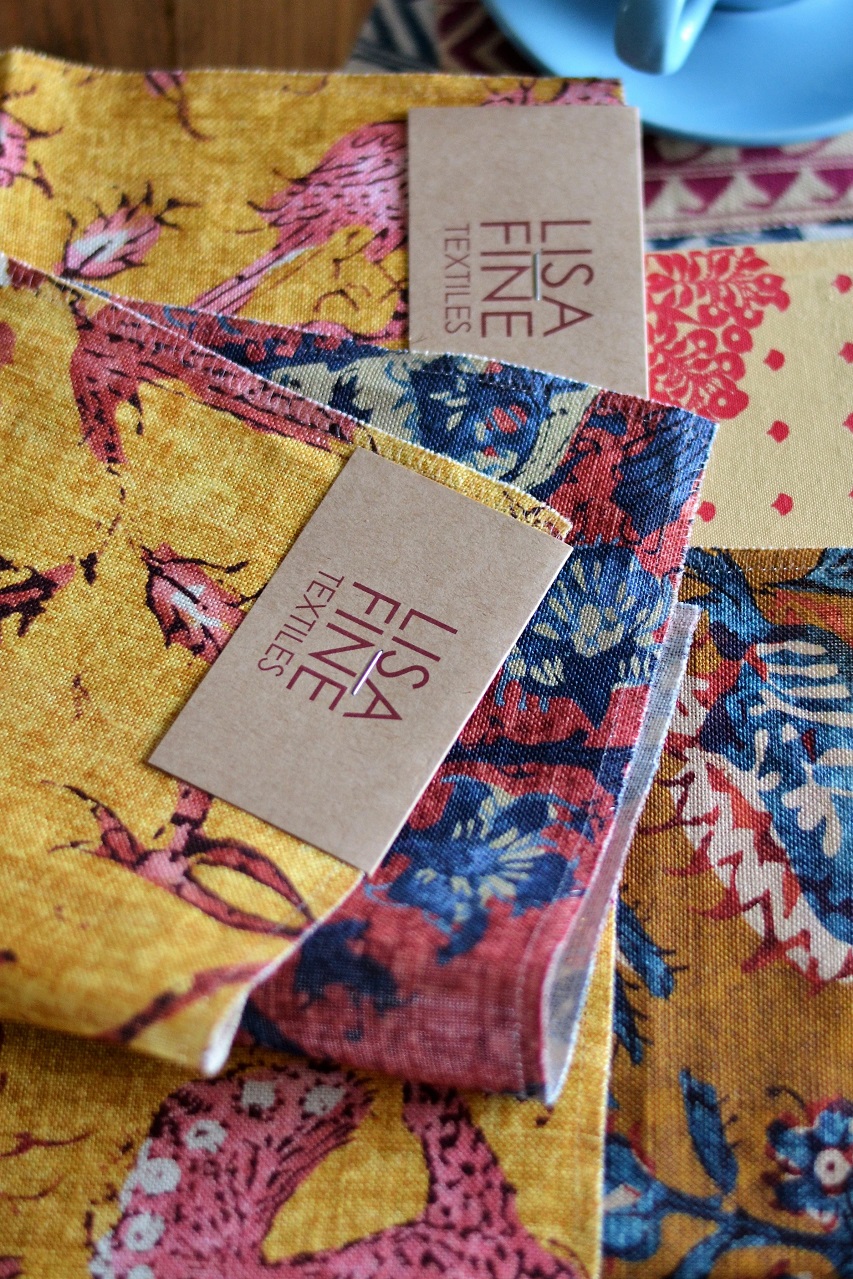
Motifs, patterns, textiles, colours. Having recently received a batch of samples from Lisa Fine Textiles, I have spent my latte moments with hand-printed, colourful fabrics and textile books spread all over my desk, as captured in my images. Here we have three designs she introduced last year, Kalindi, Cochin and Ayesha Paisley, which are a beautiful addition to her exotic collection, inspired by her travels. Soon I will be sharing with you a little chat I had with Lisa Fine herself through email, about books, art and other inspirations.

Fabric: Cochin by Lisa Fine Textiles · Lisa Stefan
Cochin by Lisa Fine Textiles, colour in foreground: rose

Of these three designs, the floral fabric Cochin is the one that has won my heart and soul, especially the colour rose with a saffron background. The pattern is hand-printed on 90% natural linen blended with 10% nylon, available in four colours: rose, cinnabar (the red and blue one - see image above, top-right), burnt sugar, and saffron (with pink flowers). Many of Lisa Fine's designs bear an Indian name. Cochin is the colonial name of the Indian city Kochi, situated on the southwest coast in the state of Kerala.

Fabric: Ayesha Paisley by Lisa Fine Textiles · Lisa Stefan
Ayesha Paisley, colour in foreground: ruby

The Ayesha Paisley fabric is hand-printed on 100% natural linen, available in four colours: ruby, sapphire, coral, and spinel (I don't have a sample of the last one).

Fabric: Ayesha Paisley by Lisa Fine Textiles · Lisa Stefan
Ayesha Paisley, in the foreground: sapphire

Colourful fabrics by Lisa Fine Textiles · Lisa Stefan
In foreground: Kalindi in every available colour (under my cup are two samples of the fabric Luxor)

The Kalindi fabric has a floral pattern with dots, hand-printed on 90% natural linen blended with 10% nylon. It's available in five rich colours: monsoon (the light blue one), indigo, saffron, dusty rose, and lipstick. I'm assuming the fabric is named after the Kalindi River in the state of West Bengal in eastern India.

To view the full range of fabrics, visit the website of Lisa Fine Textiles.
Colourful fabrics by Lisa Fine Textiles · Lisa Stefan


Perhaps some readers are in the mood for a new look in one of their spaces or even thinking about redesigning their home. In an interview that appeared in Lonny a few years ago, when her guest flat on the Left Bank in Paris was featured in the magazine, Lisa Fine gave a solid advice: 'Never be a victim of trends. If modern is in style and you love Victorian, go Victorian. Style is an expression of yourself and not what fashion dictates' (Inspiration India, Dec/Jan 2010). In the same feature she shared a few design tips and this one could help you start: 'Similar to how many designers will start with a rug and then build a room, choose a fabric to inspire the space and work from there.' My choice of fabric would be clear.


Wednesday, 4 May 2016

Lisa Fine Textiles

Lisa Fine Textiles · Lisa Stefan


In a documentary by the late Albert Maysles about designer and style icon Iris Apfel, simply called Iris (2014), she has a conversation with photographer Bruce Weber. When they start talking about fashion designers that don't know how to sew - 'they are media freaks', Iris says - she mentions young designers that have 'no sense of history' (about 46 minutes into the film). Perhaps you find this an odd intro to textile designer Lisa Fine, the woman at the helm of Lisa Fine Textiles, but I think it is exactly a sense of history that drew me to Fine's work. There is depth to her design and her patterned fabrics have an exotic and mystical element.
Lisa Fine Textiles · Lisa Stefan


Only reading some of the names of Lisa Fine's beautiful fabrics could take your mind to faraway places, or make you reach for the historic atlas (the links take you to the fabric on her website): There is Aswan, a city on the east bank of the Nile River in Egypt; Luxor, another Egyptian city where you will find the ruins of the ancient city of Thebes; Lahore, a city in the Punjab province of Pakistan; Kashgar, the historic oasis city in far western China, a stop on the old Silk Road; Bagan, an ancient city in Myanmar (Burma); Baroda, the old name of Vadodara in the Indian region of Gujarat; Malabar, a region on the western coast of India, furthest south between the Arabian Sea and the Western Ghats.

I could go on.

Lisa Fine Textiles · Lisa Stefan
The Zoraya fabric in rose and monsoon

It has been years since Lisa Fine's textiles first cast their spell on me but I had never handled the fabrics (100% linen) until I received a collection of her samples in the mail. My high expectations were met. One fabric is called Zoraya (image above). I was curious about the origin of the name so yesterday, before publishing the blog post, I decided to send a request to the office, which was promptly replied with Fine's explanation of how she came up with the name for the pattern. Soraya was the name of one of the wives of the last Shah of Iran, who ruled from 1941 to 1979. Fine was in Andalucia in Spain and was reading the history of the North Africans and Persians in Spain when she came across the name with Z, Zoraya. 'I thought the pattern had a very geometric almost ancient Persian look and liked the name Zoraya.'

A designer with a sense of history for sure.

Lisa Fine Textiles · Lisa Stefan
In the foreground: Malabar Reverse in Nordic blue

In the world of textiles and interior design it is unlikely that the name of Lisa Fine has escaped you. Recently in the American House Beautiful, there was a feature on her mother's home in Dallas, designed by the daughter, of course. (There is a book called Iznik on her mother's coffee table that I want!) Her mother gave her free rein with the space and the happy customer had just one 'complaint' about the outcome: 'The only problem is, when people come over they don't want to leave.'

Lisa Fine's colourful flat in Paris has been featured in publications like Lonny (a pdf with the feature itself and larger images here) and The New York Times (more images from the NYT feature at Apartment Therapy). Her collaboration with designer Richard Keith Langham has resulted in stunning Indian dhurries. Then there is the collaboration with textile designer Carolina Irving, Irving & Fine, where you can purchase their patterned and embroidered tunics and kaftans.

Lisa Fine Textiles · Lisa Stefan

Left: Samode in indigo/natural (also spotted in desert sand); Lahore in apricot.
Right (in frame): Baroda II in pomegranate (pattern with bird); Zoraya
in monsoon; Luxor in pompeii on ivory (orange one)

Each time I see a feature on Lisa Fine I can easily resonate with the books she has read; like me, biographies and travel writing seem to be her genre. She has travelled extensively, e.g. throughout India, and her textile design is inspired by it. I remember this one particular feature that I came across online. It had a photo collage and she was asked all kinds of questions. The final one was where she would like to go and she said Isfahan in Iran, but added that she didn't think it would be possible (when researching for this post I found it on her website: Material Connection, Ultra Travel, Summer 2012). Now that the international sanctions on Iran have been lifted, and the US-Iran relations are improving, Isfahan (Eṣfahān) seems a possibility in the future. I can only imagine the inspiration she could take from the historic Islamic architecture, its splendours and gorgeous tiles. Especially with her sense of history.

Lisa Fine Textiles · Lisa Stefan
In the foreground: Kashgar in spice. In the background: Chiara in sky blue/oyster.
Also spotted: Bagan in indigo


Wednesday, 13 April 2016

Textiles of the Islamic World by John Gillow

Book review: Textiles of the Islamic World by John Gillow · Lisa Stefan


For Christmas I got the book Textiles of the Islamic World by John Gillow, who is a well-known author, lecturer and collector in the field of textiles. First I was browsing, going back and forth just a tad too eagerly, and mainly feasting on the illustrations - gorgeous motifs and patterns - but gradually I started taking in the wealth of information. For anyone interested in textile design this book is a treasure, especially if one is interested in Islamic culture and how Islam spread to various corners of the world. The text is rich in details, e.g. on embroidery and weaving techniques, but Gillow manages well to avoid an overload of information. For a non-scholar in textile design, like myself, the book was entertaining and I can only hope to do it justice in a single blog entry. The images I snapped show just a portion of the fabrics and patterns I kept coming back to during the reading. A small portion.

[Book cover: 17th-century Ottoman embroidered textile. Private collection. New York]

Right: Wedding blanket woven by the Fulani for the Tuareg, West Africa, p. 302

Textiles of the Islamic World, published by Thames & Hudson in 2013, has 638 illustrations and is divided into eight sections, or geographical regions: 1) The Ottoman World, 2) Islamic Spain and North Africa, 3) The Arab World, 4) The Persian World, 5) Central Asia, 6) The Mughal World, 7) East and Southeast Asia, and 8) Sub-Saharan Africa. The countries within each form chapters, which Gillow starts with a short introduction before discussing regions, costumes, techniques, etc. Each chapter ends with the state of textile production in the present day. It's both alarming and saddening to read how valuable knowledge in certain countries is on the brink of being lost. War-torn areas have especially been badly affected.
Embroidered leather pot-holder and bedding cloth, Kyrgyzstan, pp. 216-7

Apart from the historic details in Gillow's book, my main interest was viewing the motifs and learning about their meaning, a topic that fascinates me. Personally, I would have welcomed much more information in the book on the symbolic meaning of motifs.

In the Muslim world, the post-Islamic textiles are richly decorated and the designs are often abstract. The patterns are geometric, floral and vegetal, and some textiles have beautiful calligraphic inscriptions, especially in Egypt. The post-Islamic textile industry avoided the use of human and god-like forms. Also animal forms, with exceptions. In Iraq, for example, there are camel, cock and lion motifs, where the camel symbolises riches and happiness, the lion, strength; the cock, victory and glory (p. 120). Then there are the hunting cloths from Herat in Afghanistan that depict animals and hunters.

Appliqué tent panel from Khiyammiya, the 'Street of the Tent Makers',
in the Old City of Cairo, Egypt, p. 93

In Saudi Arabia the two holy cities Mecca and Medina are of great importance to Muslims. Mecca was the Prophet Mohammed's (c. AD 570-622) birthplace, the founder of Islam who died in Medina. In the book, Gillow points out the significance of cloth related to the Ka'bah, the holiest spot in Mecca:
The Ka'bah, known as 'Bait Allah' ('The House of God'), is a great cube of black rock. Since historical times it has been given an annual cover, known as the 'Kiswa' (literally, 'robe'), of woven fabric adorned with calligraphic inscriptions in Arabic and embroidered in silver thread with the name of God. This was traditionally the gift of the Caliph, and in Ottoman times was made either in Cairo or Damascus and sent with great ceremony on the annual camel caravan that left both those places with a mass of pilgrims to cross the desert to Mecca and Medina. (p. 122)

Block-printed shawl from the 19th century, Deccan, India, p. 244

As someone who is fascinated with block prints (they are so perfectly imperfect), I found the chapters about India and Bangladesh quite interesting. Above I mentioned war-torn areas. Syria is one of those countries and I think the destruction of Palmyra hasn't escaped anyone who follows the news these days. What I didn't know, and found fascinating, is that in Syria the use of block-printed cloths dates back to ancient Rome. In Palmyra they have discovered block-printed cloth from India that dates from the time of Queen Zenobia. 'The patterns on these finds are exactly the same as patterns on contemporary block-printed cloth from Rajasthan' (p. 106). Think of it, the patterns used in the Roman colony of Palmyra in the 3rd century are still in use in India circa 1750 years later!

Left: Curtain made up of brocaded silk strips woven on draw-looms, Djerba, Tunisia, North Africa, p. 73.
Right: Mende strip-woven cloth, Sierra Leone and Hausa wrap, Nigeria, p. 295

For a long time East Africa has been on my list of future destinations (Kenya, Tanzania, Rwanda and Uganda are on it) and, obviously, I read that chapter with great interest. I also enjoyed comparing the textiles of Sub-Saharan Africa with the designs in the countries of North Africa (the two images above should give you an idea). Oman, on the south-eastern coast of the Arabian Peninsula, is also on my list. The Omanis had a great influence on the culture and dress of East Africa. The spice island of Zanzibar was 'for centuries an outpost of Omani power' (p. 299), and 'a notable Muslim centre as early as the tenth century AD' (p. 296). The city of Mombasa in Kenya and the island of Pemba (Tanzania) were also part of the seaborne trading routes of the Omanis. (I didn't take photos of the textiles (mainly garments) featured in the East Africa chapter; I found the textiles shown in the West Africa chapter more appealing.)

Suzani with an embroidered pattern of floral repeats enclosed within multiple
cockerels' heads, Urgut, Uzbekistan, p. 185

Early 19th-century Lakhai suzani, southern Uzbekistan, Central Asia, p. 191

Gillow's chapter about Uzbekistan in Central Asia was another one that appealed to me, especially the illustrations of suzani hangings, which are embroidered with flowers and vines. I could have photographed the entire chapter. Let me add that photographing patterns can be very tricky; sometimes there is so much movement in the pattern that it's hard to find a focal point. One of the patterns that mesmerised me was the early 19th-century Lakhai suzani in the photo above (I have posted another angle of it on Instagram). The Lakhai people live in the Surxondaryo (Surkhandarya) region, in the south-east part of the country, and 'claim descent from Karamysh, the sole surviving brother of Ghenghis Khan' (p. 190). Lakhai was Karamysh's youngest son. (Please find another example of Lakhai suzani on my Tumblr page.)

White Tekke chyrpy for an old woman, Turkmenistan and painted 'hunting cloth',
Herat, Afghanistan, p. 183

I could have written a blog entry for each section of the book but opted for keeping everything in one place and not too long. The visual part of my review could give you the wrong idea of the book. As I'm more interested in the patterns and use of motifs on e.g. rugs and wall hangings, I didn't really take any photos of the garments. The book has a lot of illustrations of garments and accessories, both for men and women, which should satisfy those interested in Islamic fashion and style.

Next on my textile-books reading list are two by Gillow, African Textiles: Colour and Creativity Across a Continent (it's on my spring reading list) and Indian Textiles (co-author Nicholas Barnard), also published by Thames and Hudson. Given how much I enjoyed reading this book, I have the feeling I will feature both on the blog some other time.

Detail of a Molesalaam appliqué, Kathiawar, India, p. 242

images by me | credit: photos from the book shown here are by Luke Gillow and Tamsin Beedle, except: cover photo · Clive Loveless, London | suzani p. 191 · Longevity Studio , London | West Africa blanket p. 302 · James Austin