Showing posts with label lisa fine textiles. Show all posts

Monday, 10 April 2017

A talk with textile designer Lisa Fine

A talk with textile designer Lisa Fine · Lisa Stefan


The late American photographer Ansel Adams once said: 'You don't make a photograph just with a camera. You bring to the act of photography all the pictures you have seen, the books you have read, the music you have heard, the people you have loved.' His words apply to any kind of creative art and I used them to start an email conversation with textile designer Lisa Fine. On the blog I have described her as a designer with a sense of history; I stick to my words. She has a knack for colours, for patterns, and it feels as if each fabric by Lisa Fine Textiles tells a story. She was born and raised in Mississippi. Today she lives in New York with her dogs and travels widely, often to India and other exotic places. Miniature paintings have inspired her career, and so has painter Henri Matisse.

Wherever possible, also in direct quotes, I have added links to e.g. short essays on museum websites that I found interesting and educational. Except for the Matisse paintings, all the images were chosen by me.

[Fabrics by Lisa Fine Textiles shown in my top image (click each for info): Cairo, Kashgar,
Luxor, Malabar, Malula, Mandalay, Pasha, and Rajkot. For books, see further below]

Persian miniature: Mir Sayyid 'Ali, Night-time in a City, c. 1540, Tabriz, Iran, Safavid Period · Books & Latte
Persian miniature: Mir Sayyid 'Ali, Night-time in a City, c. 1540, Tabriz, Iran, Safavid Period

To go back to Adams's words, what has left its mark on Lisa Fine (given how much she has discovered through her work and travels).
LF: My life is very much about people, however, books and art not only inspire and teach but are the best refuge.

My favorite painter is Matisse. I love his mix of color and pattern, especially in his orientalist portraits. Irving & Fine [collaboration with textile designer Carolina Irving] peasant blouses were very much inspired by his work. I also love the Fauvism movement.
Her other two favourite artists are Kees Van Dongen and Amedeo Modigliani.

Henri Matisse, Zorah on the Terrace, 1912 · Books & Latte
Henri Matisse, Zorah on the Terrace, 1912

She doesn't have a favourite Matisse painting but said: 'I love his Moroccan period most, especially the portraits.' Later I found his work Zorah on the Terrace in my inbox with the words: 'Love Moroccan portraits.' The other two by Matisse followed, the one below with the words: 'Love odalisque series.'

Saturday, 1 April 2017

Colourful fabrics by Lisa Fine Textiles

Colourful fabrics by Lisa Fine Textiles · Lisa Stefan


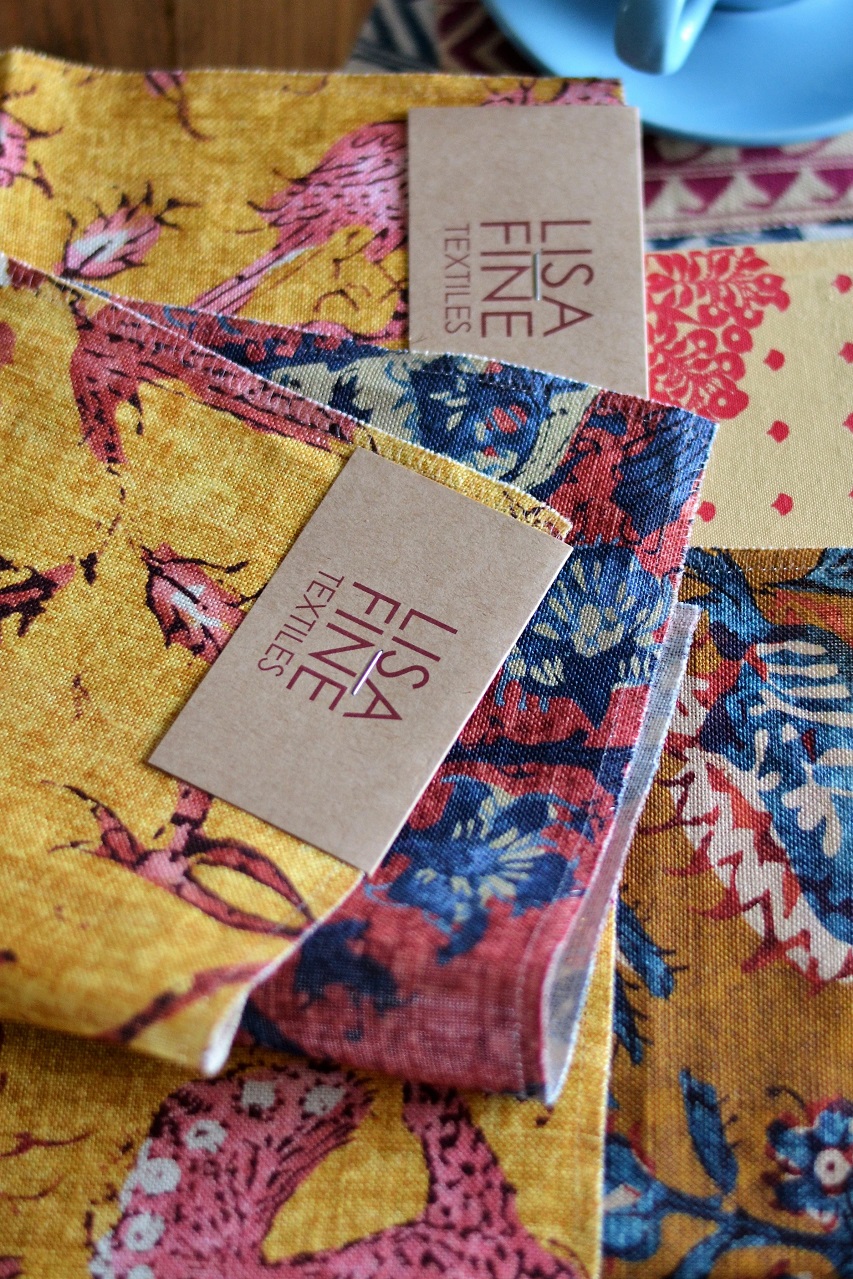
Motifs, patterns, textiles, colours. Having recently received a batch of samples from Lisa Fine Textiles, I have spent my latte moments with hand-printed, colourful fabrics and textile books spread all over my desk, as captured in my images. Here we have three designs she introduced last year, Kalindi, Cochin and Ayesha Paisley, which are a beautiful addition to her exotic collection, inspired by her travels. Soon I will be sharing with you a little chat I had with Lisa Fine herself through email, about books, art and other inspirations.

Fabric: Cochin by Lisa Fine Textiles · Lisa Stefan
Cochin by Lisa Fine Textiles, colour in foreground: rose

Of these three designs, the floral fabric Cochin is the one that has won my heart and soul, especially the colour rose with a saffron background. The pattern is hand-printed on 90% natural linen blended with 10% nylon, available in four colours: rose, cinnabar (the red and blue one - see image above, top-right), burnt sugar, and saffron (with pink flowers). Many of Lisa Fine's designs bear an Indian name. Cochin is the colonial name of the Indian city Kochi, situated on the southwest coast in the state of Kerala.

Fabric: Ayesha Paisley by Lisa Fine Textiles · Lisa Stefan
Ayesha Paisley, colour in foreground: ruby

The Ayesha Paisley fabric is hand-printed on 100% natural linen, available in four colours: ruby, sapphire, coral, and spinel (I don't have a sample of the last one).

Fabric: Ayesha Paisley by Lisa Fine Textiles · Lisa Stefan
Ayesha Paisley, in the foreground: sapphire

Colourful fabrics by Lisa Fine Textiles · Lisa Stefan
In foreground: Kalindi in every available colour (under my cup are two samples of the fabric Luxor)

The Kalindi fabric has a floral pattern with dots, hand-printed on 90% natural linen blended with 10% nylon. It's available in five rich colours: monsoon (the light blue one), indigo, saffron, dusty rose, and lipstick. I'm assuming the fabric is named after the Kalindi River in the state of West Bengal in eastern India.

To view the full range of fabrics, visit the website of Lisa Fine Textiles.
Colourful fabrics by Lisa Fine Textiles · Lisa Stefan


Perhaps some readers are in the mood for a new look in one of their spaces or even thinking about redesigning their home. In an interview that appeared in Lonny a few years ago, when her guest flat on the Left Bank in Paris was featured in the magazine, Lisa Fine gave a solid advice: 'Never be a victim of trends. If modern is in style and you love Victorian, go Victorian. Style is an expression of yourself and not what fashion dictates' (Inspiration India, Dec/Jan 2010). In the same feature she shared a few design tips and this one could help you start: 'Similar to how many designers will start with a rug and then build a room, choose a fabric to inspire the space and work from there.' My choice of fabric would be clear.


Friday, 24 February 2017

A year in reading - part 1

My reading journal - part 1 · Lisa Stefan


Here it is, the blog entry I have wondered whether to write or not, the one with comments on a few books that appeared on my 2016 reading lists. First I thought of writing these notes in a comment under the list in question but later thought it best to keep them separate. I see no reason to repeat comments that I have already made on certain books, or to comment here on the ones I reread; I only read books again if I like them or if they hold a special place in my heart.

Speaking of rereading books: Scottish author Ali Smith was recently featured in the 'By the Book' column (NYT), where she said something that reasoned with me:
[A] rereading can feel like a first-time read in itself, which is another great thing about books and time; we think we know them, but as we change with time, so do they, with us. (Sunday Book Review, 12 Feb. 2017)
I saw this feature a couple of days ago and noticed that she mentioned the book Pale Fire by Vladimir Nabokov. If you follow me on Instagram you may have noticed the cover in a photo I shared last Sunday. It so happens that I borrowed the book at the library on Saturday and it will be on my next reading list.


Below are some of my ideas about books that appeared on my № 1, 2 and 3 reading lists. I included design books on my first list but later decided to only include novels, auto/biographies, travel books, etc. Let me add that it's not my intention to steer you away from the books I unfavourably comment on, or those I didn't finish. Our literary tastes are different, and so are our cultural and social backgrounds, and I certainly don't want to appear as an authority on what to read and not to read. However, I know that I have blog readers who are using my lists as a guide to books, which is why I think it is only fair to mention those that perhaps didn't live up to my expectations.

№ 1 reading list (2 of 8):

· The Shadow of the Sun by Ryszard Kapuscinski. I read a few chapters before putting it away, only because Africa by John Reader has been on my list for some time and I wanted to read it before reading other Africa-related books on my to-read list. Polish journalist Kapuscinski covered Africa for decades and I believe that one day I will pick up his book again and finish it.
· The Great Railway Bazaar by Paul Theroux. The biggest disappointment of my 2016 reads. Started brilliantly with an observant and humorous Theroux - I could hardly put it down. At some point, his tone becomes annoying, as if all he can do is complain. I lost both my interest and patience and tossed it. A travel writer that doesn't inspire me to travel has no place in my bookish heart.

№ 2 reading list (1 of 6):

· Off the Road by Carolyn Cassady. I lost my patience and gave up. Way too revealing and not in a good way. The times were different but it astonished me how she allowed Neal to disrespectfully treat her right from the start of their relationship. The first chapters are a good lesson in how not to pick a husband.
[Another from the list: Testament of Youth by Vera Brittain (see separate blog entry).]


№ 3 reading list (2 of 6):

· Memoirs of a Dutiful Daughter by Simone de Beauvoir. The first volume of her autobiography, in which she covers her early life, her childhood in Paris and her Sorbonne years. My only fault was her serious narrative; her tone of voice was too intellectual for a child but fitted better as she grew older. The other volumes will appear on my reading lists in the future.
· Prayers for the Stolen by Jennifer Clement. In my opinion, overrated. In the beginning, the narrator is a young girl which means an easy read with a simple vocabulary, and there is plenty of humour (the mother is priceless!). The author lost me when I reached the last third or fourth part of the book (when the girl leaves home); the narrative became sloppy somehow. This was one of those books that I really wanted to like and be able to recommend but it left me rather disappointed.

'Part 2' is coming soon, with comments on a few books from the № 4, 5 and 6 reading lists.

[Update: click here for part 2.]


Monday, 19 December 2016

Book review: Avid Reader by Robert Gottlieb

Book review: Avid Reader: A Life by Robert Gottlieb · Lisa Stefan


There is a reason Toni Morrison's Beloved wasn't the first part of a long novel and why you may have read Catch-22 by Joseph Heller instead of Catch-18. That reason is editor Robert Gottlieb, who recently published his memoir Avid Reader: A Life (Farrar, Straus and Giroux). Memoirs often have too much of name-dropping but in his case we could call it title-dropping. Whether it's too much is debatable. He tells his story through his work, at Simon & Schuster, Alfred A. Knopf, and The New Yorker, and because of all the book titles his style may at first seem to lack depth. As the reading continues, it makes sense and gives an insight into his world of publishing. Apart from Heller and Morrison, other feathers in his cap were e.g. Doris Lessing, John le Carré, John Cheever, Chaim Potok, Charles Portis, and in non-fiction, Jessica Mitford, Nora Ephron, Robert Caro, Lauren Bacall, and Bill Clinton. Even Miss Piggy. This is a man who loved his job; editing was his life. For the bibliophile, also interested in publishing, this is the book to read.
Avid Reader: A Life by Robert Gottlieb · coffee · Lisa Stefan


In 1955, after studying at Columbia and Cambridge, the extremely well-read Gottlieb, then twenty-four, started working at Simon & Schuster, where his role was somewhat undefined. He was doing everything: reading manuscripts, writing jacket copy, making editorial suggestions. Two years later his boss died and key executives left the company. Suddenly, Gottlieb, Nina Bourne, the legendary advertising director (she went with him to Knopf in 1968), and a few others were running the show. Gottlieb, now eighty-five, became a canon in the publishing world, mainly for being the right man, in the right place, at the right time, who happened to be good at editing. He doesn't brag in his book, even though he has every reason to.

For me, Gottlieb's thoughts on the editor-author relationship and the role of the editor are one of the book's strengths. Doris Lessing was one of the S & S authors he had a great relationship with and she followed him to Knopf. When Gottlieb became the editor of The New Yorker (in 1987; there was drama when he succeeded former editor William Shawn) Lessing continued to show him her work. He was 'dumbstruck' when she told him she was 'always hoping for' his 'approval'. Earlier he observes that her novel The Golden Notebook 'sold very few hardcover copies . . . [b]ut they were the right six thousand copies' (p. 136). It shows that for him the job wasn't about publishing a bestseller but to reach the right readers. Since then the book has of course done very well and Lessing was awarded the 2007 Nobel Prize in Literature. He reminds us of the moment she received the news in front of her London home 'grumpily expressing her irritation at having her life interrupted this way' (p. 139). If you haven't seen the clip please look it up online. She had no idea why the reporters were waiting outside when she came home from doing her grocery shopping, and her reaction to the news was: 'Oh Christ!'

Avid Reader: A Life by Robert Gottlieb · book covers · Lisa Stefan
Some of the book titles edited by Robert Gottlieb

Toni Morrison was another author of his who was awarded the Nobel, in 1993, and they had a good working relationship. Between the great successes there were of course less successful titles and bad editorial experiences (he disliked Roald Dahl (so did the Knopf staff) and thought V.S. Naipaul, also a Nobel Laureate, was a 'snob' but a 'superb writer'). Some authors jumped ship (e.g. Salman Rushdie and Don DeLillo):
It's hard to convince a colleague (or oneself) that it's not personal—that a writer's chief concern is, and should be, protecting himself and his books as he thinks fit. If the editor and publisher don't provide that sense of security, they're not doing their job, which is first, last, and always a service job: What we're there for is to serve the writer and the book. That doesn't mean I haven't been stung when an author I valued moved on. (p. 176)
When it was time for Bill Clinton to write his memoir, Gottlieb was the chosen editor (he was back at Knopf after five years at The New Yorker). If you have read My Life  Clinton's name-dropping is probably still fresh in your memory (my father-in-law returned my copy; he gave up), but it doesn't diminish the fact that it was well written. It sums up their editorial relationship when Gottlieb writes in a margin: 'This is the single most boring page I've ever read.' Clinton sends it back having added: 'No, page 511 is even more boring!' (p. 253).
Book review: Avid Reader: A Life by Robert Gottlieb · Lisa Stefan


Gottlieb's book isn't flawless. The talk about him and his family holidaying with, or becoming close to, this author or that co-worker and their family members becomes repetitive, and reaches a point where one no longer cares. At least I didn't. There are exceptions, a few witty stories. When the late Katherine Graham was working on her autobiography Personal History he used to visit her in Washington to view her writing and stayed in her Georgetown house. '[O]ver the years we established an easygoing routine—breakfast, for instance, in slippers and dressing gowns at side-by-side tables in the library, with the Post waiting for her and the Times waiting for me' (p. 242). Her book became a bestseller and won the 1998 Pulitzer.

There is also a chapter about dancing that I have my doubts about. Gottlieb, a great fan of the ballet, became a dance critic for The New York Observer. Those following the NY dance scene will probably enjoy this chapter but the only reason I connected with it was that a few years ago I read the memoirs by former ballerina Gelsey Kirkland, Dancing on My Grave and The Shape of Love.
Avid Reader: A Life by Robert Gottlieb · coffee · Lisa Stefan


Gottlieb is an editor who, without planning to, became a writer himself. Some of his works are Collected Stories, a collection of Rudyard Kipling's stories (it made Susan Sontag exclaim in a bookshop: 'Bob, I didn't know you could write so well!' (p. 295)), Sarah: The Life of Sarah Bernhardt (for the Jewish Lives series at Yale University Press), George Balanchine: The Ballet Maker, Great Expectations: The Sons and Daughters of Charles Dickens, and Reading Jazz.

During the reading I kept asking myself how the guy found the time and energy for everything he accomplished (supportive wife, actress Maria Tucci, is definitely one of the reasons). I got my answer in the final chapter:
Why, also, considering that my personality is so relentlessly ebullient, have I since childhood felt so melancholic, perhaps even depressive? I suspect that I've summoned up my hyper-energy to keep running fast enough to ward off that depressive tendency—the few times I brushed against the real thing were so distressing that it's no wonder I've done everything possible to avoid it. (p. 311)
He was brought up in a dysfunctional family - they read at the dinner table instead of talking - and he seems to remember his childhood in books. Early in the book he admits doing eight years of psychoanalysis. That's when I thought, Okay, he doesn't find the need to dig deep in this book. He's done. I'm not saying his book is shallow. He simply doesn't dwell on things and seems to have a healthy dose of detachment. It's also good to keep in mind that he had no intention of writing this book. He only did it for his daughter (thank you, Lizzie!) who wanted her twin sons to know about the life work of their grandfather.

It has been a few weeks since I finished reading Avid Reader: A Life and I still keep it in the stack I take with me from room to room. I'm still browsing through it and noting down titles that I would like to read. This is a book I really enjoyed reading. My advice to the bibliophile: keep a notebook next to you during the reading because your to-read list is about to get longer!

Avid Reader: A Life
By Robert Gottlieb
Farrar, Straus and Giroux
Hardcover, 337 pages, illustrated
Buy here


Saturday, 28 May 2016

My peasant blouse by Irving & Fine

A peasant blouse by Irving & Fine · Lisa Stefan


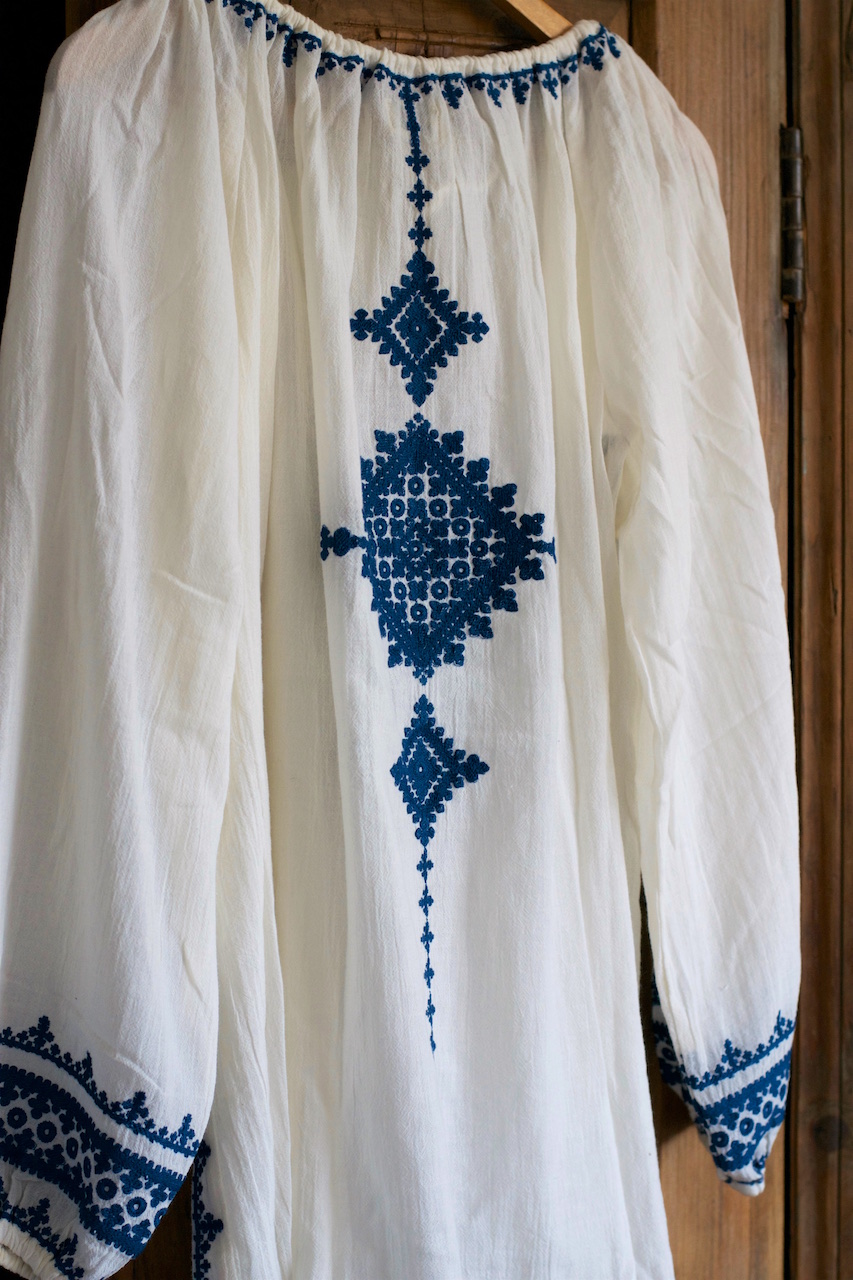
Do you know the feeling to hold a new and special garment in your hands, designed with depth and meaning? My wardrobe got richer when I received such an item, the Embroidered Peasant Tunic, a classic Tangier peasant blouse by Irving & Fine. It was a surprise gift from textile designer Lisa Fine (earlier this month I wrote a piece about her designs), although I kind of knew what it was when she told me she was going to send me their bestselling peasant top. I have had it for a week and the fabric feels so soft; double gauze cream cotton with blue embroidery, made in India. The Irving & Fine label is a collaboration between esteemed textile designers and friends Lisa Fine and Carolina Irving (remember her Manhattan home on the blog?), who create embroidered peasant blouses, tunics, kaftans, coats and accessories. Their design is inspired by their travels to exotic places.

This is my ode to their peasant blouse, a token of my appreciation.
A peasant blouse by Irving & Fine · Lisa Stefan


As I unwrapped the blouse and admired it for the first time, I was reminded of the Romanian-blouse paintings by Henri Matisse, with their puffy sleeves - see e.g. his works The Romanian Blouse, 1940, and The Romanian Green Blouse, 1939. He travelled to Morocco and was fascinated by the city of Tangier, the subject of some of his paintings. From Matisse in Tangier my mind, enchanted by my blouse, wandered to fashion designer Yves Saint Laurent, who had houses in Morocco; one in Tangier. YSL paid homage to Matisse with his couture collection for autumn/winter 1980-81 and one item was the Romanian blouse (see image No. 3), a replica of the one in Matisse's painting from 1940.

When preparing this piece I found a short interview with Lisa Fine. Asked about the inspiration for the Irving & Fine clothing, she replied: 'Ottoman & Eastern European folk costume and old Yves Saint Laurent' (Cannon Lewis). It sums up my first impressions.

A peasant blouse by Irving & Fine · Lisa Stefan


My photos should give you a clear idea of the design but here is the basic anatomy of the Irving & Fine classic peasant tunic: It's made of cream cotton double gauze with blue embroidery at the neckline, cuff and side seam, with embroidered medallions at the front and back. The hip length blouse has a gathered, self-tied scoop neck and bracelet-length sleeves. The blouse is made in India and is also available in indigo with cream embroidery.
Detail: A peasant blouse by Irving & Fine · Lisa Stefan


Is it unnatural to be in love with embroidered sleeves? I cannot stop admiring their beautiful exotic pattern. The same goes for the embroidered side seams. Such wonderful design details!

The tunic has a bohemian vibe but one can easily dress it up and down, depending on the occasion. It's loose and comfortable, and the cotton fabric feels very soft.
A peasant blouse by Irving & Fine · Lisa Stefan


When not wearing the blouse I leave it hanging on the wardrobe so I can look at it with pleasure and dream about the other Irving & Fine items I would like to have. They currently have an embroidered coat that I believe is taking a hold of my subconscious.

I have referred to Lisa Fine as a designer with a sense of history. I would describe her collaborator Carolina Irving in the same manner. Under their label Irving & Fine they not only design beautiful clothing for you to wear; when you put them on you feel inspired. The garments aren't a passing fad but pieces that help you to create a unique personal style.
A peasant blouse by Irving & Fine · Lisa Stefan


~ · ~

[The colours in the following images do not reflect the correct blue shade of the embroidery.
My daughter took the photos of me in the garden wearing the blouse.]


As Irving & Fine use the term a classic Tangier peasant blouse, I want to give a nod to the city, even though I haven't had the chance to visit it. I believe I have romanticised it in my mind; probably stuck in its golden era. Tangier is a vibrant city on the northern tip of Morocco, a short ferry ride away from Spain across the Strait of Gibraltar. Remember in The Living Daylights (1987) when James Bond tracks down General Pushkin in Tangier to kill him? That's when I became hooked, and I think of Tangier each time I hear the song by my Nordic brothers in A-ha. (I am yet to see Spectre (2015), also set there.) I can easily picture its cultural mix, its narrow streets and bazaar stalls where merchants offer their rugs and spices.


Talking about Tangier and leaving out its most famous expatriate, American writer, translator and former composer Paul Bowles, is like discussing the New Testament and not mentioning Jesus, or the Qur’an and not the Prophet. In 1958, in a travel article, 'The Worlds of Tangier', he wrote:
I am now convinced that Tangier is a place where the past and the present exist simultaneously in proportionate degree, where a very much alive today is given an added depth of reality by the presence of an equally alive yesterday. ... In Tangier the past is a physical reality as perceptible as the sunlight. (Paul Bowles.org).
It was Gertrude Stein who suggested to Bowles to try to live and work there. He arrived there for the second time in 1947, published The Sheltering Sky two years later (remember him as the narrator in Bertolucci's film?), and stayed for 52 years, until his death in 1999. (Patti Smith wrote about him and trips to Morocco in M Train, a book I loved reading.)


I would like to leave you with a visual dose of Tangier, a short video where other expats describe Tangier to the readers of T-Magazine (Umberto Pasti and Christopher Gibbs, to name some). You can read the article, 'The Aesthetes', in full with images on the NYT website (it's one of those bookmarks I have kept). Its author Andrew O'Hagan introduces Tangier as the 'high meeting place of the Mediterranean and the Atlantic, Europe and Africa, sanctity and sin, where men and women have long set out to find themselves between the devil and the deep blue sea.'

One day I will visit. Until then I have my Tangier blouse by Irving & Fine.
A peasant blouse by Irving & Fine · Lisa Stefan


Friday, 20 May 2016

Modigliani in the morning light

Modigliani in the morning light · Lisa Stefan


This morning, as I was refreshing our home for the weekend, I walked into the living room to find Modigliani bathed in the morning light. Not Modigliani himself, obviously, but a framed reprint of his painting Woman with Blue Eyes (1918, oil on canvas). I removed it from the wall and placed it on the mantelpiece next to the carnations and bowl of dates. If you happen to be strolling the streets of Paris, and in the mood for art, you will find the original at the Musée d'Art Moderne de la Ville de Paris.

Wherever I may be in the future I will link artist Amedeo Modigliani to this house. The owner left two framed reprints hanging in the living room that were my first impression when I entered it for the first time. A good first impression.

It is Friday, which in our world means home-made pizza and red wine this evening; a tradition we started when living in the centre of North Zealand in Denmark six years ago. But now it's coffee and inspirational reading in a clean house. Have a wonderful weekend!


Wednesday, 4 May 2016

Lisa Fine Textiles

Lisa Fine Textiles · Lisa Stefan


In a documentary by the late Albert Maysles about designer and style icon Iris Apfel, simply called Iris (2014), she has a conversation with photographer Bruce Weber. When they start talking about fashion designers that don't know how to sew - 'they are media freaks', Iris says - she mentions young designers that have 'no sense of history' (about 46 minutes into the film). Perhaps you find this an odd intro to textile designer Lisa Fine, the woman at the helm of Lisa Fine Textiles, but I think it is exactly a sense of history that drew me to Fine's work. There is depth to her design and her patterned fabrics have an exotic and mystical element.
Lisa Fine Textiles · Lisa Stefan


Only reading some of the names of Lisa Fine's beautiful fabrics could take your mind to faraway places, or make you reach for the historic atlas (the links take you to the fabric on her website): There is Aswan, a city on the east bank of the Nile River in Egypt; Luxor, another Egyptian city where you will find the ruins of the ancient city of Thebes; Lahore, a city in the Punjab province of Pakistan; Kashgar, the historic oasis city in far western China, a stop on the old Silk Road; Bagan, an ancient city in Myanmar (Burma); Baroda, the old name of Vadodara in the Indian region of Gujarat; Malabar, a region on the western coast of India, furthest south between the Arabian Sea and the Western Ghats.

I could go on.

Lisa Fine Textiles · Lisa Stefan
The Zoraya fabric in rose and monsoon

It has been years since Lisa Fine's textiles first cast their spell on me but I had never handled the fabrics (100% linen) until I received a collection of her samples in the mail. My high expectations were met. One fabric is called Zoraya (image above). I was curious about the origin of the name so yesterday, before publishing the blog post, I decided to send a request to the office, which was promptly replied with Fine's explanation of how she came up with the name for the pattern. Soraya was the name of one of the wives of the last Shah of Iran, who ruled from 1941 to 1979. Fine was in Andalucia in Spain and was reading the history of the North Africans and Persians in Spain when she came across the name with Z, Zoraya. 'I thought the pattern had a very geometric almost ancient Persian look and liked the name Zoraya.'

A designer with a sense of history for sure.

Lisa Fine Textiles · Lisa Stefan
In the foreground: Malabar Reverse in Nordic blue

In the world of textiles and interior design it is unlikely that the name of Lisa Fine has escaped you. Recently in the American House Beautiful, there was a feature on her mother's home in Dallas, designed by the daughter, of course. (There is a book called Iznik on her mother's coffee table that I want!) Her mother gave her free rein with the space and the happy customer had just one 'complaint' about the outcome: 'The only problem is, when people come over they don't want to leave.'

Lisa Fine's colourful flat in Paris has been featured in publications like Lonny (a pdf with the feature itself and larger images here) and The New York Times (more images from the NYT feature at Apartment Therapy). Her collaboration with designer Richard Keith Langham has resulted in stunning Indian dhurries. Then there is the collaboration with textile designer Carolina Irving, Irving & Fine, where you can purchase their patterned and embroidered tunics and kaftans.

Lisa Fine Textiles · Lisa Stefan

Left: Samode in indigo/natural (also spotted in desert sand); Lahore in apricot.
Right (in frame): Baroda II in pomegranate (pattern with bird); Zoraya
in monsoon; Luxor in pompeii on ivory (orange one)

Each time I see a feature on Lisa Fine I can easily resonate with the books she has read; like me, biographies and travel writing seem to be her genre. She has travelled extensively, e.g. throughout India, and her textile design is inspired by it. I remember this one particular feature that I came across online. It had a photo collage and she was asked all kinds of questions. The final one was where she would like to go and she said Isfahan in Iran, but added that she didn't think it would be possible (when researching for this post I found it on her website: Material Connection, Ultra Travel, Summer 2012). Now that the international sanctions on Iran have been lifted, and the US-Iran relations are improving, Isfahan (Eṣfahān) seems a possibility in the future. I can only imagine the inspiration she could take from the historic Islamic architecture, its splendours and gorgeous tiles. Especially with her sense of history.

Lisa Fine Textiles · Lisa Stefan
In the foreground: Kashgar in spice. In the background: Chiara in sky blue/oyster.
Also spotted: Bagan in indigo