Showing posts with label novels. Show all posts

Tuesday, 22 March 2022

№ 30 reading list: Proust in spring

My № 30 reading list: stack of books; Marcel Proust, Lydia Davis, Siri Hustvedt · Lisa Stefan


Spring has arrived and it's time to update the blog with a new reading list. I shared the last one in January but in my defence, I'm more active on my Instagram account with book-related content. For over a decade I have wanted to read Marcel Proust’s masterpiece In Search of Lost Time (À la recherche du temps perdu) and recently bought the 1st volume of 4 by Everyman’s Library. The novel has seven parts and this volume contains Swann's Way (Du côté de chez Swann), which most are familiar with, and the first part of Within a Budding Grove (À l'ombre des jeunes filles en fleurs). I’m only a few pages in and am already captivated by the narrative voice and the rich prose. Proust in spring will be a gratifying pastime.

№ 30 reading list:

1  Essays Two  · Lydia Davis
2  Swann's Way  · Marcel Proust
3  What I Loved  · Siri Hustvedt
4  Der Untergeher  · Thomas Bernhard [German]
5  The Makioka Sisters  · Jun'ichirō Tanizaki [rereading]

Translated by: 1) Swann's Way: C. K. Scott Moncrieff and Terence Kilmartin;
5) The Makioka Sisters: Edward G. Seidensticker

Reading Essays Two spurred me on to read Proust. Lydia Davis translated the latest available English edition of Swann's Way and discusses the project in some of the essays. (The Moncrieff translation I’m reading is older but has been updated.) These essays are my first Davis and I’m also reading Siri Hustvedt’s fiction for the first time. A fun fact: Hustvedt has been married to American writer Paul Auster (4 3 2 1, The New York Trilogy) for forty years who before was married to Davis.

I have mentioned before that each time I’m disappointed with a book and decide to toss it I reread one of my favourite books. On my last list, I had My Brilliant Friend by Elena Ferrante, the first book of her Neapolitan Quartet. I truly made an effort but gave up on Chapter 20. Neither the plot nor the characters appealed to me, and the style felt repetitive. To make it up to me I decided to reread The Makioka Sisters, a Japanese classic by Tanizaki. Before going to sleep, it's comforting to spend some time in the company of the Sisters.

Richard Diebenkorn, Untitled, 1981

image by me | Diebenkorn art via Richard Diebenkorn Foundation on Instagram


Friday, 7 January 2022

№ 29 reading list: Woolf starts the new year

My № 29 reading list: stack of books; Virginia Woolf, Iris Murdoch, Elena Ferrante · Lisa Stefan


Happy New Year! This week I realised that I completely forgot my New Year's tradition, reading Little Women into the new year. This tradition started in Scotland; I used to read a few pages or chapters into the new year while others were letting off fireworks or whatever entertains them, but this year I watched the fireworks with my son. I made up for my forgetfulness by watching Greta Gerwig's film adaptation (2019), starring Saoirse Ronan, Florence Pugh and Timothée Chalamet. It's great. On New Year's Day morning, I relaxed on the daybed in pyjama bottoms and kimono with coffee and the fourth volume of Virginia Woolf's diary, which starts in 1931. It's on my new reading list.

№ 29 reading list:

1  My Brilliant Friend  · Elena Ferrante
2  The Diary of Virginia Woolf, Volume 4 1931-35 
3  Mrs Dalloway  · Virginia Woolf [rereading]
4  Mythos: The Greek Myths Retold  · Stephen Fry
5  Wittgensteins Neffe: Eine Freundschaft  · Thomas Bernhard [German]
6  Póetík í Reykjavík: Erindi 14 höfunda  [Icelandic]
7  Living on Paper: Letters from Iris Murdoch 1934-1995  · edited by Avril
Horner and Anne Rowe

Translated by: 1) My Brilliant Friend: Ann Goldstein

The list has undergone many changes. Stephen Fry and the Icelandic book (14 literary essays) are the only works that were on the original one, which I meant to share last autumn. I don’t know why it took so long to put this one together, probably a mixture of being busy with my studies and restlessness. I read a few pages, even a few chapters, in a book that I wanted to have on the list only to put that same book aside a short time later. Wanting to read a book is sometimes not enough for me, the time and place have to be right.
№ 29 reading list: stack of books; coffee · Lisa Stefan


I found many wonderful books under the Christmas tree which will appear on lists in the near future. I gave myself a few, e.g. used books that have never been read. Among these are the first two books of the Neapolitan Quartet by Elena Ferrante, the pseudonymous Italian writer. I also bought the Everyman's Library edition of The Makioka Sisters by the Japanese writer Jun'ichirō Tanizaki (№ 6). It's one of my all-time favourite books.

Richard Diebenkorn, Untitled, 1949

images by me | Diebenkorn art via fan page on Twitter


Monday, 13 December 2021

Virginia Woolf – ‘darling dangerous woman‘

Virginia Woolf in lockdown, the cover of Mrs Dalloway · Lisa Stefan


Last year I fell for this cover of Mrs Dalloway you can see in the picture. So much so that I ordered a used copy that looked like new, which never arrived. To make up for it, I decided to buy a new copy for myself as a Christmas present, but I couldn't bring myself to gift wrap it, even though I had already read the book. Instead, Virginia Woolf's novel became my second lockdown book, with Iris Murdoch's Letters.

It so happens that Murdoch mentions Woolf in a letter she writes on Christmas Eve in 1941:
The trouble is, I have been reading Virginia Woolf, the darling dangerous woman, and am in a state of extremely nervous self-consciousness. The most selfish of all states to be in.
‘Darling dangerous woman‘ – love this description.

Each time I reread Woolf it comes more apparent to me how talented she was. The details in her writing, the way she observes people and their behaviour, are extraordinary. I enjoy reading her diaries and often reach for the volumes on my shelves. In her diary, 19 June 1923, Woolf has this to say about the writing of Mrs Dalloway (its working title was The Hours):
But now what do I feel about my writing?—this book, that is, The Hours, if thats its name? One must write from deep feeling, said Dostoevsky. And do I? Or do I fabricate with words, loving them as I do? No I think not. In this book I have almost too many ideas. I want to give life & death, sanity & insanity; I want to criticise the social system, & to show it at work, at its most intense— But here I may be posing.
Yesterday I shared the pic on Instagram with a similar caption but I wanted to keep these quotes on the blog as well. We are still in lockdown which is supposed to end on the 17th of December. Yesterday, other Austrian states lifted most restrictions but this latest wave was severer in Upper Austria and we knew that our lockdown would last longer.

image mine, appeared on Instagram 12/12/21


Tuesday, 5 January 2021

№ 25 reading list: women only

№ 25 reading list: a stack of books by women only · Lisa Stefan


Happy New Year! I would like to start the year with a new reading list, consisting of books by women only. As you probably know, Elizabeth Hardwick is a great favourite; her essay collection Seduction and Betrayal features female writers and women in literature. It so happens that Joan Didion, who has a book on the list, writes the introduction to the collection, which includes an essay about the Bloomsbury group and Virginia Woolf, who is also on the list.

№ 25 reading list:

1  Seduction and Betrayal  · Elizabeth Hardwick
2  Ninth Street Women  · Mary Gabriel
3  Approaching Eye Level  · Vivian Gornick
4  Intimations: Six Essays  · Zadie Smith
5  On Beauty  · Zadie Smith
6  The Waves  · Virginia Woolf [rereading]
7  Slouching Towards Bethlehem  · Joan Didion [rereading]

I have to confess that the list has been so long in the blog's draft that I have already read five of the seven books. I'm not far into the Mary Gabriel one - its snappy full title is Ninth Street Women: Lee Krasner, Elaine de Kooning, Grace Hartigan, Joan Mitchell, and Helen Frankenthaler: Five Painters and the Movement That Changed Modern Art - but can already recommend it. Gail Levin's biography of Lee Krasner was on my № 24 reading list. I can also recommend that one but if I had to choose between the two I would pick Ninth Street Women. Even though Gabriel doesn't go into details about the artists' childhoods, I find her book more enjoyable to read. It's also better designed and images of artworks are in colour. Levin's book about Krasner is obviously well researched but the text is sometimes too academic for my taste which restricts its flow. In my copy, a William Morrow paperback, the paper is of poorer quality and the images of Krasner's artwork are in black and white only.

Painting by Lee Krasner, The Seasons, 1957, Pollock-Krasner Foundation / Whitney Museum of American Art · Books & Latte
Lee Krasner, The Seasons, 1957

images mine, the 2nd appeared on Instagram 05/11/20 | Lee Krasner artwork, Pollock-Krasner Foundation / Whitney Museum of American Art via Haus der Kunst


Saturday, 29 August 2020

№ 24 reading list: rereading the classics

My № 24 reading list: rereading the classics · Lisa Stefan


My autumn term is about to start and I would like to share this reading list before I get busy. A rereading of classics characterises the list. At the start of this summer, when facing restrictions due to the pandemic, I felt the urge to reread certain books, preferably on a bench in a castle garden nearby. I have finished Edna O'Brien's memoir, Country Girl, and highly recommend it. She is a wonderful storyteller. The story takes off when she leaves Ireland and writes about life in sixties London, about literature and writing. I often found it difficult to put the book down.

№ 24 reading list:

1  Country Girl · Edna O'Brien
2  Lee Krasner: A Biography · Gail Levin
3  Museum Activism  edited by Robert R. Janes and Richard Sandell
4  The Varieties of Religious Experience · William James
5  One Hundred Years of Solitude · Gabriel García Márquez *
6  Crime and Punishment · Fyodor Dostoevsky * [audiobook]
7  War and Peace · Leo Tolstoy *
8  Sense and Sensibility · Jane Austen *
9  Independent People · Halldór Kiljan Laxness *

* Rereadings.

These days War and Peace is my bedtime reading - one of my favourite novels. I don‘t understand those who complain about its length. The chapters are short and I always want to read 'just one more'. By accident, I stumbled upon an audiobook of Crime and Punishment, my first audiobook ever. I truly enjoyed it; the narrator was great. Independent People is written by Iceland‘s only Nobel Laureate. When hearing an Icelandic actor narrate it on the radio there was no turning back. Laxness had to be on the list.

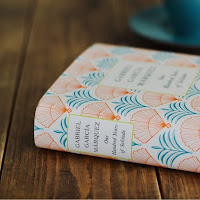
A hardcover edition of One Hundred Years of Solitude by Gabriel García Márquez · Lisa Stefan
Speaking of Nobel Laureates: On my birthday in July, my oldest gave me this beautiful hardcover edition of Márquez's book. A few years ago, I decided to reread his book Love in the Time of Cholera. I loved reconnecting with it but about 150 pages in my interest faded. I realised I had changed as a reader and the story no longer appealed to me. I was a bit worried the same would happen with One Hundred Years of Solitude but, fortunately, it didn‘t.

A few words about the book by William James (Henry‘s older brother). I didn‘t know anything about it until I listened to a wonderful episode on The Backlisted Podcast. Their guest was John Williams of The New York Times Book Review and they were talking about this book, which contains lectures given by James at the University of Edinburgh in 1901 and 1902. This is an interesting book, a little dry in the beginning but improves when you reach the third chapter.

I would like to thank Routledge for the museum studies textbook on the list, which deals with the notion of activism as part of museum practice. Apart from the introduction by its editors, the book contains 33 articles by more than 50 scholars in the field. Through my studies I have become aware of the editors' research; in a course on the spring term, we even read a chapter from this book.

Museum Activism, published by Routledge · Lisa Stefan
Museum Activism, published by Routledge / Instagram

These days I‘m enjoying the annual Edinburgh International Book Festival. This year, due to the pandemic, all events are free online. What a feast for book lovers! My list of books-to-read is already longer and I'm particularly interested in Shuggie Bain, a debut by the Scottish author Douglas Stuart. It is longlisted for the Booker this year and in mid-September we will know if it makes it to the shortlist. At the beginning of the festival, the aforementioned John Williams talked to Stuart and other authors for The New York Times Book Review and this week there was another event featuring Stuart. He strikes me as a sincere writer; someone to watch in the future.


Thursday, 20 August 2020

Strange Flowers · Donal Ryan

The cover of Strange Flowers by Donal Ryan (Doubleday) · Books & Latte


For more than two months I have been waiting to share this cover with you, which I find incredibly beautiful. The colour palette adds to it an autumnal quality. Strange Flowers is a new novel by Irish writer Donal Ryan. No one forbade me to share the cover sooner; I was the one who wanted to wait until publication day. The story begins in 1973 when the twenty-year-old Moll Gladney steps on a bus one morning and disappears. Five years later she returns, not alone, which changes the life of her family forever. I have only read one novel by Ryan and intend to read them all. His writing style appeals to me. As I have mentioned before, I like Irish writers.

Cover illustration: Owen Gent

Strange Flowers
By Donal Ryan
Hardback, 240 pages
ISBN: 9781784163044
Doubleday


Thursday, 11 June 2020

James & Nora · Edna O'Brien

The cover of James & Nora: A Portrait of a Marriage by Edna O'Brien (W&N) · Books & Latte


Out today in paperback is James & Nora: A Portrait of a Marriage by Irish writer Edna O‘Brien, published by W&N. This is a reissue of a slim book, originally published in the US in 1981, with O'Brien‘s portrait of Irish writer James Joyce and Nora Barnacle‘s marriage. The timing of its release is no coincidence, just in time for Bloomsday on June 16, celebrated by many fans of Joyce. It's named after the protagonist Leopold Bloom in his work Ulysses, which takes place on that day in 1904.

Cover image: Nora Barnacle and James Joyce by artist John Nolan

Edna O'Brien was awarded the prestigious David Cohen Prize in 2019, given to British or Irish writers for a lifetime achievement in literature. Her first novel was The Country Girls, published in 1960. It caused a scandal in Ireland and was both banned and burned. O‘Brien's large body of work consists of novels, short stories, plays, poems, non-fiction, and her memoir Country Girl.

James & Nora: A Portrait of a Marriage
By Edna O'Brien
Paperback, 80 pages
ISBN: 9781474616812
Weidenfeld & Nicolson


Friday, 15 May 2020

Virginia Woolf Editions


The cover of Mrs Dalloway by Virginia Woolf (Houghton Mifflin Harcourt publication) · Books & Latte


Mrs Dalloway said she would buy the flowers herself. 

Do you recognise this first sentence of Mrs Dalloway, Virginia Woolf's classic novel? The book was first published on 14 May 1925 by Hogarth Press, which she and her husband Leonard Woolf set up. Her sister, artist Vanessa Bell, designed the dust jacket. My next blog post was supposed to be a reading journal entry but I couldn't get these six old paperback editions out of my head after spotting them on Instagram yesterday - Mrs Dalloway Day. Here we have the covers of Mrs Dalloway, Three Guineas, and Orlando, which I have added to my wish list. If only they were hardcovers.
The cover of Three Guineas by Virginia Woolf (Mariner Books) · Books & Latte
The cover of Orlando by Virginia Woolf (Houghton Mifflin Harcourt publication) · Books & Latte


Mrs Dalloway; Three Guineas; Orlando
By Virginia Woolf
Paperback, 224; 192; 352 pages
Mariner Books


Friday, 10 January 2020

Reading journal: Whitehead, Baldwin & Brecht

Coffee and Brecht; notes from my reading journal · Lisa Stefan


School has started and I'm easing into the term, still taking moments every day to read the books on my latest reading list before the workload increases and deadlines take over. I have finished Patti Smith's Year of the Monkey which, for me, never quite took off, if we can use that phrase for a melancholy memoir that is partly about loss. The presence of the late Sam Shepard on the pages saves it. I'm a fan of Patti's writing, of her 'writing about nothing', as she explains in the book M Train, but here something is missing. The book has been praised but descriptions of dreams and diner food just didn't work for me. I wish she had waited and written about her trip to Australia the year after (among the many photos in the book is one she took of Uluru/Ayers Rock), but then the book would have had a different title.

Let us move on to the reading journal, the last entry for the 2017 reading lists. I know, I know, we have been through this.

Reading journal, № 13 reading list, 3 of 4:

· The Underground Railroad by Colson Whitehead. This novel won both the 2017 Pulitzer Prize and the 2016 National Book Award for fiction, and in 2016 it was Oprah's Book Club pick. Perhaps this has done it some disservice because readers probably expect a literary masterpiece. Despite the grave subject matter, slavery, it's very readable, and I find my mind going back to it. To the story itself, not its characters. My only quibble over the novel was the characterisation, which I didn't find particularly strong. The main character, Cora, didn't make a great impression on me but what has stayed with me is that her story is the story of too many. The title refers to the network of secret routes to help slaves escape to the free states. However, Whitehead uses magical realism and gives it a physical form, which I thought would bother me, but didn't. I haven't read any of his other books but intend to, definitely. He's a good storyteller.

· Giovanni's Room by James Baldwin. I wanted to like this book more than I did. Don't get me wrong, I liked it but I didn't love it. The Giovanni character annoyed me (although I did sympathise with him in the end) and I didn't believe that someone like David would fall for someone like Giovanni. This scene, though, has stayed with me, the night they meet at a bar in 1950s Paris:
And he took his round metal tray and moved out into the crowd. I watched him as he moved. And then I watched their faces, watching him. And then I was afraid. I knew that they were watching, had been watching both of us. They knew that they had witnessed a beginning and now they would not cease to watch until they saw the end.
This was my second book by Baldwin (I have since read more) but the first one I read, Another Country, remains my favourite.

· Der Gute Mensch von Sezuan by Bertolt Brecht. This play was the first German text I read after the move to Germany in 2017, an attempt to reclaim some of my vocabulary (there was a time when I read novels in German effortlessly). I didn't get every word but I got the meaning and enjoyed the play, which is set in China. It's a parable play about three gods that come down to earth to find one good person. The prostitute Shen Te is the only person who takes them in when they need a place to stay. Consequently, she gives up her profession and buys a tobacco shop for money they give her. Trying to be good in a corrupt world becomes difficult and she invents an alter ego, her cousin Shui Ta, to be able to run her business. In 1933 Brecht left Nazi Germany and this is one of the many plays he wrote in exile during World War II. His next play on my list is Mutter Courage und ihre Kinder (Mother Courage and Her Children).

image by me, appeared on Instagram 11/11/2017


Saturday, 14 December 2019

Sleepless Nights · Elizabeth Hardwick

The cover of Sleepless Nights by Elizabeth Hardwick (Faber) · Books & Latte


I have fallen so hard for Elizabeth Hardwick since reading a collection of her essays released in 2017. I had already put Sleepless Nights (1979) on my to-read list when Faber & Faber released this new edition last summer, which they describe as 'a kaleidoscopic scrapbook of one woman’s memories; a collage of fiction and memoir, letters and essays, portraits and dreams, and one of the greatest New York novels of all time.'

Cover image: © Daido Moriyama Photo Foundation
Cover design: Faber

Simultaneously, Faber also released her essay collection Seduction and Betrayal (1974), which you will find on a reading list one day. Another book I have added to my wish list is the newly published, in the US, The Dolphin Letters, 1970-1979: Elizabeth Hardwick, Robert Lowell, and Their Circle, edited by Saskia Hamilton (FSG).

Sleepless Nights
By Elizabeth Hardwick
Paperback, 144 pages
ISBN: 9780571346998
Faber & Faber


Tuesday, 11 June 2019

№ 21 reading list: essays by Zambra

№ 21 reading list: Alejandro Zambra, Grace Paley, Virginia Woolf, Anna Burns · Lisa Stefan


Well, it's time for the summer's first reading list. In keeping with tradition, it has an essay collection, Not to Read by Chilean writer Alejandro Zambra (No Leer in Spanish). In the opening essay he, as a kid, admits to watching Madame Bovary (1949) for an exam instead of finishing the book. Next to a red F his teacher wrote: 'Vincente Minnelli!!' These short essays are the book lovers' treat. I meant to include a novel I had started reading, The Friend by Sigrid Nunez which won the 2018 National Book Award. I found it interesting, especially the literary references (the narrator is a writer), but then I got bored of the writing style and I didn't finish it. It's therapeutic to reread something good after a disappointing read; I chose The Seagull by the Russian playwright Anton Chekhov.

№ 21 reading list:
1  Not to Read  by Alejandro Zambra
2  The Collected Stories of Grace Paley 
3  Milkman  by Anna Burns
4  Disgrace  by J. M. Coetzee
5  The Voyage Out  by Virginia Woolf
6  Journal of Katherine Mansfield  ed. by John Middleton Murry
7  The Seagull  by Anton Chekhov

Translated by: 1) Not to Read: Megan McDowell; 7) The Seagull: Laurence Senelick

Those who follow my blog know that Virginia Woolf is one of my favourites. The Bremen University Library has old editions of all her works by Hogarth Press, which she founded with her husband Leonard. They are attractively green hardbacks and initially, I borrowed The Voyage Out, her first novel, just to leaf through it. It's not my favourite book by Woolf but I couldn't resist the temptation and decided to read it again.
№ 21 reading list: Alejandro Zambra, Grace Paley, Virginia Woolf, Anna Burns · Lisa Stefan


Sometimes, I have to admit, I do miss my old way of blogging, when I collected images of interiors in folders and couldn't wait to share them. As you may have noticed, I sometimes use images of paintings in my blog posts, but this time I decided to add two spaces in the Chelsea home of artist Sarah Graham, featured in House & Garden UK. These artistic corners - that glimpse of the coffee table and the bookshelf by with window - spoke to my inner interior enthusiast. Elegant and tasteful.

Chelsea home of artist Sarah Graham. House & Garden UK · Greg Funnell | Books & Latte

Chelsea home of artist Sarah Graham. House & Garden UK

images by me | credit: House & Garden UK · Greg Funnell