Friday, 17 June 2016

№ 2 reading list: bookshelf styling

№ 2 reading list: bookshelf styling · Lisa Stefan


I have a bookshelf crush. Not my first. The July issue of Elle Decoration UK has a feature that has had me swooning just a little with my coffee, a home in LA that has so many right touches ('House on the Hills', photographed by Stephanie Bjelkstam). The open shelves in the living room display an uncluttered mix of books and decorative objects; books arranged both vertically and horizontally, adding visual interest. The shelves seem to breathe and echo the rug on the floor. Beautifully done. These days I'm reading a few books and soon I will be reviewing one of them on the blog: Decorative Textiles from Arab and Islamic Cultures: Selections from the Al Lulwa Collection. That Egyptian cotton appliqué to the left is a little preview.

My summer reading list is ready (I should probably call it my early summer reading list) and consists of plays and autobiographical writing. Recently I returned playwright Arthur Miller's memoir Timebends (wonderfully written, highly recommend it) to the library and picked up two of his plays. On the same day I was browsing online for works by Virginia Woolf and was lucky to find two used copies (vol. 3 of her diary has arrived and looks like new - love it). Here is my list:

1  All My Sons  by Arthur Miller
2  Death of a Salesman  by Arthur Miller
3  Off the Road: Twenty Years with Cassady, Kerouac and Ginsberg  by
Carolyn Cassady
4  The Diary of Virginia Woolf - Volume 3: 1925-1930  edited by Anne
Olivier Bell
5  The Letters of Virginia Woolf - Volume II: 1912-1922  edited by Nigel
Nicolson and Joanne Trautmann)
6  Testament of Youth: An Autobiographical Study of the Years 1900-1925 
by Vera Brittain

Some people would perhaps call this a bit heavy reading in summertime but I'm just not one of those readers who pick up a stack of quick-reads at the local bookshop. My children were making fun of me recently, saying that I read weird books. I'm trying to remember the exact phrase one of them used, 'English upper-class snob literature' or something like that. It cracked me up.


On a more personal note: It's the National Day of Iceland and my husband and I celebrate our 18th wedding anniversary. It's also Friday pizza day but he's abroad for work. The children and I are going for French cheese, baguette and grapes ... and chocolate. Have a wonderful weekend!

images by me | credit - top photo: Elle Decoration UK, July 2016, p. 116 · Stephanie Bjelkstam


Monday, 6 June 2016

Walnut chocolate fudge cake with raspberries

Walnut chocolate fudge cake with raspberries (vegan) · Lisa Stefan


It was a warm summer in 2010 and we had just moved to Antwerp, where we lived for two years. Our son's birthday was coming up and he asked me to make this walnut chocolate fudge cake with raspberries that needs no baking. He had seen it in Ani's Raw Food Desserts by Ani Phyo and his mind was set. A fudge cake and Playmo and our five-year old was happy. The original recipe, called raspberry ganache fudge cake, had two layers with frosting and raspberries between them. I made it, we loved it, but after only one slice we were full. For us the two layers were simply too much. I reduced the cake's size and my version is one layer with frosting and berries on top. The beauty of making the cake is its simplicity: There is no soaking of nuts or dates needed; everything is mixed in a food processor. The cake is shaped and ready to serve. Excellent on summer days when you're craving a chocolate cake but it's too warm to turn on the oven.


One of the reasons why I love this cake so much is that it has two of my favourite foods: walnuts and raspberries. Walnuts are an excellent source of (plant-based) omega-3 fatty acids. They are considered good for the heart and they have anti-inflammatory benefits. I read in my Larousse Culinary Encyclopedia that the ancient Greeks and Romans believed walnuts cured headaches because of the shape of the kernel, which looks like the two halves of a brain (p. 1143). In the same food bible I read about 'the nymph Ida prick[ing] her finger while picking berries for the young Jupiter and thus raspberries, which had been white until then, turned red' (p. 861). Let's leave the mythology and make the cake.
Walnut chocolate fudge cake with raspberries (vegan) · Lisa Stefan


This walnut chocolate fudge cake recipe is adapted from the aforementioned book by Ani Phyo, which is filled with delicious raw treats. I have reduced the cake's size, as we prefer one layer, with the frosting and raspberries on top. Phyo's recipe calls for dry walnuts (first soaked, then dried in the sun or in a dehydrator) but I simply use walnuts without soaking them. Some people are sensitive to caffeine and in such cases you can substitute the cocoa powder in the fudge cake for carob powder. The original recipe calls for pitted Medjool dates, which are soft and don't need soaking. You can of course use pitted dried dates instead and soak them first. The original frosting recipe has agave syrup but I use pure maple syrup instead. The cake can be refrigerated for up to 3 days.

WALNUT CHOCOLATE FUDGE CAKE WITH RASPBERRIES

fudge cake
220 g walnuts (2 cups)
50 g cocoa powder (¼ cup + 2 heaped Tbs)
scant ¼ teaspoon fine sea/Himalayan salt
175 g pitted Medjool dates (scant 1 cup)

frosting
60 g pitted Medjool dates (about ¼ cup)
40 ml pure maple syrup (scant 3 Tbs)
70 g ripe avocado flesh (⅓ cup)
30 g cocoa powder (¼ cup)

topping: 70-100 g raspberries (about ½ cup)

To make the fudge cake, combine the walnuts, cocoa powder and salt in a food processor and pulse until coarsely mixed. Avoid over-processing. Add the dates and pulse until mixed well. Use your fingertips to feel the texture of the batch and add one or two Medjool dates if it feels dry. Using your hands, shape into a cake of desired size on a plate (I like mine 18-19 cm (about 7 inches)). Set aside.

To make the frosting, combine the dates and maple syrup in the food processor and process until as smooth as possible. Add the avocado and process until smooth. Add the cocoa powder and process until smooth.

To serve, spread the frosting over the cake and top with fresh raspberries.


Uppskrift á íslensku.

If using pitted dried dates, instead of Medjool dates, chop them first and soak them in water for at least 30 minutes. Do not discard the soaking water, as you may need some of it to get the right texture, both for the cake and the frosting (depends on how good your food processor is). Instead of walnuts only for the fudge cake you can subsitute one cup for a blend of pecans, almonds and cashew nuts.


Saturday, 28 May 2016

My peasant blouse by Irving & Fine

A peasant blouse by Irving & Fine · Lisa Stefan


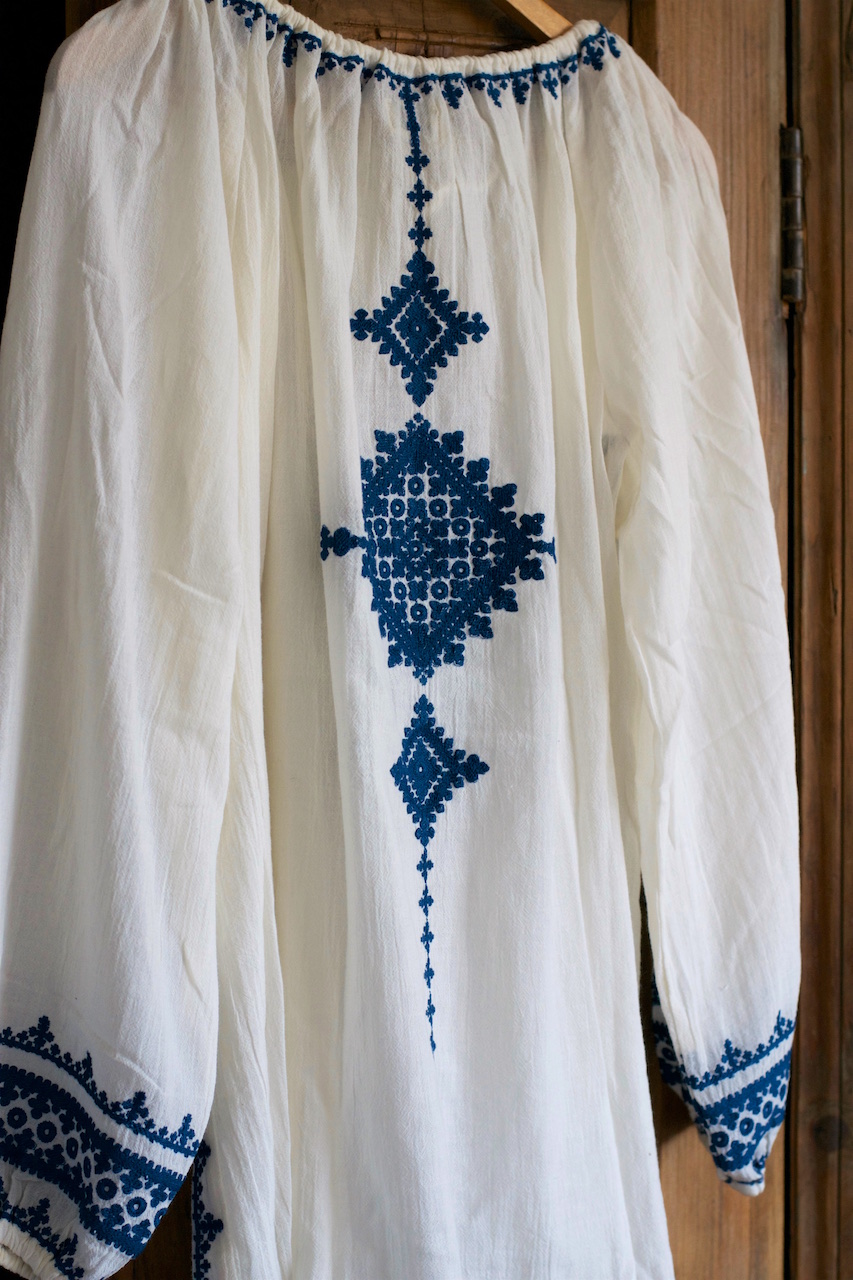
Do you know the feeling to hold a new and special garment in your hands, designed with depth and meaning? My wardrobe got richer when I received such an item, the Embroidered Peasant Tunic, a classic Tangier peasant blouse by Irving & Fine. It was a surprise gift from textile designer Lisa Fine (earlier this month I wrote a piece about her designs), although I kind of knew what it was when she told me she was going to send me their bestselling peasant top. I have had it for a week and the fabric feels so soft; double gauze cream cotton with blue embroidery, made in India. The Irving & Fine label is a collaboration between esteemed textile designers and friends Lisa Fine and Carolina Irving (remember her Manhattan home on the blog?), who create embroidered peasant blouses, tunics, kaftans, coats and accessories. Their design is inspired by their travels to exotic places.

This is my ode to their peasant blouse, a token of my appreciation.
A peasant blouse by Irving & Fine · Lisa Stefan


As I unwrapped the blouse and admired it for the first time, I was reminded of the Romanian-blouse paintings by Henri Matisse, with their puffy sleeves - see e.g. his works The Romanian Blouse, 1940, and The Romanian Green Blouse, 1939. He travelled to Morocco and was fascinated by the city of Tangier, the subject of some of his paintings. From Matisse in Tangier my mind, enchanted by my blouse, wandered to fashion designer Yves Saint Laurent, who had houses in Morocco; one in Tangier. YSL paid homage to Matisse with his couture collection for autumn/winter 1980-81 and one item was the Romanian blouse (see image No. 3), a replica of the one in Matisse's painting from 1940.

When preparing this piece I found a short interview with Lisa Fine. Asked about the inspiration for the Irving & Fine clothing, she replied: 'Ottoman & Eastern European folk costume and old Yves Saint Laurent' (Cannon Lewis). It sums up my first impressions.

A peasant blouse by Irving & Fine · Lisa Stefan


My photos should give you a clear idea of the design but here is the basic anatomy of the Irving & Fine classic peasant tunic: It's made of cream cotton double gauze with blue embroidery at the neckline, cuff and side seam, with embroidered medallions at the front and back. The hip length blouse has a gathered, self-tied scoop neck and bracelet-length sleeves. The blouse is made in India and is also available in indigo with cream embroidery.
Detail: A peasant blouse by Irving & Fine · Lisa Stefan


Is it unnatural to be in love with embroidered sleeves? I cannot stop admiring their beautiful exotic pattern. The same goes for the embroidered side seams. Such wonderful design details!

The tunic has a bohemian vibe but one can easily dress it up and down, depending on the occasion. It's loose and comfortable, and the cotton fabric feels very soft.
A peasant blouse by Irving & Fine · Lisa Stefan


When not wearing the blouse I leave it hanging on the wardrobe so I can look at it with pleasure and dream about the other Irving & Fine items I would like to have. They currently have an embroidered coat that I believe is taking a hold of my subconscious.

I have referred to Lisa Fine as a designer with a sense of history. I would describe her collaborator Carolina Irving in the same manner. Under their label Irving & Fine they not only design beautiful clothing for you to wear; when you put them on you feel inspired. The garments aren't a passing fad but pieces that help you to create a unique personal style.
A peasant blouse by Irving & Fine · Lisa Stefan


~ · ~

[The colours in the following images do not reflect the correct blue shade of the embroidery.
My daughter took the photos of me in the garden wearing the blouse.]


As Irving & Fine use the term a classic Tangier peasant blouse, I want to give a nod to the city, even though I haven't had the chance to visit it. I believe I have romanticised it in my mind; probably stuck in its golden era. Tangier is a vibrant city on the northern tip of Morocco, a short ferry ride away from Spain across the Strait of Gibraltar. Remember in The Living Daylights (1987) when James Bond tracks down General Pushkin in Tangier to kill him? That's when I became hooked, and I think of Tangier each time I hear the song by my Nordic brothers in A-ha. (I am yet to see Spectre (2015), also set there.) I can easily picture its cultural mix, its narrow streets and bazaar stalls where merchants offer their rugs and spices.


Talking about Tangier and leaving out its most famous expatriate, American writer, translator and former composer Paul Bowles, is like discussing the New Testament and not mentioning Jesus, or the Qur’an and not the Prophet. In 1958, in a travel article, 'The Worlds of Tangier', he wrote:
I am now convinced that Tangier is a place where the past and the present exist simultaneously in proportionate degree, where a very much alive today is given an added depth of reality by the presence of an equally alive yesterday. ... In Tangier the past is a physical reality as perceptible as the sunlight. (Paul Bowles.org).
It was Gertrude Stein who suggested to Bowles to try to live and work there. He arrived there for the second time in 1947, published The Sheltering Sky two years later (remember him as the narrator in Bertolucci's film?), and stayed for 52 years, until his death in 1999. (Patti Smith wrote about him and trips to Morocco in M Train, a book I loved reading.)


I would like to leave you with a visual dose of Tangier, a short video where other expats describe Tangier to the readers of T-Magazine (Umberto Pasti and Christopher Gibbs, to name some). You can read the article, 'The Aesthetes', in full with images on the NYT website (it's one of those bookmarks I have kept). Its author Andrew O'Hagan introduces Tangier as the 'high meeting place of the Mediterranean and the Atlantic, Europe and Africa, sanctity and sin, where men and women have long set out to find themselves between the devil and the deep blue sea.'

One day I will visit. Until then I have my Tangier blouse by Irving & Fine.
A peasant blouse by Irving & Fine · Lisa Stefan