Showing posts with label cardamom. Show all posts

Sunday, 20 January 2019

Breakfast pancakes with berries

Breakfast pancakes with berries · Lisa Stefan


Although I created this recipe nine years ago in Denmark, and have since made some changes, it will probably always remind me of a Sunday morning in Bremen. Shortly after we moved here, when we were still drowning in cardboard boxes, I felt we needed to start the day with a family gathering at the table. I had raspberries in the freezer and decided to make breakfast pancakes, which we call American pancakes in Iceland (the ones in the photo have blueberries, hence the spots on the top one). In my memory this is the first cosy weekend breakfast in our new home. Usually the batter yields 10 pancakes, which I serve with pure maple syrup. The cardamom is a matter of taste; a pinch of it only adds a hint of flavour.
(Measurements: 1 cup = 250 ml, 1 tablespoon/tbsp = 15 ml.)

BREAKFAST PANCAKES

260 g white spelt flour or plain flour, organic (2 cups)
2½ teaspoons baking powder, gluten-free
½ teaspoon fine sea/Himalayan salt
2 tablespoons unrefined cane sugar, organic
a pinch of ground cardamom
2 eggs, free-range
280 ml milk (1 cup and 2 tbsp)
2½ tablespoons vegetable oil
optional: frozen blueberries or raspberries

In a large bowl, sift together the dry ingredients. Separate the eggs. Whip the egg whites up with a pinch of salt until fluffy (not too stiff). Add the yolks, milk and oil to the bowl with the dry ingredients and whisk until the batter is smooth with no lumps. Add the whipped egg whites and whisk gently. Keep the berries in a separate bowl.

Heat a pan over a medium heat after wiping it with oil. Ladle batter into the pan and use the ladle to spread it. Add some berries on top. Cook for 2-3 minutes, or until golden brown on the bottom, before flipping it with a spatula to cook the other side.

(The heat probably depends on your pan. Many start with a high heat and then lower it, but I cannot do it with my pan: if it gets too hot I cannot control it. When cooking on gas one can easily adjust the heat but now I have an electric hob and find it best to lift the pan off the heat when ladling the batter. In between I brush it with oil.)

Serve the pancakes with pure maple syrup or butter. If not made with frozen berries it's ideal to enjoy them with fresh berries.

Uppskrift á íslensku


Monday, 14 December 2015

Swedish braided bread with cardamom

Recipe: Home-made Swedish braided bread with cardamom · Lisa Stefan


Swedish braided bread with cardamom is the latest recipe on our Christmas menu, a welcome new tradition that is making our Sunday brunches in December even better. Perhaps the recipe should be called Nordic or Scandinavian Christmas bread, as it isn't specifically Swedish. Some people call it coffee or tea bread but I'm used to calling it Swedish. In Finland they call it pulla and another Finnish word for it is nisu or nissua. The Norwegian bread is called julekake (Christmas cake) and has raisins in it but I don't think they necessarily braid the loaf. In Denmark I have seen teboller (tea buns) with cardamom. The ingredients in these recipes will vary slightly but the cardamom, widely used in Scandinavia, is the common factor.
Swedish braided bread with cardamom · Lisa Stefan


In Sweden they either bake a loaf or buns from the dough and usually they sprinkle pearl sugar on top, which is something you will never find in my cupboards. In some recipes the braids are formed into a ring that has been filled with butter, sugar and spices, and often topped with sliced almonds. All these Nordic recipes include butter and sugar, but it shouldn't come as a surprise that my version is less sugary and has just a bit of coconut oil instead of the butter. The bread is still soft and has a sweet taste but for us it's more about the heavenly taste of cardamom.


In my recipe I use freshly ground cardamom, from half tablespoon of cardamom pods (20-25 green ones). My first braided bread experiments included fresh yeast but I decided to experiment with dried yeast as well, in case some of my readers weren't able to buy fresh yeast (no one in this household complained, perhaps it was the cardamom coma!). The recipe calls for 735 grams of flour (5½ cups) but it's enough to use dried yeast needed for 500 grams (1 lb). I bake the bread with white spelt flour but I have also used organic plain flour, using either fresh or dried yeast, with good results. It was my intention to share a yeast-free version as well but to avoid confusion I will post it separately some other time.
Fresh from the oven: Swedish braided bread with cardamom · Lisa Stefan


I have told you before that I have Danish ancestors and was brought up in Iceland with quite many Danish traditions. However, I don't remember ever having seen braided bread on the table or buns with cardamom. The look of the bread has always fascinated me and I wanted to make my own version, as I have found the breads I have tasted too sugary. It isn't complicated to bake the bread, it just takes time as you first have to activate the yeast and then allow the dough to rise two times, first for an hour and then for 30-40 minutes after the loaves have been braided. If you don't know how to braid don't let it stop you, just make regular loaves instead. As I said before, my version of braided bread contains no butter and is less sugary than the recipes I have come across. Let's just say that in my recipe the scent of cardamom plays a leading role.

SWEDISH BRAIDED BREAD WITH CARDAMOM

makes 2 loaves
17 g fresh yeast + 125 ml warm water (½ cup) to activate the yeast
  (or dried yeast for 500 g of flour - see notes in ivory box below)
185 ml milk (¾ cup)
4 tablespoons organic unrefined cane sugar
2 tablespoons coconut oil
1 teaspoon sea/Himalayan salt
½ tablespoon cardamom pods (or ground cardamom)
1 egg, free-range
135 g + 600 g white spelt flour or organic plain flour (1 + 4½ cups)
coconut oil for greasing
1 egg white for brushing

To activate the yeast: Put the fresh yeast with warm water (35-37°C /95-98.6°F) in a medium bowl. Stir gently with a spoon to dissolve the yeast and let it sit for about 5 minutes, until the surface is covered with froth. (See notes in the ivory box below if using dried yeast.)

Crack the cardamom pods with e.g. a rolling pin to remove the seeds. Crush the seeds coarsely using a mortar and pestle or a grinder. You can also wrap the seeds in baking parchment and crush them with a rolling pin.

Warm the milk in a small saucepan - do not boil it! Put sugar, coconut oil, salt and cardamom in a medium bowl. Pour the warm milk over and stir gently while dissolving the sugar and coconut oil.

In a large baking bowl, put 135 grams (1 cup) spelt flour/plain flour and egg. Break the yolk with a whisker before pouring the yeast mixture and milk mixture into the bowl. Whisk until smooth. Add the 600 grams (4½ cups) of flour and combine with a wooden spoon. Knead the dough while still in the bowl to get a feel for the texture. If it feels sticky sift some flour into the bowl and knead the dough until the texture feels right: moist but not sticky.

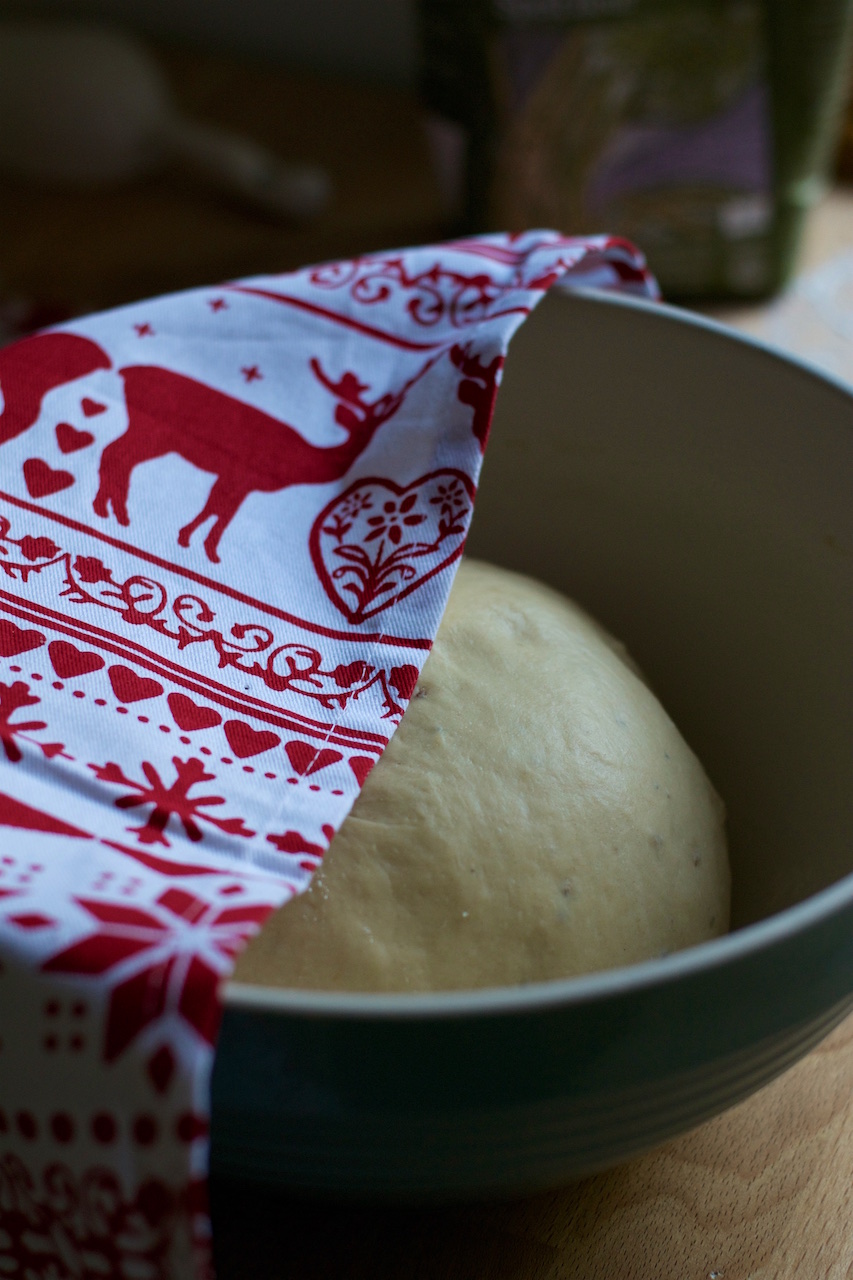
Transfer the dough to a floured surface and knead with your hands for 5-7 minutes. Grease the bowl with a little bit of coconut oil before putting the dough back in. Cover the bowl with a clean tea towel and set aside in a warm place for at least 1 hour, until it has doubled in size.

Punch the dough down and knead it slightly before dividing the dough in half, and each half into three balls. Roll the balls and shape into 6 equal ropes, 30 cm long each (about 12 inches).

Arrange 3 ropes of dough on a baking tray lined with baking parchment and pinch the ends farthest from you together. Braid the ropes and fold the ends under the loaf. Repeat with the other 3 ropes and make sure there is space between the braided loaves. Cover with a tea towel and set aside in a warm place for 30-40 minutes.

Brush the loaves with egg white before baking at 180°C/350°F (160°C fan oven) for 20-25 minutes. If you tap the bread bottom and the bread sounds hollow you will know it's done. Place the loaves on a wire cooling rack before slicing and serving with butter.

Uppskrift á íslensku.

For this recipe you can use either fresh yeast or dried yeast. Activating fresh yeast: see instructions above.

If using dried yeast: I have baked the breads with two types of dried yeast. Even though the recipe calls for 735 grams of flour (5½ cups), I use the dried yeast needed for 500 grams (1 lb) - simply follow the manufacturer's instructions on the packet, as those may vary.

One type is instant: I mix one package with the 135 grams of the flour before adding the egg and milk mixture. When I add the rest of the flour, the 600 grams, I keep 100-125 ml (about ½ cup) lukewarm water on the side and use as needed.

The other type of dried yeast I have used needs to be activated: It calls for 125-150 ml lukewarm water (1 part boiling, 2 parts cold), 1 teaspoon of sugar and 1 tablespoon of dried yeast. First you dissolve the sugar in the water in a medium bowl, and then you sprinkle the yeast into the bowl, whisk thoroughly and leave in a warm place for about 15 minutes, until the surface is covered with froth.


Thursday, 24 September 2015

Iznik pottery | Pear muffins

Iznik pottery | Pear muffins · Lisa Stefan


There are a few things to be happy for this September. A new coffee house in the next village pleasantly surprised me with stylish interior design: rustic style meets industrial. I'm finding an excuse to bicycle to the post office more often only to sit down with a book and a latte before heading back home. Then there is a feature on Iznik pottery in the latest The World of Interiors issue with mesmerising motifs and colours. Downton Abbey is back with an interesting storyline and gorgeous costume design. Did you notice Lady Mary's blue kimono-style robe? What else? The heavenly scent of pear muffins baking in the oven. The little things ...
Iznik pottery · Lisa Stefan


Let us start with that feature in the October issue of The World of Interiors, where art historian John Carswell reviews the catalogue The Ömer Koç Iznik Collection by Hülya Bilgi (600 pages, weighs 5 kilos, sold by John Sandoe Books). It shows the Iznik pottery collection of the Koç family, the wealthiest in Turkey. In his interesting review, Carswell briefly tells the story of the Iznik pottery industry from the beginning of the 15th century until its end 300 years later. In the old days, the formerly Byzantine town Iznik, 100 km south-east of Istanbul, flourished because of its position on the main trade route across Anatolia (Asia Minor) from the East. Today it's a 'sleepy little town' but in the late 13th c. it was 'one of the first centres occupied by the Ottoman dynasty'.

The images accompanying the article show fascinating motifs on tiles, jugs and dishes, painted in vivid colours. According to Carswell, the hallmarks of Iznik design were cobalt blue, turquoise, manganese purple, olive green and red. 'The designs combine purely Turkish motifs with elements transposed from imported Chinese blue-and-white porcelain' and he adds later that '[w]e have no clue why they chose a specific set of motifs and combined them in such a distinctive and particular way.'
Iznik pottery · Lisa Stefan


If you happen to be travelling to Turkey you may want to visit the Topkapi Palace in Istanbul, to enjoy Iznik tiles. The aforementioned catalogue isn't within my current book-budget but for those interested I found two less pricy books online that I would like to have a look at and perhaps offer a permanent place on my coffee table: Iznik Pottery and Tiles: In the Calouste Gulbenkian Collection by Maria d'Orey Capucho and Iznik: The Artistry of Ottoman Ceramics by Walter B. Denny.


I'm not quite done with patterns. Series 6 of Downton Abbey is upon us and I am head-over-heels in love with Lady Mary's blue kimono style robe that Michelle Dockery wore gracefully in a few scenes in the first episode. I tried to find images of it online to see the pattern in detail, but I had no luck so I just paused a scene on the ITV Player and snapped photos of my tablet (please excuse the poor quality).

I don't know whether the robe/kimono is vintage or especially designed for the show but I love its cut and colour. I think costume designer Anna Robbins is doing a great job with displaying the style of the 1920s. I have to admit that the exhausting plots of the last Downton Abbey series almost made me give up on the show but I'm glad I gave it a chance on Sunday. That first episode was promising ... at least the costumes.


Spotted in these images: Benaki wallpaper sample in blue mink (LW 198381) by Lewis & Wood
and Wild Thing fabric sample in copper cobalt (LW 188335)

October is approaching and autumn is just around the corner. It's time to embrace the season and turn the pears into muffins. You should have seen my children's happy faces the other day when these were waiting for them after school.
Recipe: Pear muffins · Lisa Stefan


These muffins are moderately sugary and stuffed with pears. Someone asked me recently why I use gluten-free baking powder when I bake with flour containing gluten. The simple reason is that the gluten-free baking powder from Doves Farm is my favourite. I don't like regular baking powder, which always seems to have an annoying aftertaste (use 50% less in the recipe if using regular). A note on choosing between the buttermilk and pureed pears for the wet mixture: It depends on whether the pears I use are juicy or slightly firm. If they are firm I like using pureed pears (I buy Hipp Organic jars in the baby food section), which give the muffins a richer pear taste. If using juicy and sweet pears I make my own buttermilk with milk and lemon juice (see tip below). American readers please note that 1 cup of flour is about 125-135 grams, which means there are about 2 cups in the recipe, depending on the type you use.

PEAR MUFFINS

3 medium-sized pears
1 large egg, free-range
75 g organic unrefined cane sugar (¼ cup)
1-1½ tablespoons honey (or pure maple syrup)
1½ tablespoons coconut oil
60 ml buttermilk or organic pureed pears (¼ cup)
200 g white spelt flour (or organic plain flour)
50 g wholemeal spelt flour
2½ teaspoons baking powder, gluten-free
¼ teaspoon fine sea/Himalayan salt
½ teaspoon ground cardamom
¼ teaspoon ground nutmeg
optional: a pinch of ground cloves

Peel and core the pears before chopping them finely. Put them aside.

Whisk together the egg, sugar, honey, buttermilk/pureed pears, and coconut oil in a bowl (if the coconut oil is solid place the closed jar in a bowl of hot water before use). If you are making home-made buttermilk let it sit in the measuring cup for a few minutes and whisk it in when it has thickened.

Measure the spelt flour, baking powder, salt and spices into another bowl.

Fold the wet mixture gently into the dry one with a spoon or a spatula and then gently stir in the finely diced pears. At first the batter may appear dry but the pears will add moisture.

Lightly grease 12 silicone muffin cups with coconut oil, spoon the batter into them and place the cups in a muffin tin. Bake at 200°C/400°F (180°C fan oven) for 22-25 minutes. When the muffins are ready, wait for a few minutes before removing them from the silicone cups and then place them on a wire cooling rack.


Uppskrift á íslensku.

If you rather want to use buttermilk instead of pureed pears, it's very easy to make your own. Pour 60 ml (¼ cup) of milk into a measuring cup and add to it 1 teaspoon of freshly squeezed lemon juice. Stir gently and let it sit for a few minutes until it has thickened.


Monday, 13 April 2015

Chai latte and textiles

Chai latte · Lisa Stefan


This morning I started feeling a little under the weather and there was only one thing that came to mind: chai latte (Indian tea). I snapped a photo of my bowl which I enjoyed with my stack of The World of Interiors. In their latest issue, May 2015, is a feature on the beautiful Welsh farmhouse, Allt-y-Bela, of garden designer Arne Maynard. I have shared the house and its garden on the blog and I don't know how often I have pinned images of both. Grab a copy of the magazine if you can!

For those interested in textile design: In the above photo my bowl is resting on a page in the October 2014 issue. It's a gorgeous feature of watercolour patterns by the textile designer William Kilburn (1745–1818). These paintings are available in a book called Mr. Kilburn's Calicos: William Kilburn's Fabric Printing Patterns from the Year 1800 by Gabriel Sempill and Simon Lawrence. It's an expensive book but I bet it's worth every penny.

The World of Interiors, October 2014, pp. 112-113

I had already posted my chai latte recipe on my old food blog but it's my intention to slowly repost the old recipes here to keep them all in one place. I have been making this tea for years and there really is no rule when it comes to preparing it (the ingredients below are more of a suggestion). You can add spices or skip them. I recommend using not too much sugar and rather allowing the flavour of the spices to play its magic.

CHAI LATTE (INDIAN TEA)

500 ml water (2 cups)
500 ml milk/soy milk (2 cups)
4 bags organic black tea
2-2½ tablespoons organic unrefined cane sugar
1-3 cinnamon sticks or 1 teaspoon ground cinnamon
½ teaspoon whole cloves
¼ teaspoon whole aniseed or 1 star anise
a few black peppercorns or freshly ground black pepper
a pinch of ground ginger
a pinch of ground nutmeg
a pinch of ground cardamom (you can also use pods)

Put all the ingredients into a saucepan and bring to the boil over medium-high heat.

Serve the tea in a cup or a bowl and enjoy.

Optional: If you have time you can start with boiling the water with the spices to get a hotter blend, and then add the rest of the ingredients later (one cinnamon stick would then be enough). You can also boil the milk separately and whisk it before adding it to the tea; the foamy milk will make your tea look like a real latte.


Uppskrift á íslensku