Showing posts with label christmas. Show all posts

Sunday, 24 December 2017

№ 13 reading list | Happy Holidays

№ 13 reading list | Happy Holidays · Lisa Stefan


Earlier this week, I promised to share a short reading list - this one is № 13 - before the holidays (I snapped the photo a couple of days ago between the gift-wrapping; you should see how much the hyacinths have grown since then!). At this moment, I'm enjoying a coffee break while leafing through the latest issue, January 2018, of The World of Interiors, which our oldest brought me from the UK. Tonight and tomorrow's desserts are ready and soon we will start preparing our Christmas Eve feast. The Nordic tradition is to celebrate Christmas on this day with a fancy meal, following the opening of presents.

№ 13 reading list:
1  The Underground Railroad  by Colson Whitehead
2  Giovanni's Room  by James Baldwin
3  Der Gute Mensch von Sezuan  by Bertolt Brecht [German]
4  Jane Eyre  by Charlotte Brontë

Last summer I bought a copy of Giovanni's Room by James Baldwin and I have been waiting for a more quiet time to read it. If my last blog post escaped you, he has become my new favourite author. Over the holidays, I have made it a habit to reread one classic and this year I chose Jane Eyre. It's been years since I read it and last Christmas I got this beautiful Penguin clothbound edition. It's been staring at me for a year and I swear I can sometimes hear it whisper, Read me!  The other two you may have spotted on Instagram already; Whitehead was part of a book gift from a dear friend in Iceland and the play by Brecht was the first book I bought in German after the move (here is a Bloomsbury edition in English, The Good Person of Szechwan, translated by John Willett). I'm already reading it, but slowly. Very slowly. It's my way to try to reclaim my German vocabulary.

I wish you all Merry Christmas and a Happy New Year!


Friday, 23 December 2016

Happy Holidays with tulips

Happy Holidays with tulips · Lisa Stefan


As I write this in the comfort of my living room with the fire burning and guitar playing, Storm Barbara has swept in. Luckily our region has a yellow zone warning and we're only expecting heavy rain and wind. For us the weather doesn't really matter, it's almost Christmas time and we're not heading anywhere - the next days consist of good food, reading and sleeping. I start Christmas Eve morning with good coffee before preparing the dessert, risalamande (rice and almond pudding) that I serve with home-made cherry sauce in the evening ... delicious! Around lunch time tomorrow we enjoy Swedish braided bread and hot chocolate while the smoked lamb (Icelandic tradition) is cooking. In my mind, the ideal julehygge.

I would like to wish you, my dear blog readers, Happy Holidays and my best wishes for 2017. Thank you for all the blog visits this year and your kind comments and likes on other social media sites.


Tuesday, 22 December 2015

Danish rice and almond pudding (risalamande)

Traditional Danish rice and almond pudding (risalamande) · Lisa Stefan


Christmas time is upon us and it's time for the last blog entry this year. I would like to use the opportunity to share again the recipe for rice and almond pudding (risalamande), a traditional Danish dessert that always gets many views on my old food blog in December. I remember seeing the pudding on the Christmas table in my childhood but it wasn't an annual tradition. The Danes have served the pudding at Christmas since the late 1800s and it has undergone some changes. I think I remember it correctly that the whipped cream wasn't added to the recipe until the era of the Second World War (1939-1945) when the price of rice got higher. A few years ago, when we were living in Copenhagen, my aunt and her Danish husband invited us to their home for a Christmas dinner and for dessert they served risalamande with organic cherry sauce, which was a wonderful combination. This was back in 2009 and since then the rice pudding has been on our Christmas table.


I serve the pudding on Christmas Eve, which is the day of celebration in the Nordic countries, when a festive dinner is enjoyed before the presents are opened. If buying the cherry sauce I would opt for an organic choice, free of refined sugar. Preparing the sauce is very easy. If I can get fresh cherries at this time of year I use 600 grams: Cut the cherries and remove the pits before mixing with 1 tablespoon of pure maple syrup in a food processor. Pour it into a small saucepan, stir in 2-3 tablespoons of unrefined cane sugar and add a bit of freshly squeezed lemon juice. Let it simmer gently for 10-15 minutes until the liquid has mostly evaporated, but not to the point of having dried out. Transfer the sauce to a bowl and allow it to cool before serving.

You can also use frozen cherries: you will only need 300 grams that go straight into a saucepan with the syrup, sugar and lemon juice, and let it simmer longer. When the sauce is ready you can mash the cherries with a fork or a spoon before allowing it to cool. On Sunday I made the rice and almond pudding and for the sauce I used frozen mixed berries. It tasted wonderful and that's the sauce you see in the photos.

In this house the Christmas preparation is pretty much done and the smoked lamb (hangikjöt) is on its way from Iceland via express mail. Here in Scotland there is hardly any chance of white Christmas, even a bush by our dining room window has started to form buds. I would like to wish you Happy Holidays and my best wishes for 2016, and at the same time to thank you for all the blog visits this year.
Danish rice and almond pudding (risalamande) · Lisa Stefan


On this blog, late in 2011, I mentioned the risalamande recipe (some write ris a la mande or ris à l'amande) and much to my surprise my readers were eager to view it, which is why I shared it on my old food blog. It is the recipe I got from my aforementioned aunt and her husband in Denmark and I have only made slight changes: I use more sugar because my children like it that way (they use half a tablespoon) and instead of blanched almonds I use almonds with the skin, which provides dietary fibre. I always prepare the pudding in the morning of Christmas Eve, as it needs time to cool, and the scent of vanilla that fills the house is heavenly. As I said before, I serve it with either organic cherry sauce or home-made. If you are interested in a lighter version of the pudding you can substitute the whipping cream for Greek yoghurt, or you can combine cream and yoghurt. At Christmas I always prepare the real thing, with the whipped cream.

RICE PUDDING (RISALAMANDE)

190 g pudding rice (scant 1 cup)
250 ml water (1 cup)
1 litre milk (4 cups)
1 vanilla pod
2 tablespoons unrefined cane sugar
½ teaspoon fine sea/Himalayan salt
75 g almonds (½ cup)
400 ml whipping cream (about 1½ cup + 2 tablespoons)

To make the pudding: Rinse the pudding rice (white short-grain rice) before boiling in 250 ml water (1 cup) for 2 minutes in a saucepan. Add the 1 litre of milk (4 cups) and bring gently to the boil. Turn the heat down and let it simmer gently for about 35 minutes. Use a lid but tilt it to allow the steam to escape. (The cooking time applies to Danish grødris (pudding rice). Other type of rice could need longer time to cook. Most of the liquid should be absorbed and the rice should be soft.)

Before adding the vanilla pod to the saucepan you need to split it and remove the seeds. Use a sharp knife to split it lengthways and then scrape the seeds out with the knife tip (I use the seeds to make my own vanilla sugar with unrefined cane sugar).

When the rice pudding is done remove the saucepan from the heat and remove the two halves of the vanilla pod. Spoon the rice pudding into a big bowl, add the salt and sugar and stir gently. Cover the bowl and allow the pudding to cool in the fridge.

Chop the almonds with a knife or in a food processor and add them to the cold pudding. (You can use blanched almonds if you prefer. If you can't buy them then simply put them in a bowl of hot water and rub the skin off with your fingers.) Whip the cream (not too stiff) and gently stir it in.

Serve the pudding with cherry sauce or sauce with mixed berries.


Uppskrift á íslensku.


Monday, 14 December 2015

Swedish braided bread with cardamom

Recipe: Home-made Swedish braided bread with cardamom · Lisa Stefan


Swedish braided bread with cardamom is the latest recipe on our Christmas menu, a welcome new tradition that is making our Sunday brunches in December even better. Perhaps the recipe should be called Nordic or Scandinavian Christmas bread, as it isn't specifically Swedish. Some people call it coffee or tea bread but I'm used to calling it Swedish. In Finland they call it pulla and another Finnish word for it is nisu or nissua. The Norwegian bread is called julekake (Christmas cake) and has raisins in it but I don't think they necessarily braid the loaf. In Denmark I have seen teboller (tea buns) with cardamom. The ingredients in these recipes will vary slightly but the cardamom, widely used in Scandinavia, is the common factor.
Swedish braided bread with cardamom · Lisa Stefan


In Sweden they either bake a loaf or buns from the dough and usually they sprinkle pearl sugar on top, which is something you will never find in my cupboards. In some recipes the braids are formed into a ring that has been filled with butter, sugar and spices, and often topped with sliced almonds. All these Nordic recipes include butter and sugar, but it shouldn't come as a surprise that my version is less sugary and has just a bit of coconut oil instead of the butter. The bread is still soft and has a sweet taste but for us it's more about the heavenly taste of cardamom.


In my recipe I use freshly ground cardamom, from half tablespoon of cardamom pods (20-25 green ones). My first braided bread experiments included fresh yeast but I decided to experiment with dried yeast as well, in case some of my readers weren't able to buy fresh yeast (no one in this household complained, perhaps it was the cardamom coma!). The recipe calls for 735 grams of flour (5½ cups) but it's enough to use dried yeast needed for 500 grams (1 lb). I bake the bread with white spelt flour but I have also used organic plain flour, using either fresh or dried yeast, with good results. It was my intention to share a yeast-free version as well but to avoid confusion I will post it separately some other time.
Fresh from the oven: Swedish braided bread with cardamom · Lisa Stefan


I have told you before that I have Danish ancestors and was brought up in Iceland with quite many Danish traditions. However, I don't remember ever having seen braided bread on the table or buns with cardamom. The look of the bread has always fascinated me and I wanted to make my own version, as I have found the breads I have tasted too sugary. It isn't complicated to bake the bread, it just takes time as you first have to activate the yeast and then allow the dough to rise two times, first for an hour and then for 30-40 minutes after the loaves have been braided. If you don't know how to braid don't let it stop you, just make regular loaves instead. As I said before, my version of braided bread contains no butter and is less sugary than the recipes I have come across. Let's just say that in my recipe the scent of cardamom plays a leading role.

SWEDISH BRAIDED BREAD WITH CARDAMOM

makes 2 loaves
17 g fresh yeast + 125 ml warm water (½ cup) to activate the yeast
  (or dried yeast for 500 g of flour - see notes in ivory box below)
185 ml milk (¾ cup)
4 tablespoons organic unrefined cane sugar
2 tablespoons coconut oil
1 teaspoon sea/Himalayan salt
½ tablespoon cardamom pods (or ground cardamom)
1 egg, free-range
135 g + 600 g white spelt flour or organic plain flour (1 + 4½ cups)
coconut oil for greasing
1 egg white for brushing

To activate the yeast: Put the fresh yeast with warm water (35-37°C /95-98.6°F) in a medium bowl. Stir gently with a spoon to dissolve the yeast and let it sit for about 5 minutes, until the surface is covered with froth. (See notes in the ivory box below if using dried yeast.)

Crack the cardamom pods with e.g. a rolling pin to remove the seeds. Crush the seeds coarsely using a mortar and pestle or a grinder. You can also wrap the seeds in baking parchment and crush them with a rolling pin.

Warm the milk in a small saucepan - do not boil it! Put sugar, coconut oil, salt and cardamom in a medium bowl. Pour the warm milk over and stir gently while dissolving the sugar and coconut oil.

In a large baking bowl, put 135 grams (1 cup) spelt flour/plain flour and egg. Break the yolk with a whisker before pouring the yeast mixture and milk mixture into the bowl. Whisk until smooth. Add the 600 grams (4½ cups) of flour and combine with a wooden spoon. Knead the dough while still in the bowl to get a feel for the texture. If it feels sticky sift some flour into the bowl and knead the dough until the texture feels right: moist but not sticky.

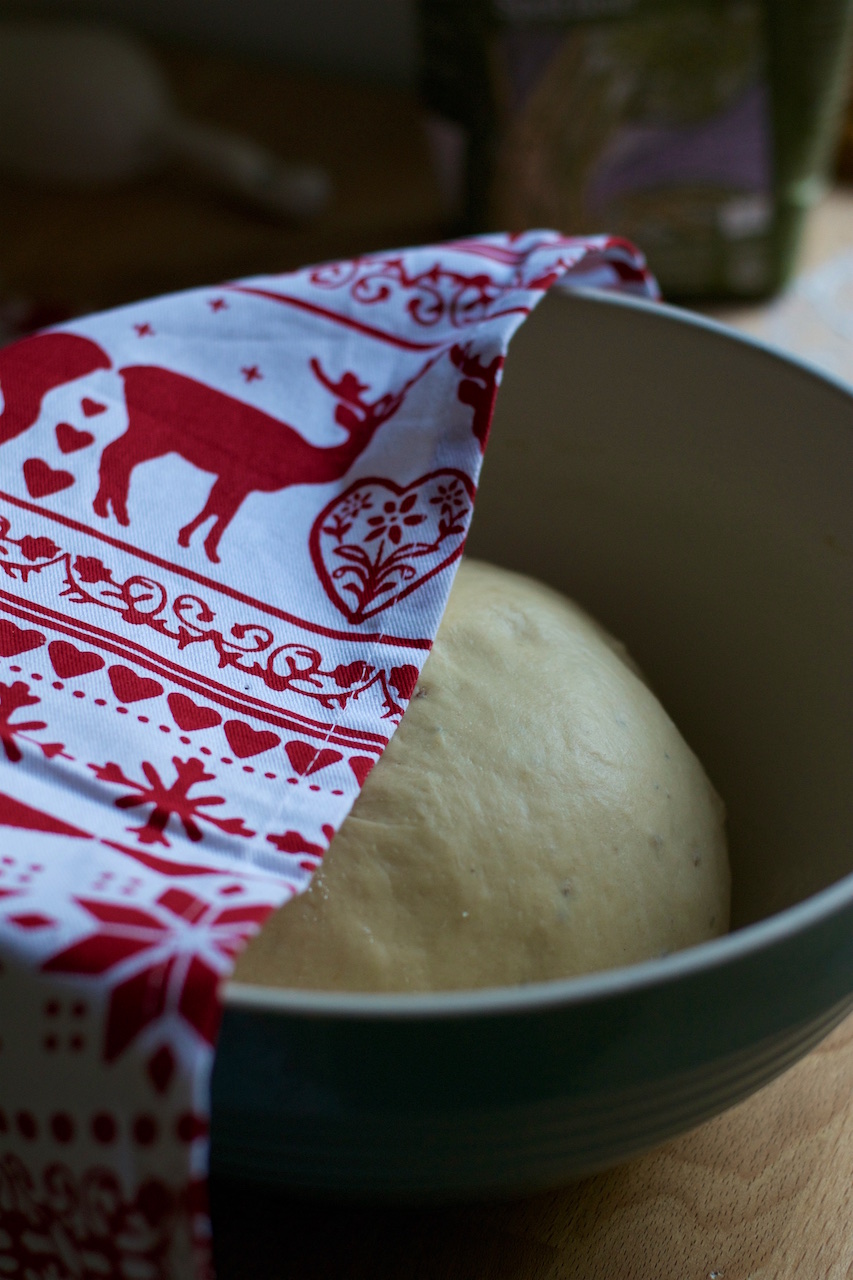
Transfer the dough to a floured surface and knead with your hands for 5-7 minutes. Grease the bowl with a little bit of coconut oil before putting the dough back in. Cover the bowl with a clean tea towel and set aside in a warm place for at least 1 hour, until it has doubled in size.

Punch the dough down and knead it slightly before dividing the dough in half, and each half into three balls. Roll the balls and shape into 6 equal ropes, 30 cm long each (about 12 inches).

Arrange 3 ropes of dough on a baking tray lined with baking parchment and pinch the ends farthest from you together. Braid the ropes and fold the ends under the loaf. Repeat with the other 3 ropes and make sure there is space between the braided loaves. Cover with a tea towel and set aside in a warm place for 30-40 minutes.

Brush the loaves with egg white before baking at 180°C/350°F (160°C fan oven) for 20-25 minutes. If you tap the bread bottom and the bread sounds hollow you will know it's done. Place the loaves on a wire cooling rack before slicing and serving with butter.

Uppskrift á íslensku.

For this recipe you can use either fresh yeast or dried yeast. Activating fresh yeast: see instructions above.

If using dried yeast: I have baked the breads with two types of dried yeast. Even though the recipe calls for 735 grams of flour (5½ cups), I use the dried yeast needed for 500 grams (1 lb) - simply follow the manufacturer's instructions on the packet, as those may vary.

One type is instant: I mix one package with the 135 grams of the flour before adding the egg and milk mixture. When I add the rest of the flour, the 600 grams, I keep 100-125 ml (about ½ cup) lukewarm water on the side and use as needed.

The other type of dried yeast I have used needs to be activated: It calls for 125-150 ml lukewarm water (1 part boiling, 2 parts cold), 1 teaspoon of sugar and 1 tablespoon of dried yeast. First you dissolve the sugar in the water in a medium bowl, and then you sprinkle the yeast into the bowl, whisk thoroughly and leave in a warm place for about 15 minutes, until the surface is covered with froth.


Monday, 26 October 2015

Comfort food: Spice loaf / bread

Spice loaf / bread recipe · Lisa Stefan


Perhaps I shouldn't admit it but I got into the holiday spirit early this year. I blame the kids. One evening when having dinner they started talking about our Christmas traditions, the food we enjoy, and I haven't recovered. I think I may have to pretend to be American and celebrate Thanksgiving this year just to get me some turkey and pumpkin pie. Back to my holiday mood. It's serious. I even baked a spice loaf two days in a row last week, mainly to enjoy the Christmassy scent of spices coming from the oven. And yesterday I started my experiments for our Christmas brunches, which you may have seen on Instagram.
Spice loaf / bread recipe · Lisa Stefan


October has kept me busy but one of the highlights this month was getting my friend (Cafe)Sigrun's cookbook in the mail, which you can spot in two images. It's the cookbook I worked on and told you about in this post. It was published in Iceland in the beginning of the month and has been well received. I thought my heart would burst when I opened the envelope. It was a strange feeling holding the book in my hands and turning its pages: there they were in print the documents that had been on my computer screen for months! I'm going to share a few recipes later and give you a peek inside the book.


The spice loaf recipe, which contains cinnamon, ginger, cloves, nutmeg and cocoa powder, is one of those from my old food blog. I adapted it from my friend (Cafe)Sigrun, who was inspired by a spice tour in Africa when she put hers together, which is spicier. I have been baking the spice bread, a loaf cake, for many years and it's our comfort food. Sometimes when it's cold outside, and it's just the children and me at home, we enjoy it with hot chocolate for dinner. It's one of the few things I eat with butter, but I also like it without it. I bake it with spelt flour and I combine white and wholemeal, but you can use another flour. When I make it I use a dl measuring jug (something I was brought up with in Iceland) but I have added the measurement in grams and cups for those who don't have one or have never heard of it before.

SPICE LOAF / BREAD

3½ dl spelt flour (175 g, scant 1½ cups)
2½ dl rolled oats (100 g, 1 cup)
1¼ dl organic unrefined cane sugar (110 g, ½ cup)
2-3 tablespoons cocoa powder, organic/fair-trade
2½ teaspoons baking powder, gluten free
1 teaspoon ground cinnamon
½ teaspoon ground ginger
¼ teaspoon ground nutmeg
¼ teaspoon ground cloves
250 ml milk / soya milk (1 cup)
2 tablespoons pure maple syrup

Combine all the dry ingredients in a large bowl.

Add the milk and maple syrup and combine slowly, until there is no dry spelt flour left at the bottom. Add 1-3 tablespoons of milk if needed.

Line a (ceramic) loaf tin with baking parchment and pour the batter into it.

Bake at 190°C/375°F (175°C fan oven) for 35-40 minutes. You can stick a fork into the middle to see if the bread is ready. My children prefer the loaf a little sticky so I never bake it longer than 35 minutes in my oven. You can freeze slices of the spice loaf and put them straight into a toaster.

Uppskrift á íslensku.


Monday, 13 April 2015

Chai latte and textiles

Chai latte · Lisa Stefan


This morning I started feeling a little under the weather and there was only one thing that came to mind: chai latte (Indian tea). I snapped a photo of my bowl which I enjoyed with my stack of The World of Interiors. In their latest issue, May 2015, is a feature on the beautiful Welsh farmhouse, Allt-y-Bela, of garden designer Arne Maynard. I have shared the house and its garden on the blog and I don't know how often I have pinned images of both. Grab a copy of the magazine if you can!

For those interested in textile design: In the above photo my bowl is resting on a page in the October 2014 issue. It's a gorgeous feature of watercolour patterns by the textile designer William Kilburn (1745–1818). These paintings are available in a book called Mr. Kilburn's Calicos: William Kilburn's Fabric Printing Patterns from the Year 1800 by Gabriel Sempill and Simon Lawrence. It's an expensive book but I bet it's worth every penny.

The World of Interiors, October 2014, pp. 112-113

I had already posted my chai latte recipe on my old food blog but it's my intention to slowly repost the old recipes here to keep them all in one place. I have been making this tea for years and there really is no rule when it comes to preparing it (the ingredients below are more of a suggestion). You can add spices or skip them. I recommend using not too much sugar and rather allowing the flavour of the spices to play its magic.

CHAI LATTE (INDIAN TEA)

500 ml water (2 cups)
500 ml milk/soy milk (2 cups)
4 bags organic black tea
2-2½ tablespoons organic unrefined cane sugar
1-3 cinnamon sticks or 1 teaspoon ground cinnamon
½ teaspoon whole cloves
¼ teaspoon whole aniseed or 1 star anise
a few black peppercorns or freshly ground black pepper
a pinch of ground ginger
a pinch of ground nutmeg
a pinch of ground cardamom (you can also use pods)

Put all the ingredients into a saucepan and bring to the boil over medium-high heat.

Serve the tea in a cup or a bowl and enjoy.

Optional: If you have time you can start with boiling the water with the spices to get a hotter blend, and then add the rest of the ingredients later (one cinnamon stick would then be enough). You can also boil the milk separately and whisk it before adding it to the tea; the foamy milk will make your tea look like a real latte.


Uppskrift á íslensku


Tuesday, 24 December 2013

Happy Holidays

Christmas traditions and preparation · Lisa Stefan


As I write this, I'm finishing my cup of coffee and about to start preparing the rice and almond pudding, a Danish dessert that has become a tradition in our household on Christmas Eve (we open the presents after dinner tonight). The turkey is in the fridge, waiting to be prepared as well. I'm ready for a delicious feast.

I visited my new friend John Lewis and bought a white tablecloth and white napkins for our Christmas table (I love their Christmas ad this year, about the animal that had never seen Christmas). I snapped a few photos yesterday when I was getting everything ready. The berry branches are old, I bought them in Iceland many years ago and they are one of the few things I kept when we moved abroad.


Christmas wouldn't be complete without my Amazon book package. This year I got a few books from my wish list: two for the coffee table, Ralph Lauren (it's huge, filled with images) and The Natural Home by stylist Hans Blomquist. As I couldn't imagine Christmas without literature, I got a beautiful Penguin Clothbound Classics edition of Jane Austen's Persuasion. And yes, I got some Downton Abbey too. Yesterday three books from friends arrived via mail so there will be no shortage of reading material in this house over the holidays.
Penguin Clothbound Classics: Persuasion by Jane Austen · Lisa Stefan


*Looking for inspiration for the holidays? Check out my Christmas board on Pinterest

I wish you all happy and peaceful holidays with loved ones! Or as we say in Icelandic: Gleðileg jól!