Showing posts with label isak dinesen. Show all posts

Monday, 17 April 2017

Remembering Karen Blixen

Coffee with Karen Blixen 1885-1962 · Lisa Stefan


Happy Easter! Today is the birthday of Karen Blixen (17 April 1885 - 7 September 1962), a Danish author who wrote many tales under the pseudonym Isak Dinesen (Babette's Feast and Other Stories, Shadows on the Grass, Seven Gothic Tales, Winter's Tales, and Last Tales). She was a gifted storyteller, best known for her book Out of Africa, often described as a lyrical meditation on her life in Kenya, where she had a farm, a coffee plantation (the book has no chronological order). Most people know of Blixen because of Sydney Pollack's film adaptation: While the film may give you an idea of Blixen's life in the stunning African landscape, only by reading the book will you experience its true atmosphere. For me it depicts an Africa I will never experience. A bygone era.

In one of my journals there is a quote by Blixen. Once she was asked how a story begins for a writer and this was her reply, in Danish:
Det begynder med atmosfære, et landskab, der for mig er vidunderligt skønt, og så – så kommer menneskene pludselig ind i billedet. Med det er de der, de lever, og jeg kan lade dem leve videre i bøgerne.
Basically, she is saying that first comes atmosphere, a landscape, which she finds wonderful and then, suddenly, people enter the scene. With that they are there, they live, and she can let them live on in the books. (I found the quote on the FB page of Karen Blixen Museet.)

In February came great news for Karen Blixen fans when it was announced that her book Out of Africa will be turned into a TV series.

image by me | the photo of Karen Blixen appears in the book Letters from Africa 1914-1931


Monday, 29 February 2016

Karen Blixen's Letters from Africa 1914-1931


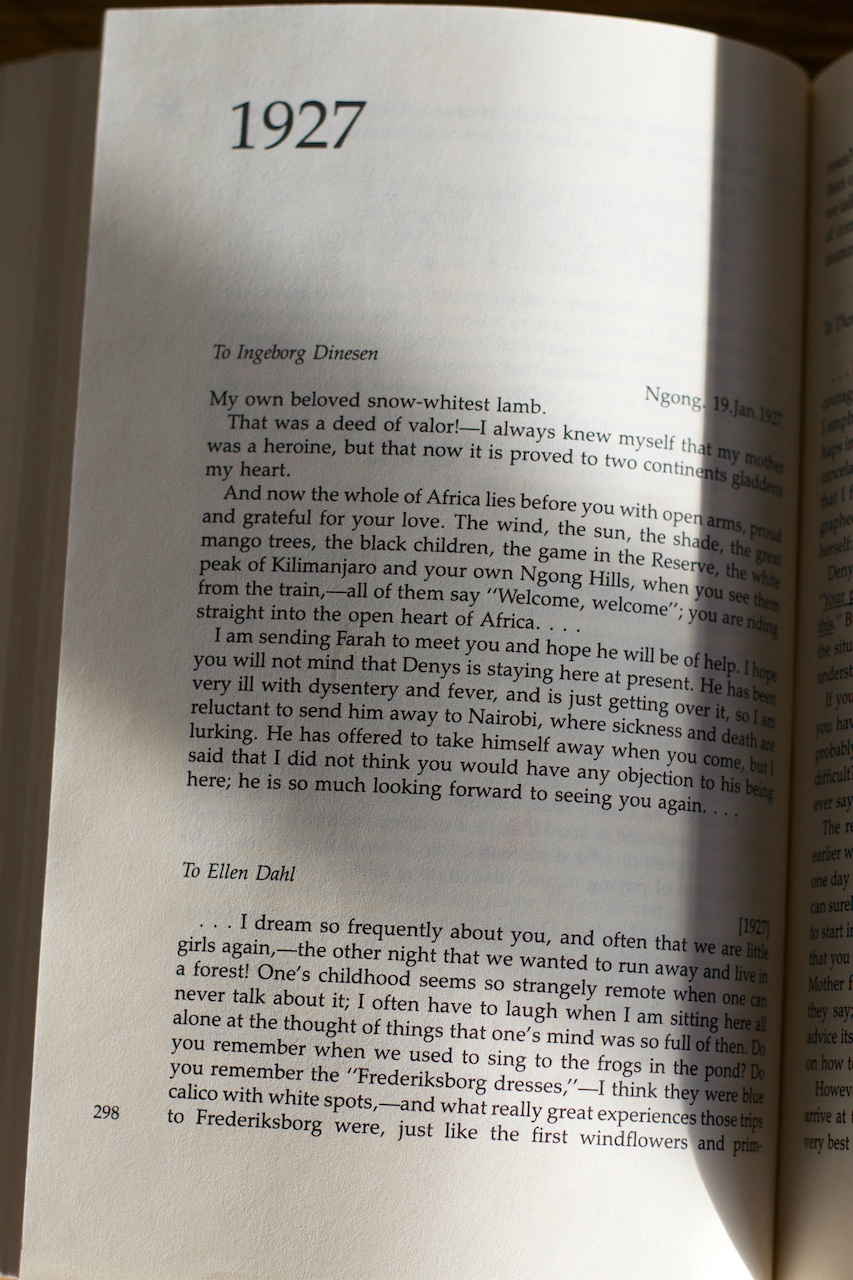
A page in Karen Blixen's Letters from Africa 1914-1931 · Lisa Stefan
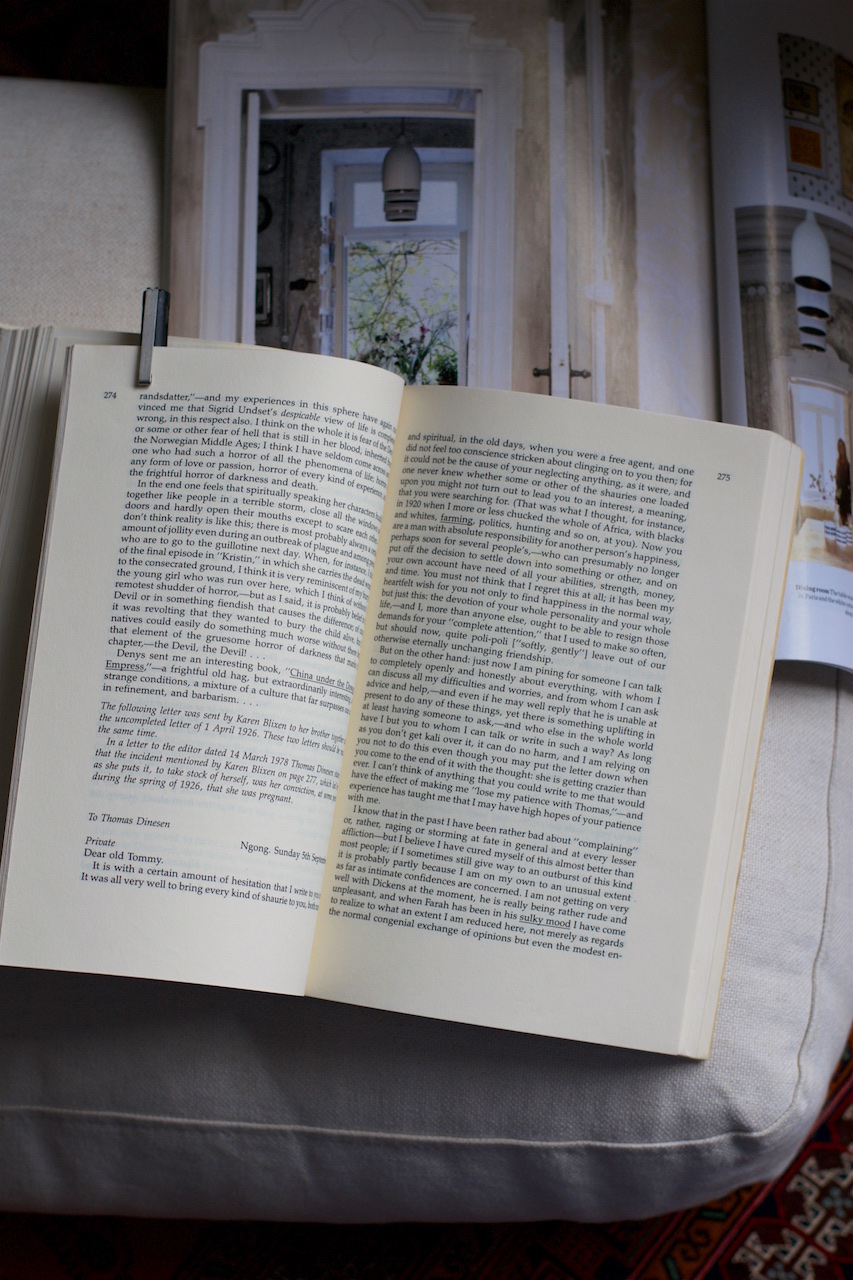
Karen Blixen's letters from Africa 1914-1931 · Lisa Stefan


Recently I finished reading Letters from Africa 1914-1931, a collection of the letters which author Karen Blixen (pseudonym Isak Dinesen) wrote home to her family in Denmark during her years in Kenya. She arrived there at the beginning of 1914 (the first sentence in her memoir Out of Africa is: 'I had a farm in Africa, at the foot of the Ngong Hills') and this she wrote to her mother in 1919:
It is so beautiful here, a paradise on earth, when there is enough rain. And in a way, during the times of tribulation one comes to love this intractable country still more; I have a feeling that wherever I may be in the future, I will be wondering whether there is rain at Ngong. (26 Feb.)
The Letters were edited by Frans Lasson for the Rungstedlund Foundation. I believe reading someone's letter collection requires a keen interest in the person in question and patience, as things will be repeated. (Coffee also helps!) If you are already familiar with Blixen's life there isn't much that will startle you, but for me the surprise was realising how hard she really struggled to keep her farm going. In Out of Africa she spares the reader the distressing details. In her letters, however, all the struggles are there but Lasson also left parts of the financial troubles out. Sydney Pollack's film Out of Africa (1985) certainly touches upon the subject of hardship but Blixen endured greater difficulties than it could ever depict and, unsurprisingly, the film romanticises her life in Africa, which of course had its pleasurable moments.
Isak Dinesen: Letters from Africa 1914-1931 (Karen Blixen) · Lisa Stefan


For those who haven't read Out of Africa (published in 1937), it's a memoir of her Kenya years but it has no chronological order and Blixen leaves many things out. In the director's comments on the DVD, Pollack says: 'What's beguiling about Out of Africa isn't what she wrote on the page . . . but in a way what isn't on the page' (Out of Africa, 1985, 6:50). I quite agree with him and now her letters have helped me fill in the gaps. What strikes me in her letters is that she never stops seeing the beauty of her surroundings despite the hardships - droughts, failed crops, and constant financial pressures.
You must not think that I feel, in spite of it having ended in such defeat, that my "life has been wasted" here, or that I would exchange it with that of anyone I know. . . . A great world of poetry has revealed itself to me and taken me to itself here, and I have loved it. . . . I have been the friend of Somali, Kikuyu, and Masai, I have flown over the Ngong Hills,—"I plucked the best rose of life, and Freja be praised,"—I believe that my house here has been a kind of refuge for wayfarers and the sick, . . . (Letter to her mother, 17 March 1931)
Karen Blixen and coffee · Lisa Stefan


Having read the Letters there is a scene in Pollack's film that breaks my heart every time but now also has a new meaning for me. It happens towards the end of the film when the coffee mill has burned down and she is bankrupt (in reality there actually was a fire but it happened earlier and they had insurance). Blixen [Meryl Streep] is having a conversation with Denys Finch Hatton [Robert Redford] when she gets into her car, puts her hand on her abdomen and fiddles with her jacket (Out of Africa, 1985, 2:12:06). In these few seconds, Streep's gesture marks for me Blixen's utter defeat. (The scene is in this clip on YouTube, at 3:15.)

Blixen put her heart and soul into keeping the coffee plantation going but eventually, the shareholders in Denmark (her family) decided to sell the farm, which never turned into the profitable investment that she had envisioned. I think every reader of the Letters roots for Blixen and hopes for that long-awaited, good coffee crop that will turn everything around, yet knows it isn't about to happen.
But you must not think that I am frightfully depressed and see everything in a tragic light. That is not at all the case; on the contrary, I think that these difficult times have helped me to understand better than before how infinitely rich and beautiful life is in every way and that so many things that one goes around worrying over are of no importance whatsoever. (Letter to her brother Thomas, 10 April 1931)

Isak Dinesen: Letters from Africa 1914-1931 (Karen Blixen) · Lisa Stefan
In her book, Shadows on the Grass, Blixen explains the importance of a letter she received from
the King of Denmark. I shared the story of the letter in an earlier blog post

Another factor that kept me reading the Letters was witnessing the birth of a writer, understanding Blixen's transition from being a coffee farmer in Africa to becoming a published author after the move back to Denmark. Despite the many natives that worked on her farm, the coffee plantation was an isolated place, in the sense that it was isolated from the arts. Literature, poetry and music were part of Blixen's upbringing but in Africa she wasn't able to attend concerts or go to the theatre. She talks about certain works and authors in her letters and asks her family to send her books and music. The arts and the nature and wildlife of Africa, especially the Ngong Hills, were key topics in her letters. I find it fitting to end this with a beautiful quote from her memoir:
If I know a song of Africa - I thought - of the giraffe, and the African new moon lying on her back, of the ploughs in the fields, and the sweaty faces of the coffee-pickers, does Africa know a song of me? Would the air over the plain quiver with a colour that I had had on, or the children invent a game in which my name was, or the full moon throw a shadow over the gravel of the drive that was like me, or would the eagles of Ngong look out for me? (Out of Africa)

Blixen and coffee · Lisa Stefan
One of the many cups of coffee I drank during the reading


Friday, 26 July 2013

Seven Gothic Tales by Isak Dinesen

Seven Gothic Tales by Isak Dinesen (Karen Blixen) · Lisa Stefan


I woke up this morning to thunders and lightning and the rain has been pouring down. It feels refreshing; I like the darkness accompanying it. Well, the sky is slowly brightening up so maybe today will be yet another sunny day.

Yesterday we celebrated our boy's birthday (the living room floor is a Playmo Knights battlefield) and I also went into the city to go to the library. I so enjoyed revisiting Karen Blixen's book Out of Africa earlier this month and I wanted to read more by Blixen and about her life. I was telling my parents on the phone the other day that I don't know why Blixen fascinated me from a young age. Maybe it was the Danish vibe that I felt in the home of my paternal grandparents, who were both part Danish.

I wanted to borrow - and did - Seven Gothic Tales, which Blixen wrote in English under the nom de plume Isak Dinesen after returning to Denmark from Kenya (Out of Africa came later). Then I got a few books that Sidney Pollack's film Out of Africa (1985) was based on: Shadows on the Grass, where Blixen continues with stories about her life in Kenya, Isak Dinesen: The Life of Karen Blixen by Judith Thurman, and Silence Will Speak by Errol Trzebinski. The last one is about the life of Denys Finch Hatton and his relationship with Blixen (played by Robert Redford in the film).

Maybe I should have warned you that this post was about books, but I guess the photo gave it away. Have a wonderful weekend!