Showing posts with label films. Show all posts

Friday, 17 August 2018

Reading journal 2017: Modiano, DeLillo, Bedford ...

My reading journal: Modiano, DeLillo, Bedford ... · Lisa Stefan


What are you reading these days? I'm reading The Hare with Amber Eyes by Edmund de Waal from my latest reading list and already looking forward to sharing my next one. You see, I just purchased books and I also found plenty of books that I have wanted to read in the library's online catalogue, e.g. Penelope Fitzgerald's The Bookshop. I doubt the film release has escaped book lovers. I love it when the world of literature appears on the screen and cannot wait to see Glenn Close and Jonathan Pryce in The Wife, based on Meg Wolitzer's novel. Enough about literary films for now, let's continue with the '2017 Reading journal'.

№ 10 reading list (7 of 9):

· The Ballad of the Sad Café by Carson McCullers. There are some fine stories in this collection but the title story stands out: A novella with an air so thick you can almost touch it, touch the tension on the horizon. This quote says it all: 'This was not a fight to hash over and talk about afterwards; people went home and pulled the covers up over their heads.' The main character, Miss Amelia Evans, will permanently be etched on my memory.

· Patrick Modiano: Two books by the French novelist and Nobel laureate were on the list, Pedigree (translated by Mark Polizzotti) and In the Café of Lost Youth (translated by Euan Cameron). The former is the author’s personal story, about his parents. I didn't write down any quotes in my journal, only that the book felt sad. The latter immediately transported me to the streets of Paris. For me, Modiano's writing is more about mood than story. Reading him often feels like watching a film; he makes certain characters very vivid on the page without verbosity. The book I want to read next is The Occupation Trilogy.

· Invisible Cities by Italo Calvino. This short novel is one of those that isn't everyone's cup of tea. It didn't grab me on the first page but the more I read, the more I got hooked on the prose. It's a conversation between Marco Polo and the Mongolian ruler Kublai Khan. Polo is describing the cities he has visited, when in fact he is always describing the same city, Venice. (Translated by William Weaver.)

· Stoner by John Williams. I loved this book. Loved William Stoner but couldn't stand his wife, a character that pushed all my buttons. Stoner is a poor Missouri farm boy who enters university and discovers literature. Those scenes are the book's beauty, a thrill for bookworms. However, Stoner's life is filled with disappointments, so much so that it can drag the reader down. It might be the reason why the book wasn't a success, which is the subject of this interesting article that appeared in The New Yorker.

· Point Omega by Don DeLillo. This short novel went straight to the list of my favourite reads in 2017. I loved the writing; its texture. The story mainly takes place in the Californian desert and turns into a mystery when one of the characters disappears. I intend to buy myself a copy one day and read it again.

· Jigsaw: An Unsentimental Education by Sybille Bedford. It's not easy to write about this partly autobiographical novel in a few words. If you read it I find it likely that it will stay with you. Bedford grew up in Germany with her father and with her mother in Italy after his death. She was educated in England and spent the 1920s travelling between England and the south of France (her mother and stepfather had moved there to escape the rise of fascism). Despite being completely unreliable and flawed, her mother is a fascinating character with great interest in literature ('I must have read (with earnest marginal notes) and my mother re-read half of Balzac, most of Maupassant, some Zola ...'). In France, the family lived a cultural, bohemian life; their circle of friends included the Huxleys (Aldous Huxley was Bedford's mentor; she wrote his authorised biography). This is a coming-of-age story set between two world wars but it's so much more.

image by me, appeared on Instagram 27/06/2017


Thursday, 1 June 2017

№ 9 reading list: Japanese literature I

№ 9 reading list: Japanese literature I · Lisa Stefan


Months ago the idea of a Japanese reading list started sprouting in my mind, and once I began writing down authors and titles in my pocket notebook I realised that there would be more than one list. Despite the word snow appearing in one of the titles below, it somehow felt right to ease into the summer reading Japanese literature. This first list is slightly shorter than intended, for the simple reason that one of the books I ordered hasn't arrived and at the last minute I decided not to include two works by the same author. It means that a novel by Yasunari Kawabata, who received the Nobel Prize in Literature in 1968, will appear on the next list. My blog readers will recognise Tanizaki, but his novel The Makioka Sisters was on an earlier list. I love the fact that at least one blog reader read and enjoyed it as much as I did.

№ 9 reading list:
1  First Snow on Fuji  by Yasunari Kawabata
2  The Temple of the Golden Pavilion  by Yukio Mishima
3  Some Prefer Nettles  by Jun'ichirō Tanizaki
4  The Tale of Genji  by Murasaki Shikibu *
5  The Tale of Genji  by Murasaki Shikibu **
6  My Neighbor Totoro: The Novel  by Tsugiko Kubo ***

Translated by: * Edward G. Seidensticker; ** Dennis Washburn
*** Illustrated by Hayao Miyazaki

As you can see, there are two unabridged editions of The Tale of Genji and I still haven't decided which one to read. The Washburn translation is a new paperback edition by W. W Norton & Co, the other an Everyman's Library edition. I'm trying to order the translation by Seidensticker through my local library, which is the main reason I have postponed sharing the list. If it fails to arrive I'm not sure at this point which one I will purchase. On my Instagram account you may have noticed that I'm already reading The Temple of the Golden Pavilion by Mishima. He fictionalised the story of the monk who in 1950 set fire to the Golden Pavilion of Kyoto, erected in the 15th century (the American airplanes spared the temples during the war). This was a shocking event. During the trial the young monk said he was protesting against the commercialisation of Buddhism. However, scholar Donald Keene writes in the introduction that 'he may have been directly inspired by nothing more significant than pique over having been given a worn garment when he had asked the Superior of the temple for an overcoat'! I'm more than halfway through the book with the pavilion still standing, and troubling the mind of the rather repulsive protagonist.


Have you seen the animation My Neighbour Totoro (1988) by Hayao Miyazaki? It's one of the Japanese favourites in our home. Last year my son and I were sitting at the café of our local Waterstones when he spotted the book on a shelf. We didn't even know it existed and learned then and there that the film had been turned into a novel, featuring Miyazaki's illustrations. It's a beautiful book and of course we walked out of the bookshop with a purchased copy. My son loved reading the story and now it's my turn.


Friday, 6 January 2017

Books and coffee | Happy New Year

Books and coffee: The Golden Notebook by Doris Lessing · Lisa Stefan


Happy New Year! I hope you enjoyed a relaxing holiday season and that 2017 will send good things your way. In this house we're still in holiday mode, without the festive food. Packed after New Year's, one of the kids suggested a menu of apples and carrots this week, which I found a wee bit extreme, as the Scots would say. We spent Christmas at home with occasional walks to the Waterstones bookshop and café. Browsing sufficed because there were plenty of books under the tree. Remember about a month ago when I mentioned rereading Little Women if I had the Penguin clothbound edition? Guess what, my husband gave me the book and two other classics. These editions are so beautiful. I haven't finished the books on my last reading list but I read Louisa May Alcott into the new year. These days I'm noting down ideas for my next list and after our library visit on Wednesday some are just waiting to be read. To give you a hint: On my table you can spot The Golden Notebook by Doris Lessing. I will reveal the list later.

In December I watched some TV (by that I mean catching up with the BBC iPlayer - I don't watch TV, I read). I loved Maggie Smith and Alex Jennings in The Lady in the Van (2015). How Alan Bennett put up with Mrs Shepherd for fifteen years is beyond my kin. On BBC there was a documentary, Alan Bennett's Diaries (2016), by Adam Low that I enjoyed. I'm thinking about reading Bennett's diaries after viewing his latest volume, Keeping On Keeping On, in a bookshop. And oh yes, I was in awe of BBC2's adaptation of Zadie Smith's NW, directed by Saul Dibb, screenplay by Rachel Bennette, which I watched after finishing the book. The cast was fantastic and Nikki Amuka-Bird better receive an award for her role as Natalie/Keisha Blake. She was extraordinary. My only disappointment with the film was that they left out the hilarious and tragic character of Annie, from the 'guest' chapter about Felix, but I completely get why they did.

Well, it's time to finish sprucing up the home for the weekend. I will soon share my review of Map Stories by Francisca Mattéoli, which I meant to do before Christmas, and I have a few coffee table books in sight.


Tuesday, 29 November 2016

My quiet coffee moment

My dining area: books and coffee · Lisa Stefan


Today I needed a quiet coffee moment with books and notebooks. As soon as I had taken the photo, my Persian prince came downstairs and fell asleep on the table, next to the stack of books. He's snoring. Does anyone else feel as if in these last days they have been bombarded with commercialism? I'm referring to the endless Black Friday and Cyber Monday emails filling up my inbox, often more than one from the same brand within 24 hours. Enough is enough! This morning I mercilessly clicked the 'unsubscribe' button and kept only book and textile-related newsletters.

Did you see the Little Women-inspired doodle on Google? Writer Louisa May Alcott was born on this day, also C.S. Lewis. I have been thinking about the film (1994) all morning. Winona Ryder was wonderful in the role of Jo March and I have always had a soft spot for Gabriel Byrne who played Professor Bhaer. It's been many years since I read the book. Perhaps if I get a copy of the Penguin clothbound classic I will read it again. Speaking of books. Soon I will share my review of editor Robert Gottlieb's Avid Reader: A Life. It was the last one on my 'Booktober' reading list and I finished it before all the others. A likely indicator of how much I enjoyed reading his memoir.


Saturday, 24 September 2016

№ 4 reading list: early autumn 2016

№ 4 reading list: Albert Camus, Tova Jansson, Isak Dinesen · Lisa Stefan


Saturday morning, coffee and books. In the background on repeat, Cat Power performing her cover of Troubled Waters; I never tire of this song. It's time to share my early autumn reading list - yes, there will be a late-autumn one, I already have some works lined up. I wanted to include Michael Chabon's Wonder Boys on the list but it wasn't available at the library and my ordered copy hasn't arrived, yet. I loved Michael Douglas in the film (2000), directed by Curtis Hanson, who passed away last Tuesday. I have already finished two books on the list and one of them is The Little Book of Hygge, which I recently reviewed on the blog. At the moment I'm reading five books at once. Some are short story collections so I pick up the one I'm in the mood for. Here is the list:

1   Siddhartha  by Hermann Hesse
2   The Outsider  by Albert Camus
3   The Summer Book  by Tove Jansson
4   A Winter Book: Selected Stories  by Tove Jansson
5   Anecdotes of Destiny  by Isak Dinesen (Karen Blixen)
6   In Other Rooms, Other Wonders  by Daniyal Mueenuddin
7   Kitchen  by Banana Yoshimoto
8   The American  by Henry James
9   Casino Royale  by Ian Fleming
10  The Little Book of Hygge: The Danish Way to Live Well  by Meik Wiking

At the library I spotted Yoshimoto's Kitchen, her first book, and had to borrow it to read again. Japanese authors are so wonderfully different. Many years ago I worked in a bookshop with school and took the risk of recommending it to a customer, who struck me as a reader ready for something different. Sometimes it was tricky recommending books to customers, not everyone has the same taste (luckily) and I didn't want anyone to waste money on something they didn't enjoy. Well, this one came back to tell me that she had loved it, that it was 'different', and she went home with a stack of my favourite books.

Stéphane Audran as Babette in Babette's Feast (1987)

Two Nordic authors are on my list. You know already about my love for Karen Blixen. Many years ago I read her story Babette's Feast and have since treasured it. It's featured in the story collection on the list and I'm looking forward to reading it again. Have you seen the film (1987, original Danish title Babettes gæstebud)? It's one of my favourites. It won the Oscar in the category Best Foreign Language Film. The other Nordic author on my list is Tove Jansson, who became famous for her books about the Moomintrolls (see my recent post about The Moomin Shop in London). She also wrote fiction for adults and I don't understand why I hadn't read any of them before. I'm so enjoying the two on my list. The Summer Book, first published in 1972, is a beautifully written story about a six-year-old and her grandmother, who spend a summer on a tiny island in the Gulf of Finland (Jansson herself had a cabin on a tiny, remote island in the same Gulf). The story has no plot, it's about life and nature. Such a quiet and calm read.

Finnish author Tove Jansson
Tove Jansson at her cabin on the Finnish island Klovharun

The other book on the list that I have also finished is Casino Royale, Ian Fleming's first book about James Bond. I was not impressed, which is the reason I didn't include it in my photo! Perhaps my expectations were too high because I enjoyed the film. The plot is interesting but I was simply bored during the reading. There were also sentences that I had to read twice to believe my own eyes ('the sweet tang of rape' (p. 201); it was published in different times, in 1953, but hello, misogynistic much?). One day I will probably give Fleming another chance and read From Russia with Love, which many consider his best. Just not yet.

1: image by me | 2: still via BFI · credit: Panorama Film A/S, Det Danske Filminstitut, Nordisk Film + Rungstedlundfonden · director + screenplay Gabriel Axel | 3: via Tove Jansson


Thursday, 14 July 2016

Testament of Youth by Vera Brittain

Testament of Youth by Vera Brittain · Lisa Stefan


On 1 July when the Battle of the Somme centenary commemorations were taking place I happened to be reading the last pages of Testament of Youth, the First World War autobiography by writer, feminist and pacifist Vera Brittain (1893-1970). Her Oxford dream comes true when the war has broken out and after one year at Sommerville College she puts her studies on hold to volunteer as a nurse. With the help of diary entries and letters, her book describes the horror of the Great War and its aftermath - she lost a fiancé, a brother and friends. First published in 1933, it has continued to reach a new generation of readers.

The film Testament of Youth (2014) is adapted from the book, with actress Alicia Vikander in a leading role, superbly capturing Vera's serious tone. I have to mention the film and, while bending the rule of using my photos only, feature part of its beautiful set design: Her bedroom and its gorgeous bookish paraphernalia in her parents' home in Buxton, Derbyshire, is the work of set decorator Robert Wischhusen-Hayes.


One doesn't pick up Vera Brittain's book for entertainment. It's a serious, emotional read, about love and friendships during war, and how war steals youth, forcing young people to grow up faster than they should. Sometimes I didn't understand how Vera could go on as a volunteer. The hours, the workload, the conditions; it got beyond exhausting - she worked in England, Malta and France. On top of that was the constant fear of losing someone dear:
Even when the letters came they were four days old, and the writer since sending them had had time to die over and over again. (p. 121)
On more than one occasion she fell apart or got sick but always got back on her feet and kept going. She did it for those she had lost and those still fighting.


Without going into too many details, before going to Oxford she meets Roland Leighton through her brother Edward. With him at the front, their relationship develops through letters. Constantly lurking is the fear that he will be killed in combat or forever changed by war:
To this constant anxiety for Roland's life was added . . . a new fear that the War would become between us - as indeed, with time, the War always did, putting a barrier of indescribable experience between men and the women whom they loved, thrusting horror deeper and deeper inward, linking the dread of spiritual death to the apprehension of physical disaster. (p. 122)
Those who have seen the film probably remember a scene by the beach with Roland turning violent. In real life it didn't happen. It was one of the dramatic licenses taken to tell a true story. In fact, the lovers had a short row through letters but I thought of that scene when I read this particular description of her brother:
[H]e was an unfamiliar, frightening Edward, who never smiled nor spoke except about trivial things, who seemed to have nothing to say to me and indeed hardly appeared to notice my return. (p. 324)
The siblings had a beautiful relationship and this was a very different Edward. He was one of the soldiers wounded in the Battle of the Somme and was awarded the Military Cross for his bravery in it. The war claimed his life in 1918. When I reached this part of the book I thought that screenwriter Juliette Towhidi had done a marvellous job. That beach scene is quite powerful.


Back to the book. Despite the horror of war there are a few stolen moments of joy. My personal favourite is when Vera enjoys a break from work, goes to the theatre, and afterwards writes to Roland:
Do you ever like to picture the people who write to you as they looked when they wrote? I do. At the present moment I am alone in the hostel common-room, sitting in an easy chair in front of the fire, clad precisely in blue and white striped pyjamas, a dark blue dressing-gown and a pair of black velvet bedroom slippers. (p. 199)
From the trenches Roland affectionately replies:
I should so like to see you in blue and white pyjamas. You are always correctly dressed when I find you, and usually somewhere near a railway station, n'est-ce pas? . . . It all seems such a waste of Youth, such a desiccation of all that is born for Poetry and Beauty. (p. 200)
This was in 1915 and they were engaged. Only a few pages later Roland is dead, shot by a German sniper right before his Christmas leave that same year.


In Downton Abbey there is a scene during the Great War where Lady Sybil [Findlay] says to Isobel Crawley [Wilton]: 'Sometimes, it feels as if all the men I ever danced with are dead' (series 2, about 10 min. into episode 1). That sentence has stuck with me. I think it has to do with my home country Iceland having no army. We don't have this collective memory of sending our young men to war, of its human cost and sacrifices (sons of Icelanders that had emigrated to Canada and the US died in the war but that's another story). Since moving to the UK I feel as if I have been gradually grasping the sense of the First World War and its impact on the British nation. Vera Brittain's book certainly gave me new insights.

After the war Vera went back to study at Oxford. At one point, when nerves and nightmares were taking their toll, these were her thoughts:
Why couldn't I have died in the War with the others? . . . I'm nothing but a piece of wartime wreckage, living on ingloriously in a world that doesn't want me! (p. 448)
Eventually, the emotional scars of the war faded. She got through the experience with the help of Winifred Holtby, an Oxford friend (both became authors; Holtby died in 1935). Vera finished her studies, spoke publicly for the League of Nations, got married, and became an advocate for peace.

Kit Harington and Alicia Vikander as Roland and Vera in Testament of Youth (2014)

1: photo by me | background image of a field of poppies by Andrew Montgomery, from the book Country by Jasper Conran | 2-5: screenshots by me (production stills of bedroom unavailable) | 6: still via Alicia Vikander.com | credit: BBC Films, Heyday Films, Screen Yorkshire + BFI | director James Kent · screenplay Juliette Towhidi · costume design Consolata Boyle


Thursday, 21 April 2016

Dora Carrington and Lytton Strachey

Dora Carrington and Lytton Strachey · Lisa Stefan


This setting is starting to look familiar; me, sitting on a cushion on the floor surrounded with books (that's Vassily Kandisky's Capricious Forms, 1937, on the page) and magazines, sometimes with a film or a drama series in the player. Only the cup of coffee is missing. On Netflix they have added The Honourable Woman, a gripping BBC mini series that I enjoyed watching again. The cast is great but for me Stephen Rea stands out. You will also find there a favourite of mine, the First World War drama Testament of Youth (2014), starring Alicia Vikander, based on Vera Brittain's memoir with the same name. Its set design is gorgeous; the costumes too. One of my own DVDs that I have been watching is Carrington (1995), about the interesting relationship between artist Dora Carrington (1893-1932) and writer Lytton Strachey (1880-1932).

Carrington and Strachey, played by Emma Thompson and Jonathan Pryce, belonged to the Bloomsbury group. Strachey was gay but he and Carrington had a special relationship and set up a home together. (If you visit the National Portrait Gallery in London you can view Carrington's portrait of Strachey.) Their story is certainly a love story, but of a different kind, with a tragic ending. Carrington took her own life following Strachey's death from cancer. Thompson is wonderful in her role but Strachey's wittiness helps Pryce steal the show. Penelope Wilton (Isobel Crawley in Downton Abbey) as Lady Ottoline Morrell is also a scene-stealer. She is simply fabulous. In everything she does.

I am constantly adding books to my reading list and Strachey is on it. I want to read Lytton Strachey: The New Biography by Michael Holroyd and also The Letters of Lytton Strachey, edited by Paul Levy. I just haven't decided which one to read first. Have you read them?


Monday, 29 February 2016

Karen Blixen's Letters from Africa 1914-1931


A page in Karen Blixen's Letters from Africa 1914-1931 · Lisa Stefan
Karen Blixen's letters from Africa 1914-1931 · Lisa Stefan


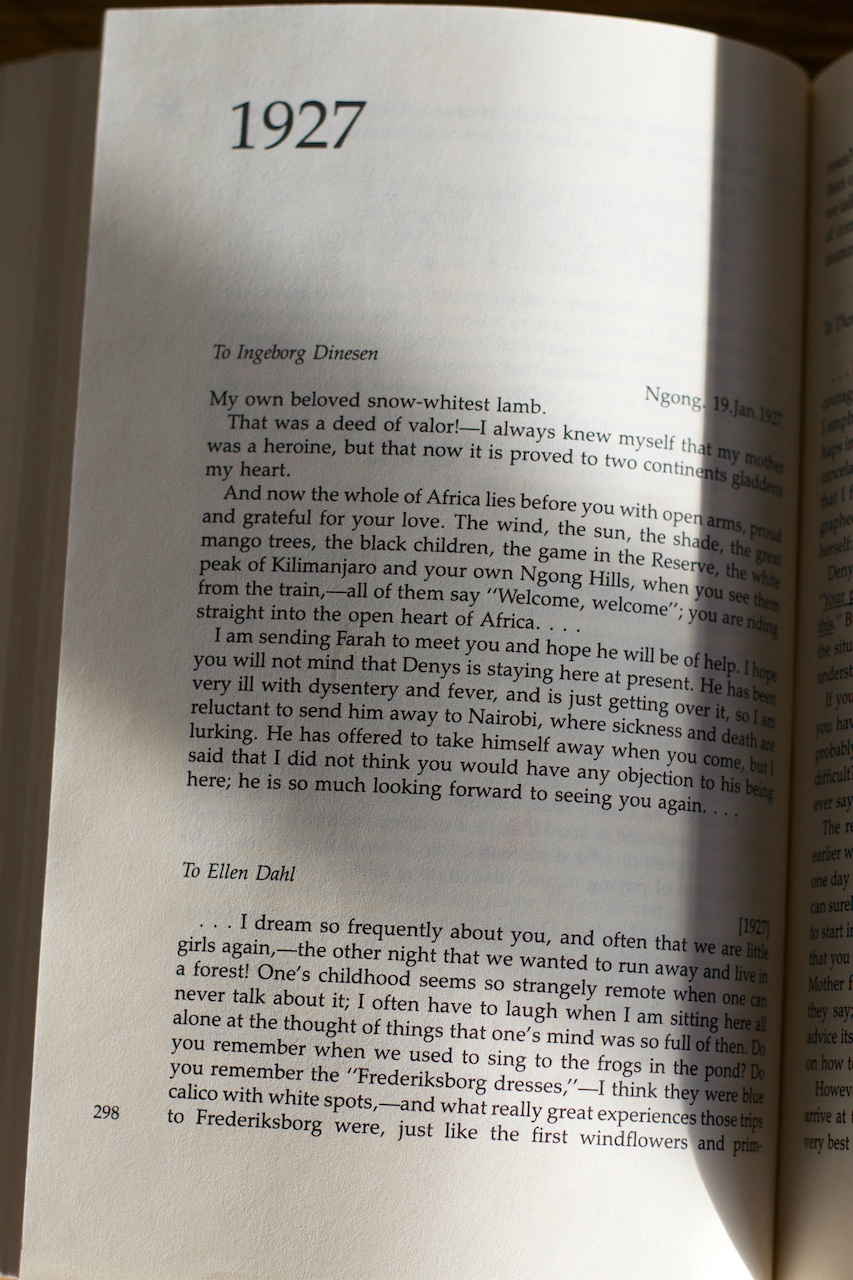
Recently I finished reading Letters from Africa 1914-1931, a collection of the letters which author Karen Blixen (pseudonym Isak Dinesen) wrote home to her family in Denmark during her years in Kenya. She arrived there at the beginning of 1914 (the first sentence in her memoir Out of Africa is: 'I had a farm in Africa, at the foot of the Ngong Hills') and this she wrote to her mother in 1919:
It is so beautiful here, a paradise on earth, when there is enough rain. And in a way, during the times of tribulation one comes to love this intractable country still more; I have a feeling that wherever I may be in the future, I will be wondering whether there is rain at Ngong. (26 Feb.)
The Letters were edited by Frans Lasson for the Rungstedlund Foundation. I believe reading someone's letter collection requires a keen interest in the person in question and patience, as things will be repeated. (Coffee also helps!) If you are already familiar with Blixen's life there isn't much that will startle you, but for me the surprise was realising how hard she really struggled to keep her farm going. In Out of Africa she spares the reader the distressing details. In her letters, however, all the struggles are there but Lasson also left parts of the financial troubles out. Sydney Pollack's film Out of Africa (1985) certainly touches upon the subject of hardship but Blixen endured greater difficulties than it could ever depict and, unsurprisingly, the film romanticises her life in Africa, which of course had its pleasurable moments.
Isak Dinesen: Letters from Africa 1914-1931 (Karen Blixen) · Lisa Stefan


For those who haven't read Out of Africa (published in 1937), it's a memoir of her Kenya years but it has no chronological order and Blixen leaves many things out. In the director's comments on the DVD, Pollack says: 'What's beguiling about Out of Africa isn't what she wrote on the page . . . but in a way what isn't on the page' (Out of Africa, 1985, 6:50). I quite agree with him and now her letters have helped me fill in the gaps. What strikes me in her letters is that she never stops seeing the beauty of her surroundings despite the hardships - droughts, failed crops, and constant financial pressures.
You must not think that I feel, in spite of it having ended in such defeat, that my "life has been wasted" here, or that I would exchange it with that of anyone I know. . . . A great world of poetry has revealed itself to me and taken me to itself here, and I have loved it. . . . I have been the friend of Somali, Kikuyu, and Masai, I have flown over the Ngong Hills,—"I plucked the best rose of life, and Freja be praised,"—I believe that my house here has been a kind of refuge for wayfarers and the sick, . . . (Letter to her mother, 17 March 1931)
Karen Blixen and coffee · Lisa Stefan


Having read the Letters there is a scene in Pollack's film that breaks my heart every time but now also has a new meaning for me. It happens towards the end of the film when the coffee mill has burned down and she is bankrupt (in reality there actually was a fire but it happened earlier and they had insurance). Blixen [Meryl Streep] is having a conversation with Denys Finch Hatton [Robert Redford] when she gets into her car, puts her hand on her abdomen and fiddles with her jacket (Out of Africa, 1985, 2:12:06). In these few seconds, Streep's gesture marks for me Blixen's utter defeat. (The scene is in this clip on YouTube, at 3:15.)

Blixen put her heart and soul into keeping the coffee plantation going but eventually, the shareholders in Denmark (her family) decided to sell the farm, which never turned into the profitable investment that she had envisioned. I think every reader of the Letters roots for Blixen and hopes for that long-awaited, good coffee crop that will turn everything around, yet knows it isn't about to happen.
But you must not think that I am frightfully depressed and see everything in a tragic light. That is not at all the case; on the contrary, I think that these difficult times have helped me to understand better than before how infinitely rich and beautiful life is in every way and that so many things that one goes around worrying over are of no importance whatsoever. (Letter to her brother Thomas, 10 April 1931)

Isak Dinesen: Letters from Africa 1914-1931 (Karen Blixen) · Lisa Stefan
In her book, Shadows on the Grass, Blixen explains the importance of a letter she received from
the King of Denmark. I shared the story of the letter in an earlier blog post

Another factor that kept me reading the Letters was witnessing the birth of a writer, understanding Blixen's transition from being a coffee farmer in Africa to becoming a published author after the move back to Denmark. Despite the many natives that worked on her farm, the coffee plantation was an isolated place, in the sense that it was isolated from the arts. Literature, poetry and music were part of Blixen's upbringing but in Africa she wasn't able to attend concerts or go to the theatre. She talks about certain works and authors in her letters and asks her family to send her books and music. The arts and the nature and wildlife of Africa, especially the Ngong Hills, were key topics in her letters. I find it fitting to end this with a beautiful quote from her memoir:
If I know a song of Africa - I thought - of the giraffe, and the African new moon lying on her back, of the ploughs in the fields, and the sweaty faces of the coffee-pickers, does Africa know a song of me? Would the air over the plain quiver with a colour that I had had on, or the children invent a game in which my name was, or the full moon throw a shadow over the gravel of the drive that was like me, or would the eagles of Ngong look out for me? (Out of Africa)

Blixen and coffee · Lisa Stefan
One of the many cups of coffee I drank during the reading


Wednesday, 27 January 2016

A time well spent

A time well spent: coffee & Karen Blixen · Lisa Stefan


I have a confession to make. This morning was rainy and dull and with time on my hands I thought it best to finish organising the rest of our clothes. A chest of drawers in our bedroom is still empty after the move and there are still clothes in boxes. It all started well but then I longed for a cup of coffee and probably made the mistake of bringing it upstairs. Before I knew it I was sitting on the rug with books and magazines, and the film Out Of Africa (1985) running in player. I have no excuse. Most of the drawers are still empty but I believe my time was well spent. In my opinion it cannot be a waste of time if it leaves you inspired.

Lately I have been watching Out of Africa a lot. I don't sit with my eyes fixed on the screen, I just let it run in the player and watch it with one eye or listen while I'm doing something else. I often keep the director Sidney Pollack's commentary on because I never grow tired of what he has to say about Karen Blixen, Kenya and how they shot the film. He doesn't only talk about particular scenes, as most directors do, he goes deeper and I love his way of storytelling. Maybe this is just my way of holding on to his voice after his death. Anyway, it's a film I have watched so many times that I can no longer keep track, but each time I do I'm drawn to different scenes. This morning it was the relationship between Blixen [Meryl Streep] and her Somali servant Farah [Malick Bowens], who was with her the entire time she lived on the farm in Kenya. Their conversations aren't long but the scenes are delightful and often witty. In her book Shadows on the Grass she refers to him as her "servant by the grace of God" and I think Pollack's film captures the meaning of it beautifully.
Out of Africa by Karen Blixen · Lisa Stefan


About my rereading. Karen Blixen's Out of Africa is one of the books I have been reading again. I was thinking about it the other day that the more I see of the stuff people share on social media - selfies and pointless websites, dare I say stupidity? - the more I feel the need to take a step back and revisit either quality books or films. They help to cleanse the mind of rubbish articles and unwanted images out there.

A note on my photos: Top photo shows page 133 in the Dec. 2015 issue of The World of Interiors (taken by Andreas von Einsiedel). The article 'Window on the World' is about the late Julian Barrow, an artist and world traveller, who had a studio in Chelsea. The patterns are from V&A Pattern: Indian Florals. The bottom photo shows a page in the same issue of WoI. The article, 'Bauhaus Below the Border' which starts on page 66, is about Josef and Anni Albers. The exhibition A Beautiful Confluence: Anni and Josef Albers and the Latin American World runs at the Museo delle Culture in Milan until 21 Feb.