Showing posts with label bloomsbury group. Show all posts

Wednesday, 17 August 2016

Store Street Espresso, Bloomsbury, London

Store Street Espresso, Bloomsbury, London · Lisa Stefan


Last week we went to London, where I got to see the Georgia O'Keeffe exhibition at Tate Modern - not a chance I was going to miss it! I needed a city trip before tuning into autumn. We dined at the Wild Food Cafe in Neal's Yard, walked in Covent Garden, Westminster and St. James's Park, and went to the Whole Foods Market on Kensington High Street, which always feels like our London food-home. The kids even asked, We are going to WFM, aren't we? And there was coffee. In the heart of Bloomsbury I had the best latte. I had promised a coffee-geeky friend to go to Store Street Espresso at 40 Store St (to be exact, it's part of the Fitzrovia district). It was a promise I happily fulfilled during our Bloomsbury/Fitzrovia stroll and the coffee shop lived up to my expectations.

Store Street Espresso, Bloomsbury, London · Lisa Hjalt
Store Street Espresso, Bloomsbury, London · Lisa Stefan


I was under the influence of the Bloomsbury group upon entering Store St Espresso. We had walked from Bloomsbury St into Gower St and at No. 10 I spotted the blue plaque of Lady Ottoline Morrell. I knew it was there, yet my heart skipped a beat. She wasn't exactly a member of the group but she was a patron of the arts and if you have read the diaries and letters of e.g. Virginia Woolf you will know Ottoline. This was my state of mind when I ordered my latte.

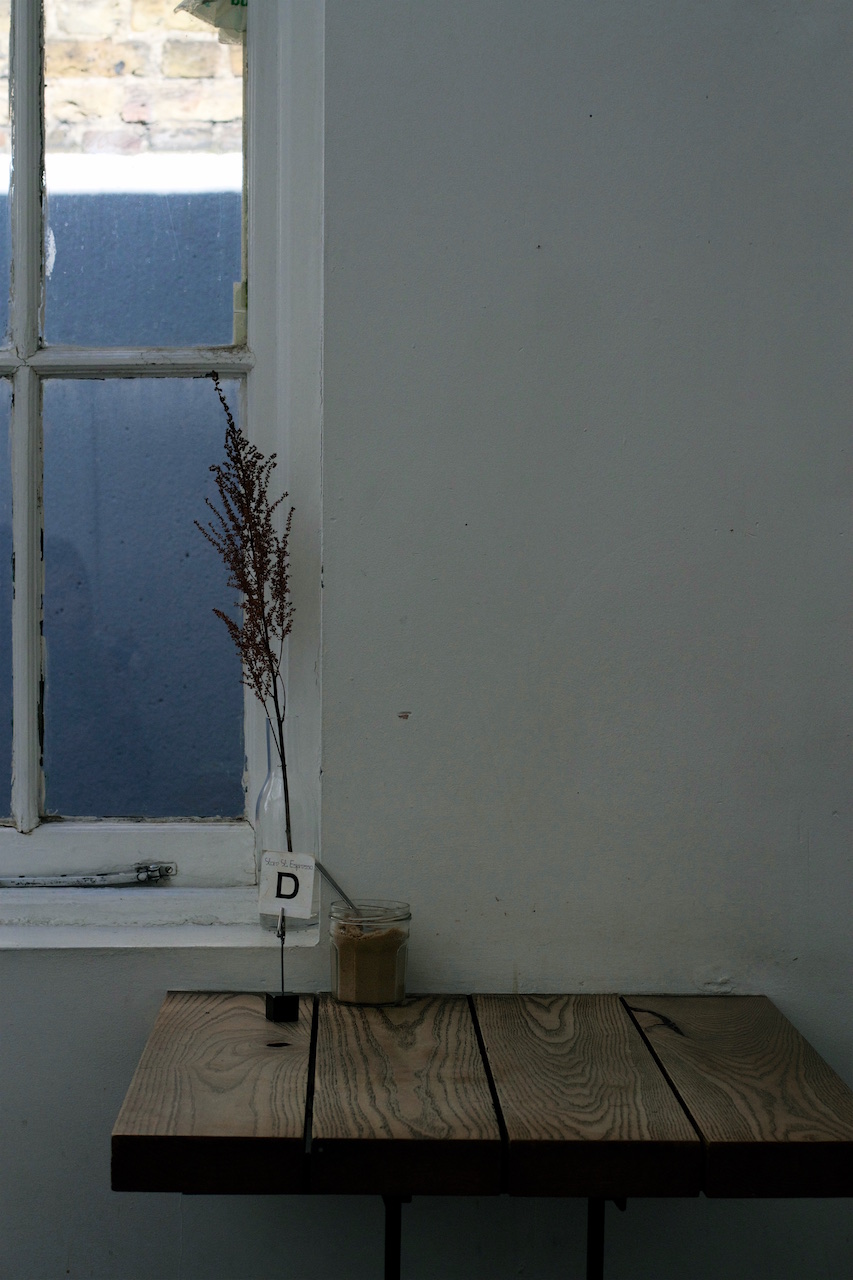
It was a very warm and sunny day in the city and we had done a lot of walking when I sat down and had my first sip; it was superb. Store St Espresso is my idea of a good café. It has that minimalist, rustic look with industrial touches. The atmosphere is ideal; it's an unpretentious café. The guests seem to mind their own business, on their laptops, phones or reading. I guess some would call this a place for hipsters but while I sat there I noticed all kinds of people with one thing in common, there to enjoy their coffee.


The location of Store St Espresso is great. The street is quiet, close to parks and The British Museum. I urge you to grab a coffee if you happen to be in the neighbourhood. Well, I urge you to eat in. There is a great window nook if you like people-watching and in fine weather you can sit outdoors.
Store Street Espresso, Bloomsbury, London · Lisa Stefan


I am not done with my trip on the blog but during our stay I certainly got my London fix. My mind is still wandering the streets of Bloomsbury, thinking of Virginia Woolf and her circle of friends. It's also lingering at the Tate, admiring O'Keeffe's paintings. Fortunately, the Scottish summer turned on its charm when we got home, enabling me to start writing this on the patio with a cup of coffee, and finishing on a chair in the front of the house, next to the hydrangeas, while admiring the sunset.

How I love August days like these!
Store Street Espresso, Bloomsbury, London · Lisa Stefan


Thursday, 21 April 2016

Dora Carrington and Lytton Strachey

Dora Carrington and Lytton Strachey · Lisa Stefan


This setting is starting to look familiar; me, sitting on a cushion on the floor surrounded with books (that's Vassily Kandisky's Capricious Forms, 1937, on the page) and magazines, sometimes with a film or a drama series in the player. Only the cup of coffee is missing. On Netflix they have added The Honourable Woman, a gripping BBC mini series that I enjoyed watching again. The cast is great but for me Stephen Rea stands out. You will also find there a favourite of mine, the First World War drama Testament of Youth (2014), starring Alicia Vikander, based on Vera Brittain's memoir with the same name. Its set design is gorgeous; the costumes too. One of my own DVDs that I have been watching is Carrington (1995), about the interesting relationship between artist Dora Carrington (1893-1932) and writer Lytton Strachey (1880-1932).

Carrington and Strachey, played by Emma Thompson and Jonathan Pryce, belonged to the Bloomsbury group. Strachey was gay but he and Carrington had a special relationship and set up a home together. (If you visit the National Portrait Gallery in London you can view Carrington's portrait of Strachey.) Their story is certainly a love story, but of a different kind, with a tragic ending. Carrington took her own life following Strachey's death from cancer. Thompson is wonderful in her role but Strachey's wittiness helps Pryce steal the show. Penelope Wilton (Isobel Crawley in Downton Abbey) as Lady Ottoline Morrell is also a scene-stealer. She is simply fabulous. In everything she does.

I am constantly adding books to my reading list and Strachey is on it. I want to read Lytton Strachey: The New Biography by Michael Holroyd and also The Letters of Lytton Strachey, edited by Paul Levy. I just haven't decided which one to read first. Have you read them?


Thursday, 1 October 2015

The Diary of Virginia Woolf - Volume 1 1915-19

The cover of The Diary of Virginia Woolf - Volume 1 1915-19 · Lisa Stefan


'Something interesting happens every day' are words spoken by Virginia Woolf that my son and I have taken to heart and turned into a question that we ask each other every day. It started in the summer when I was reading The Diary of Virginia Woolf - Volume 1: 1915-19, part of my ongoing Woolf-and-Bloomsbury-group phase. They appear in a short documentary, The Mind and Times of Virginia Woolf, in the bonus material of The Hours (2002) DVD (towards the end, at minute 24). One interviewee was the late Nigel Nicolson, the son of Woolf's closest friend Vita Sackville-West. He talks about his childhood memories of Woolf, about the questions she would ask about events of the day, and how she would encourage keeping a diary because 'something interesting happens every day'.

For those who thrive on the thrill of a good plot in novels, perhaps reading diary entries with everyday descriptions of, for example, the weather doesn't sound interesting. I think one has to be intrigued by any kind of life writing to enjoy such books. In the case of Woolf's diaries, it helps to be a fan of her work. My idea was to end my evening reading with one or two entries from Volume 1 but I always read more. What I found fascinating is how she observes people and her surroundings. The precise descriptions sometimes feel like poetry, especially when she describes the weather or the changing of the seasons. Then there is life during the Great War, which interested me. 'Happily the weather is turned cloudy; spring blotted out, but one must sacrifice spring to the war' (p. 128 - 15 March 1918).
The Diary of Virginia Woolf - Volume 1 1915-19 · Lisa Stefan


The diaries, five volumes, were edited by Anne Olivier Bell (wife of Quentin, the son of Woolf's sister, Vanessa Bell). There are footnotes for those who want to know more about the people and events Woolf writes about. The first volume covers the years 1915 to 1919. 'My writing now delights me solely because I love writing & dont [sic], honestly, care a hang what anyone says. What seas of horror one dives through in order to pick up these pearls—however they are worth it' (p. 20 - 16 January 1915). After six weeks of entries the diary stops in February 1915, when Woolf slid into madness, right before the publishing of her first work, The Voyage Out, in March 1915. Sadly, two years before she had tried to commit suicide. Because of her mental problems there is silence until 1917 when she starts again with brief entries. In the autumn the entries get longer but it isn't until in 1918 that the diary takes off and becomes an essential part of her life. In January 1919 she writes:
I note however that this diary writing does not count as writing, since I have just reread my years diary & am much struck by the rapid haphazard gallop at which it swings along, sometimes indeed jerking almost intolerably over the cobbles. Still if it were not written rather faster than the fastest typewriting, if I stopped & took thought, it would never be written at all; & the advantage of the method is that it sweeps up accidentally several stray matters which I should exclude if I hesitated, but which are the diamonds of the dustheap. (pp. 233-34)

The Diary of Virginia Woolf - Volume 1 1915-19 · Lisa Stefan
On the back cover: The Monk's House kitchen entry, Virginia and Leonard Woolf's home in Rodmell

In April 1919, Woolf writes a long entry where she contemplates on her diary writing:
I got out this diary, & read as one always does read one's own writing, with a kind of guilty intensity. I confess that the rough & random style of it, often so ungrammatical, & crying for a word altered, afflicted me somewhat. ... But what is more to the point is my belief that the habit of writing thus for my own eye only is good practise. It loosens the ligaments. Never mind the misses & the stumbles. ... What sort of diary should I like mine to be? Something loose knit, & yet not slovenly, so elastic that it will embrace any thing, solemn, slight or beautiful that comes into my mind. I should like it to resemble some deep old desk, or capacious hold-all, in which one flings a mass of odds & ends without looking them through. (p. 266)
I am currently waiting for a copy of Volume 2: 1920-24 to arrive in the mail, looking forward to picking up where I left off. For those of you who aren't into diaries but are interested in her life, there is a biography called Virginia Woolf by Hermione Lee, which I intend to read when I'm done with all the five volumes of the diaries. Lee is one of the interviewee in the aforementioned documentary.


Wednesday, 16 September 2015

Charleston: A Bloomsbury House & Garden

The cover of Charleston: A Bloomsbury House and Garden by Quentin Bell and Virginia Nicholson · Lisa Stefan


This summer my collection of coffee table books grew larger when on my birthday I got a copy of Charleston: A Bloomsbury House and Garden by Quentin Bell and his daughter Virginia Nicholson. Quentin was the son of artist Vanessa Bell (author Virginia Woolf's sister) and her husband Clive. The book tells the story of the Charleston House in Sussex, which Vanessa took on rent during World War I - by then her marriage to Clive was in name only. Her sons lived with her, as did artist Duncan Grant and his friend David Garnett, who were lovers. Actually, many years later David married her and Duncan's daughter, Angelica, who was born in the house. That is not the subject of this blog post but let's just say that relationships often got a little complicated, or shall we say interesting, within the Bloomsbury group, as the circle of friends was called (see also my recent post on BBC's Life in Squares). The book about Charleston is enjoyable and the decorative details are a constant source of inspiration. This is a bohemian style with a wonderfully personal and artistic twist.

Vanessa Bell's bedroom, p. 58

The way the book is set up each room gets a chapter that tells its story, how it was used in the beginning and later decorated. Quentin was 85 years old when he started writing the book. He had finished the first draft when his health deteriorated. When he was unable to write his daughter, Virginia, who also knew the house well, sat with him and listened to his stories of the house and recorded them on tape. He died in 1996 and she finished the book. The chapters are divided into sections marked with their initials, so the reader always knows who's telling the story. Alen MacWeeney photographed each room for the book and every photo has a caption explaining the details. There are also old black and white photos of the inhabitants and their friends, but the house was a popular holiday home for the Bloomsbury circle.

Vanessa's bedroom, seen above, used to be the larder but in 1939 it was converted and a tiny window was replaced with a French window that opens onto the garden. I have never visited Charleston but this corner has become my favourite. Her beautiful desk is a 19th-century French fall-front secretaire. She designed the curtain fabric for the Omega Workshops in 1913. The curtains in the photo are a reproduction of the original fabric by Laura Ashley in 1986.

Duncan's sitting room in the studio, p. 67

Vanessa later negotiated a long lease on Charleston, which meant that she and Duncan were able to construct a proper studio. It was ready in 1925 with plenty of space to paint and there was room for a sitter or model. Roger Fry, a member of the Bloomsbury group and the founder of the Omega Workshops, helped with the construction. Part of the space became Duncan's sitting room. Duncan decorated the screen behind the chair and the panels around the fireplace in the 1930s. Later, in 1939, Vanessa turned a room on the second floor into a studio of her own.

The window in Duncan's bedroom, p. 109

Quentin writes that he has slept in all the rooms in Charleston but Duncan's bedroom remains his favourite room, having 'the most complete decorative scheme of any in the house' (p. 108). Vanessa painted the decorations in the window embrasure and she also designed the cover of the antique French window seat.

In Clive Bell's study, p. 47

The above photo shows Clive Bell's study, which used to be a living room. Clive had been a frequent visitor at Charleston but in 1939 he moved in. Vanessa painted the window embrasure in 1916-17. Duncan decorated the tiles set into the tabletop in the 1920s or 1930s.

Until I am able to visit the Charleston House (see their website for opening hours) I will enjoy its rooms and decorative objects in my book. My only regret is not having the hardcover edition because I know that this book will become more precious than others on my coffee table.

A constant source of inspiration, indeed.

Zarafshan linen fabric in rust/slate by Lewis & Wood

A final note: All the textile samples I used in the styling are from Lewis & Wood. The fabric, inspired by the Eastern Suzani tradition, is Zarafshan, made from 100% linen. It is available in various colours, three shown here: In the first two images Indigo/Cranberry, the third Turquoise/Lime, and in the last two Rust/Slate. More on Lewis & Wood later.


Thursday, 13 August 2015

BBC's Life in Squares: The Bloomsbury group

BBC's Life in Squares on my tablet · Lisa Stefan


Did you watch the miniseries Life in Squares on BBC? It was introduced as a three-part drama about the relationship between English painter Vanessa Bell and her sister, writer Virginia Woolf. To me it felt more like the story of Vanessa and artist Duncan Grant's relationship. Not that I'm complaining, I thoroughly enjoyed the series and its beautiful set design and costumes. Actress Phoebe Fox plays the younger Vanessa and Eve Best the older. I hadn't seen Fox in anything before and was very impressed with her performance; she fit well into my idea of Vanessa. James Norton is memorable in the role of younger Duncan (I first saw him as Tommy in Happy Valley) and so is Rupert Penry-Jones in that of the older. In fact, the entire cast is wonderful, an assembly of fine British actors who give great performances and bring to life on screen the famous avant-garde Bloomsbury group and its bohemian lifestyle, with the help of screenwriter Amanda Coe and Swedish director Simon Kaijser.
Lavender and bees · Lisa Stefan


The series is still available on the BBC iPlayer but will soon be released on DVD. If you haven't already watched it I have to warn you about the first episode. A lot of material is crammed into it - love affairs and deaths - that will make much more sense to those already familiar with the individuals of the Bloomsbury circle. It's my personal opinion that there should have been four episodes instead of three to better introduce the characters. In episode 2 the storytelling becomes much more flowing and easier to follow.


Maybe it's a cliché to call the lifestyle of the Bloomsbury group bohemian, as I did above, but the mise en scène certainly is. Think paintings, art supplies, desks, books, letters, etc. During the World War I, Vanessa Bell set up a home in the Charleston House in Sussex, where the main part of the Life in Squares takes place. You will find beautiful images of its artistic interiors on the website of House & Garden.

To the Lighthouse by Virginia Woolf · Lisa Stefan
Lavender · Lisa Stefan


For me the timing of the series is interesting because in the beginning of this summer I picked up Virginia Woolf's To the Lighthouse, which I tend to read in summertime. During the reading I started thinking about the sisters, watched The Hours (2002) for the hundredth time, and pre-ordered the paperback edition of Vanessa Bell by Frances Spalding. I realised my focus had always been on Virginia and her story, and I didn't know enough about Vanessa. The series has now given me a better idea and I'm even more eager to receive the biography in the mail.

The World of Interiors, September 2014, p. 146

I have what I can only call a longstanding infatuation with Virginia Woolf. I cannot remember when it started, and I cannot remember which of her work I read first. So much has been written about her life and if you are interested in her story I can recommend the book Moments Of Being: Autobiographical Writings. Then there is her nephew Quentin Bell's (son of Vanessa and Clive Bell) biography about her life from the year 1912 to 1941, Virginia Woolf: A Biography. Her husband Leonard Woolf edited her diaries and published them after her death (see A Writer's Diary: Being Extracts from the Diary of Virginia Woolf).

After watching Life in Squares I'm eager to go a little Bloomsbury-group crazy. I'm looking forward to reading the aforementioned biography of Vanessa Bell and then I would love to watch again Carrington (1995), starring two of my favourites, Emma Thompson as Dora Carrington and Jonathan Pryce as Lytton Strachey (see trailer). There is a film in the making by Dutch director Sacha Polak called Vita & Virginia, about Virginia's relationship with Vita Sackville-West. More to look forward to!