Showing posts with label vanessa bell. Show all posts

Wednesday, 8 February 2017

№ 7 reading list | Vanessa Bell exhibition

№ 7 reading list: Borges, Lessing ... · Lisa Stefan


In an old notebook of mine there is a quote that always makes me laugh. Actress Emma Thompson was featured in NYT 's By the Book and when asked about the last book that had made her cry, she said: 'I was on holiday years ago with “Corelli’s Mandolin.” Rendered inconsolable and had to be put to bed for the afternoon' (Sunday Book Review, 23.09.2012). I adore Emma Thompson. It's time for another reading list and Bernières's book is on it, a Vintage Books edition, beautifully illustrated by Rob Ryan. There is also a novel by my favourite Icelandic author, Sigurdur Palsson, whom I often spotted at cafés in Reykjavik, always impeccably dressed, usually wearing a patterned silk scarf or a beret (he studied in France). I have already mentioned Doris Lessing and me rereading Little Women. Here is the № 7 reading list, the first of 2017 (for convenience I have numbered the lists):

1  Fictions  by Jorge Luis Borges
2  The Grass is Singing  by Doris Lessing
3  The Golden Notebook  by Doris Lessing
4  Captain Corelli's Mandolin  by Louis De Bernières
5  Instead of a Book: Letters to a Friend  by Diana Athill
6  Local Souls  by Allan Gurganus
7  Parísarhjól  by Sigurður Pálsson [Icelandic]
8  Little Women  by Louisa May Alcott
9  In Montmartre: Picasso, Matisse and Modernism in Paris, 1900-1910  by
Sue Roe


I almost feel guilty for not having read Athill's memoir, Instead of a Letter, but when I saw Instead of a Book on sale at Waterstones I knew it was going on my list. It contains the letters she wrote for over thirty years to the American poet Edward Field, who kept them and wanted them published. In the introduction, Athill wittily observes:
Usually when someone's letters are published the writer is dead. In this case there was a problem: Edward is six years younger than I am, but since I'm ninety-three that doesn't make him young. If he waited until I was dead he might be dead too. (p. vii)
Kudos to writers who crack you up in a bookshop! Gurganus is an author I have never read. I bought his book after listening to Michael Silverblatt's conversation with him on the Bookworm (from Nov. 2013) and ended up listening to all their conversations. I thought about keeping it on the shelf until I had read Oldest Living Confederate Widow Tells All, but it kept pulling and on the list it went. I was delighted to find Roe's book at that library. At this point I cannot say much about it, but I do wish it had more illustrations (in my image you see Modigliani's painting Caryatid, 1911).

Vanessa Bell, Nude with Poppies, 1916 · Books & Latte
Vanessa Bell, Nude with Poppies, 1916

Sometimes I wish I lived closer to the London area. If I did I would hop on a train to see the Vanessa Bell exhibition at the Dulwich Picture Gallery that opens today (a short train ride from central London). Artist Vanessa Bell (1879–1961) belonged to the bohemian Bloomsbury group and was Virginia Woolf's sister (the photo of her in my image above is taken at Charleston in 1925). The exhibition closes on the 4th of June. There is an accompanying publication, Vanessa Bell, edited by Sarah Milroy (Philip Wilson Publishers) that I would like to have. If you are a Bell fan perhaps the March 2017 collectors' edition of Harper's Bazaar UK will interest you, exclusively available at Dulwich Picture Gallery.

PS. Thanks to blogger Diana Mieczan of exPress-o for her delightful entry about my blog. She is correct, my coffee cup is almost every time set on a cloth napkin. I have been doing this for a long time and like to believe the coffee tastes better.

top image by me | photo of Vanessa Bell appears in the book Charleston: A Bloomsbury House & Garden | Amedeo Modigliani's painting appears in the book In Montmartre © Musée d'Art Moderne de la Ville de Paris | Vanessa Bell art via Art UK © 1961 estate of Vanessa Bell, courtesy Henrietta Garnett, Swindon Art Gallery


Wednesday, 16 September 2015

Charleston: A Bloomsbury House & Garden

The cover of Charleston: A Bloomsbury House and Garden by Quentin Bell and Virginia Nicholson · Lisa Stefan


This summer my collection of coffee table books grew larger when on my birthday I got a copy of Charleston: A Bloomsbury House and Garden by Quentin Bell and his daughter Virginia Nicholson. Quentin was the son of artist Vanessa Bell (author Virginia Woolf's sister) and her husband Clive. The book tells the story of the Charleston House in Sussex, which Vanessa took on rent during World War I - by then her marriage to Clive was in name only. Her sons lived with her, as did artist Duncan Grant and his friend David Garnett, who were lovers. Actually, many years later David married her and Duncan's daughter, Angelica, who was born in the house. That is not the subject of this blog post but let's just say that relationships often got a little complicated, or shall we say interesting, within the Bloomsbury group, as the circle of friends was called (see also my recent post on BBC's Life in Squares). The book about Charleston is enjoyable and the decorative details are a constant source of inspiration. This is a bohemian style with a wonderfully personal and artistic twist.

Vanessa Bell's bedroom, p. 58

The way the book is set up each room gets a chapter that tells its story, how it was used in the beginning and later decorated. Quentin was 85 years old when he started writing the book. He had finished the first draft when his health deteriorated. When he was unable to write his daughter, Virginia, who also knew the house well, sat with him and listened to his stories of the house and recorded them on tape. He died in 1996 and she finished the book. The chapters are divided into sections marked with their initials, so the reader always knows who's telling the story. Alen MacWeeney photographed each room for the book and every photo has a caption explaining the details. There are also old black and white photos of the inhabitants and their friends, but the house was a popular holiday home for the Bloomsbury circle.

Vanessa's bedroom, seen above, used to be the larder but in 1939 it was converted and a tiny window was replaced with a French window that opens onto the garden. I have never visited Charleston but this corner has become my favourite. Her beautiful desk is a 19th-century French fall-front secretaire. She designed the curtain fabric for the Omega Workshops in 1913. The curtains in the photo are a reproduction of the original fabric by Laura Ashley in 1986.

Duncan's sitting room in the studio, p. 67

Vanessa later negotiated a long lease on Charleston, which meant that she and Duncan were able to construct a proper studio. It was ready in 1925 with plenty of space to paint and there was room for a sitter or model. Roger Fry, a member of the Bloomsbury group and the founder of the Omega Workshops, helped with the construction. Part of the space became Duncan's sitting room. Duncan decorated the screen behind the chair and the panels around the fireplace in the 1930s. Later, in 1939, Vanessa turned a room on the second floor into a studio of her own.

The window in Duncan's bedroom, p. 109

Quentin writes that he has slept in all the rooms in Charleston but Duncan's bedroom remains his favourite room, having 'the most complete decorative scheme of any in the house' (p. 108). Vanessa painted the decorations in the window embrasure and she also designed the cover of the antique French window seat.

In Clive Bell's study, p. 47

The above photo shows Clive Bell's study, which used to be a living room. Clive had been a frequent visitor at Charleston but in 1939 he moved in. Vanessa painted the window embrasure in 1916-17. Duncan decorated the tiles set into the tabletop in the 1920s or 1930s.

Until I am able to visit the Charleston House (see their website for opening hours) I will enjoy its rooms and decorative objects in my book. My only regret is not having the hardcover edition because I know that this book will become more precious than others on my coffee table.

A constant source of inspiration, indeed.

Zarafshan linen fabric in rust/slate by Lewis & Wood

A final note: All the textile samples I used in the styling are from Lewis & Wood. The fabric, inspired by the Eastern Suzani tradition, is Zarafshan, made from 100% linen. It is available in various colours, three shown here: In the first two images Indigo/Cranberry, the third Turquoise/Lime, and in the last two Rust/Slate. More on Lewis & Wood later.


Thursday, 13 August 2015

BBC's Life in Squares: The Bloomsbury group

BBC's Life in Squares on my tablet · Lisa Stefan


Did you watch the miniseries Life in Squares on BBC? It was introduced as a three-part drama about the relationship between English painter Vanessa Bell and her sister, writer Virginia Woolf. To me it felt more like the story of Vanessa and artist Duncan Grant's relationship. Not that I'm complaining, I thoroughly enjoyed the series and its beautiful set design and costumes. Actress Phoebe Fox plays the younger Vanessa and Eve Best the older. I hadn't seen Fox in anything before and was very impressed with her performance; she fit well into my idea of Vanessa. James Norton is memorable in the role of younger Duncan (I first saw him as Tommy in Happy Valley) and so is Rupert Penry-Jones in that of the older. In fact, the entire cast is wonderful, an assembly of fine British actors who give great performances and bring to life on screen the famous avant-garde Bloomsbury group and its bohemian lifestyle, with the help of screenwriter Amanda Coe and Swedish director Simon Kaijser.
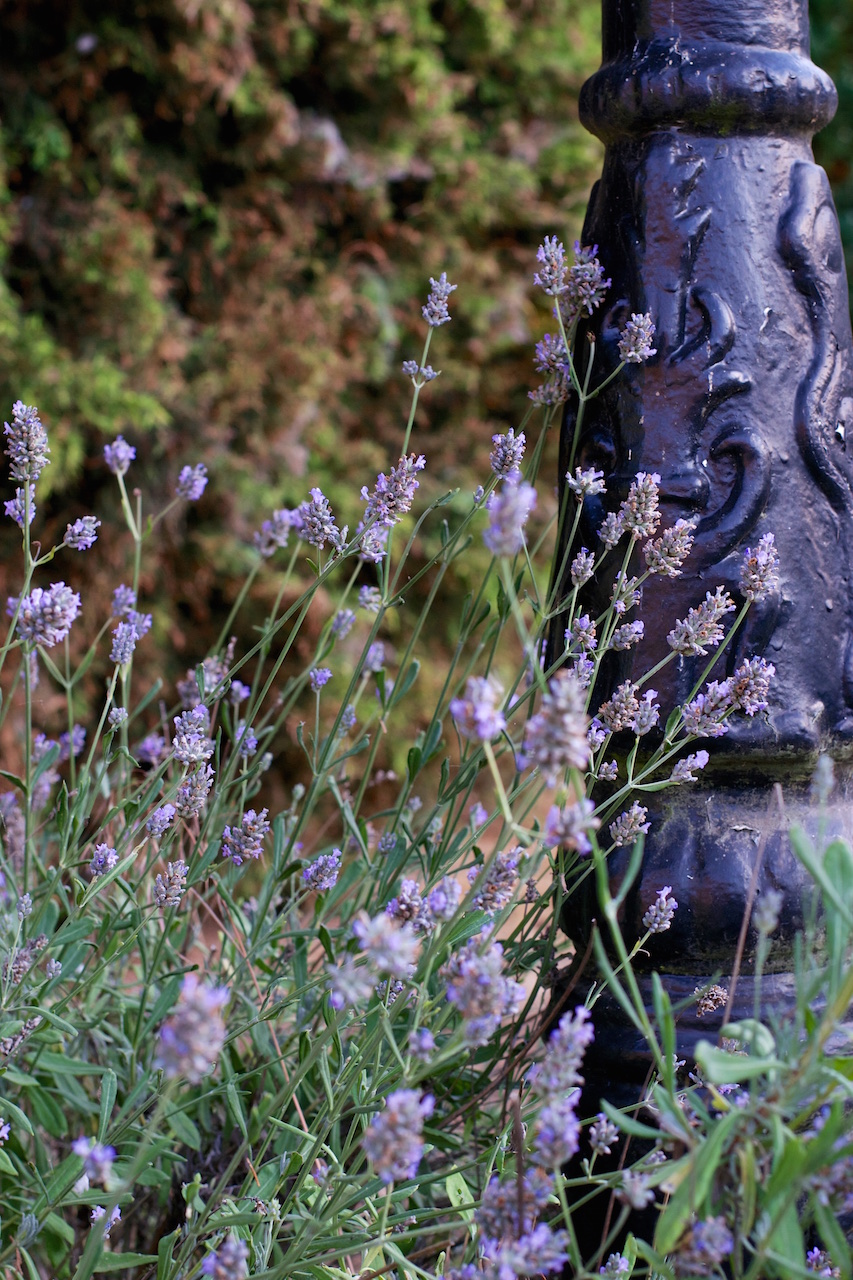
Lavender and bees · Lisa Stefan


The series is still available on the BBC iPlayer but will soon be released on DVD. If you haven't already watched it I have to warn you about the first episode. A lot of material is crammed into it - love affairs and deaths - that will make much more sense to those already familiar with the individuals of the Bloomsbury circle. It's my personal opinion that there should have been four episodes instead of three to better introduce the characters. In episode 2 the storytelling becomes much more flowing and easier to follow.


Maybe it's a cliché to call the lifestyle of the Bloomsbury group bohemian, as I did above, but the mise en scène certainly is. Think paintings, art supplies, desks, books, letters, etc. During the World War I, Vanessa Bell set up a home in the Charleston House in Sussex, where the main part of the Life in Squares takes place. You will find beautiful images of its artistic interiors on the website of House & Garden.

To the Lighthouse by Virginia Woolf · Lisa Stefan
Lavender · Lisa Stefan


For me the timing of the series is interesting because in the beginning of this summer I picked up Virginia Woolf's To the Lighthouse, which I tend to read in summertime. During the reading I started thinking about the sisters, watched The Hours (2002) for the hundredth time, and pre-ordered the paperback edition of Vanessa Bell by Frances Spalding. I realised my focus had always been on Virginia and her story, and I didn't know enough about Vanessa. The series has now given me a better idea and I'm even more eager to receive the biography in the mail.

The World of Interiors, September 2014, p. 146

I have what I can only call a longstanding infatuation with Virginia Woolf. I cannot remember when it started, and I cannot remember which of her work I read first. So much has been written about her life and if you are interested in her story I can recommend the book Moments Of Being: Autobiographical Writings. Then there is her nephew Quentin Bell's (son of Vanessa and Clive Bell) biography about her life from the year 1912 to 1941, Virginia Woolf: A Biography. Her husband Leonard Woolf edited her diaries and published them after her death (see A Writer's Diary: Being Extracts from the Diary of Virginia Woolf).

After watching Life in Squares I'm eager to go a little Bloomsbury-group crazy. I'm looking forward to reading the aforementioned biography of Vanessa Bell and then I would love to watch again Carrington (1995), starring two of my favourites, Emma Thompson as Dora Carrington and Jonathan Pryce as Lytton Strachey (see trailer). There is a film in the making by Dutch director Sacha Polak called Vita & Virginia, about Virginia's relationship with Vita Sackville-West. More to look forward to!