
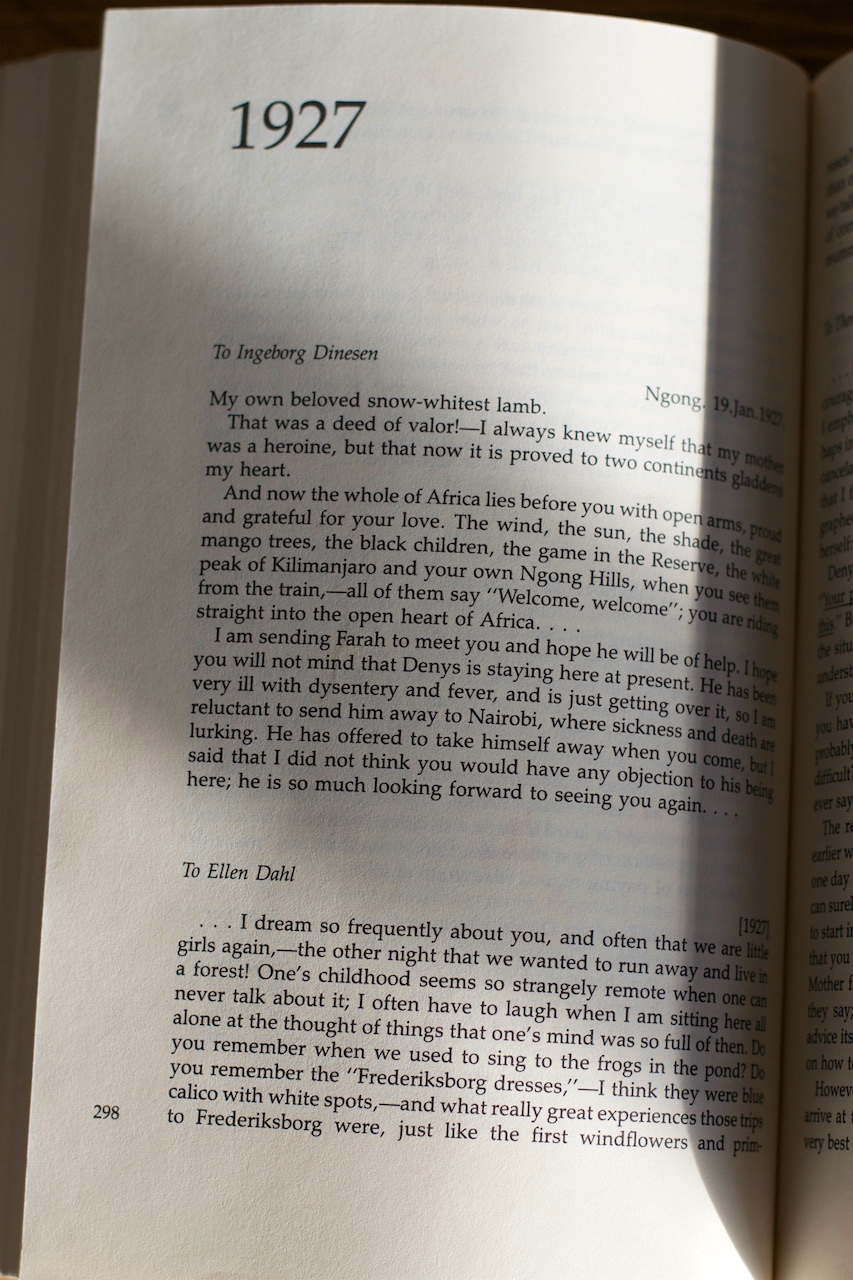
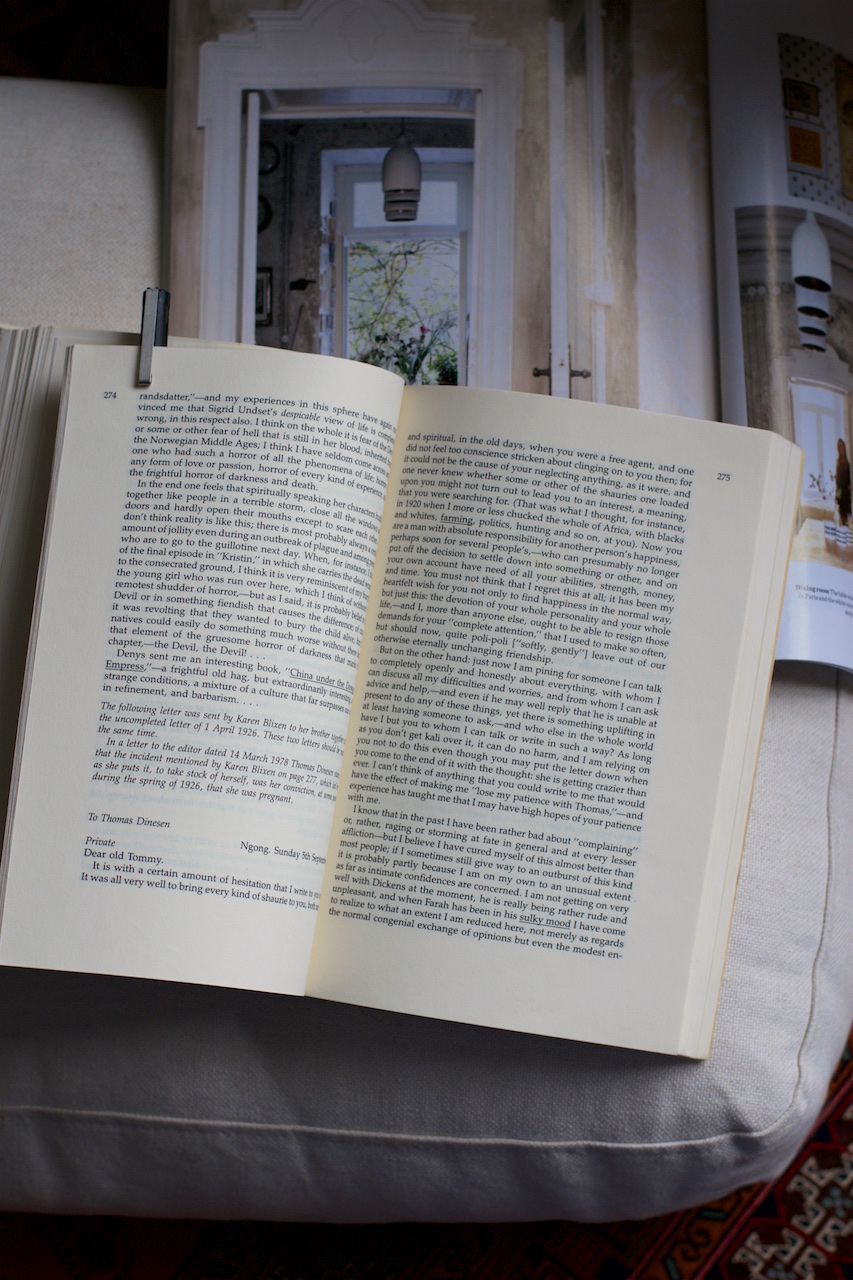
Recently I finished reading Letters from Africa 1914-1931, a collection of the letters which author Karen Blixen (pseudonym Isak Dinesen) wrote home to her family in Denmark during her years in Kenya. She arrived there at the beginning of 1914 (the first sentence in her memoir Out of Africa is: 'I had a farm in Africa, at the foot of the Ngong Hills') and this she wrote to her mother in 1919:
It is so beautiful here, a paradise on earth, when there is enough rain. And in a way, during the times of tribulation one comes to love this intractable country still more; I have a feeling that wherever I may be in the future, I will be wondering whether there is rain at Ngong. (26 Feb.)The Letters were edited by Frans Lasson for the Rungstedlund Foundation. I believe reading someone's letter collection requires a keen interest in the person in question and patience, as things will be repeated. (Coffee also helps!) If you are already familiar with Blixen's life there isn't much that will startle you, but for me the surprise was realising how hard she really struggled to keep her farm going. In Out of Africa she spares the reader the distressing details. In her letters, however, all the struggles are there but Lasson also left parts of the financial troubles out. Sydney Pollack's film Out of Africa (1985) certainly touches upon the subject of hardship but Blixen endured greater difficulties than it could ever depict and, unsurprisingly, the film romanticises her life in Africa, which of course had its pleasurable moments.

For those who haven't read Out of Africa (published in 1937), it's a memoir of her Kenya years but it has no chronological order and Blixen leaves many things out. In the director's comments on the DVD, Pollack says: 'What's beguiling about Out of Africa isn't what she wrote on the page . . . but in a way what isn't on the page' (Out of Africa, 1985, 6:50). I quite agree with him and now her letters have helped me fill in the gaps. What strikes me in her letters is that she never stops seeing the beauty of her surroundings despite the hardships - droughts, failed crops, and constant financial pressures.
You must not think that I feel, in spite of it having ended in such defeat, that my "life has been wasted" here, or that I would exchange it with that of anyone I know. . . . A great world of poetry has revealed itself to me and taken me to itself here, and I have loved it. . . . I have been the friend of Somali, Kikuyu, and Masai, I have flown over the Ngong Hills,—"I plucked the best rose of life, and Freja be praised,"—I believe that my house here has been a kind of refuge for wayfarers and the sick, . . . (Letter to her mother, 17 March 1931)

Having read the Letters there is a scene in Pollack's film that breaks my heart every time but now also has a new meaning for me. It happens towards the end of the film when the coffee mill has burned down and she is bankrupt (in reality there actually was a fire but it happened earlier and they had insurance). Blixen [Meryl Streep] is having a conversation with Denys Finch Hatton [Robert Redford] when she gets into her car, puts her hand on her abdomen and fiddles with her jacket (Out of Africa, 1985, 2:12:06). In these few seconds, Streep's gesture marks for me Blixen's utter defeat. (The scene is in this clip on YouTube, at 3:15.)
Blixen put her heart and soul into keeping the coffee plantation going but eventually, the shareholders in Denmark (her family) decided to sell the farm, which never turned into the profitable investment that she had envisioned. I think every reader of the Letters roots for Blixen and hopes for that long-awaited, good coffee crop that will turn everything around, yet knows it isn't about to happen.
Blixen put her heart and soul into keeping the coffee plantation going but eventually, the shareholders in Denmark (her family) decided to sell the farm, which never turned into the profitable investment that she had envisioned. I think every reader of the Letters roots for Blixen and hopes for that long-awaited, good coffee crop that will turn everything around, yet knows it isn't about to happen.
But you must not think that I am frightfully depressed and see everything in a tragic light. That is not at all the case; on the contrary, I think that these difficult times have helped me to understand better than before how infinitely rich and beautiful life is in every way and that so many things that one goes around worrying over are of no importance whatsoever. (Letter to her brother Thomas, 10 April 1931)
 |
In her book, Shadows on the Grass, Blixen explains the importance of a letter she received from
the King of Denmark. I shared the story of the letter in an earlier blog post |
Another factor that kept me reading the Letters was witnessing the birth of a writer, understanding Blixen's transition from being a coffee farmer in Africa to becoming a published author after the move back to Denmark. Despite the many natives that worked on her farm, the coffee plantation was an isolated place, in the sense that it was isolated from the arts. Literature, poetry and music were part of Blixen's upbringing but in Africa she wasn't able to attend concerts or go to the theatre. She talks about certain works and authors in her letters and asks her family to send her books and music. The arts and the nature and wildlife of Africa, especially the Ngong Hills, were key topics in her letters. I find it fitting to end this with a beautiful quote from her memoir:
If I know a song of Africa - I thought - of the giraffe, and the African new moon lying on her back, of the ploughs in the fields, and the sweaty faces of the coffee-pickers, does Africa know a song of me? Would the air over the plain quiver with a colour that I had had on, or the children invent a game in which my name was, or the full moon throw a shadow over the gravel of the drive that was like me, or would the eagles of Ngong look out for me? (Out of Africa)
 |
One of the many cups of coffee I drank during the reading
|
 |
 |
 |


