Showing posts with label karen blixen. Show all posts

Monday, 17 April 2017

Remembering Karen Blixen

Coffee with Karen Blixen 1885-1962 · Lisa Stefan


Happy Easter! Today is the birthday of Karen Blixen (17 April 1885 - 7 September 1962), a Danish author who wrote many tales under the pseudonym Isak Dinesen (Babette's Feast and Other Stories, Shadows on the Grass, Seven Gothic Tales, Winter's Tales, and Last Tales). She was a gifted storyteller, best known for her book Out of Africa, often described as a lyrical meditation on her life in Kenya, where she had a farm, a coffee plantation (the book has no chronological order). Most people know of Blixen because of Sydney Pollack's film adaptation: While the film may give you an idea of Blixen's life in the stunning African landscape, only by reading the book will you experience its true atmosphere. For me it depicts an Africa I will never experience. A bygone era.

In one of my journals there is a quote by Blixen. Once she was asked how a story begins for a writer and this was her reply, in Danish:
Det begynder med atmosfære, et landskab, der for mig er vidunderligt skønt, og så – så kommer menneskene pludselig ind i billedet. Med det er de der, de lever, og jeg kan lade dem leve videre i bøgerne.
Basically, she is saying that first comes atmosphere, a landscape, which she finds wonderful and then, suddenly, people enter the scene. With that they are there, they live, and she can let them live on in the books. (I found the quote on the FB page of Karen Blixen Museet.)

In February came great news for Karen Blixen fans when it was announced that her book Out of Africa will be turned into a TV series.

image by me | the photo of Karen Blixen appears in the book Letters from Africa 1914-1931


Saturday, 24 September 2016

№ 4 reading list: early autumn 2016

№ 4 reading list: Albert Camus, Tova Jansson, Isak Dinesen · Lisa Stefan


Saturday morning, coffee and books. In the background on repeat, Cat Power performing her cover of Troubled Waters; I never tire of this song. It's time to share my early autumn reading list - yes, there will be a late-autumn one, I already have some works lined up. I wanted to include Michael Chabon's Wonder Boys on the list but it wasn't available at the library and my ordered copy hasn't arrived, yet. I loved Michael Douglas in the film (2000), directed by Curtis Hanson, who passed away last Tuesday. I have already finished two books on the list and one of them is The Little Book of Hygge, which I recently reviewed on the blog. At the moment I'm reading five books at once. Some are short story collections so I pick up the one I'm in the mood for. Here is the list:

1   Siddhartha  by Hermann Hesse
2   The Outsider  by Albert Camus
3   The Summer Book  by Tove Jansson
4   A Winter Book: Selected Stories  by Tove Jansson
5   Anecdotes of Destiny  by Isak Dinesen (Karen Blixen)
6   In Other Rooms, Other Wonders  by Daniyal Mueenuddin
7   Kitchen  by Banana Yoshimoto
8   The American  by Henry James
9   Casino Royale  by Ian Fleming
10  The Little Book of Hygge: The Danish Way to Live Well  by Meik Wiking

At the library I spotted Yoshimoto's Kitchen, her first book, and had to borrow it to read again. Japanese authors are so wonderfully different. Many years ago I worked in a bookshop with school and took the risk of recommending it to a customer, who struck me as a reader ready for something different. Sometimes it was tricky recommending books to customers, not everyone has the same taste (luckily) and I didn't want anyone to waste money on something they didn't enjoy. Well, this one came back to tell me that she had loved it, that it was 'different', and she went home with a stack of my favourite books.

Stéphane Audran as Babette in Babette's Feast (1987)

Two Nordic authors are on my list. You know already about my love for Karen Blixen. Many years ago I read her story Babette's Feast and have since treasured it. It's featured in the story collection on the list and I'm looking forward to reading it again. Have you seen the film (1987, original Danish title Babettes gæstebud)? It's one of my favourites. It won the Oscar in the category Best Foreign Language Film. The other Nordic author on my list is Tove Jansson, who became famous for her books about the Moomintrolls (see my recent post about The Moomin Shop in London). She also wrote fiction for adults and I don't understand why I hadn't read any of them before. I'm so enjoying the two on my list. The Summer Book, first published in 1972, is a beautifully written story about a six-year-old and her grandmother, who spend a summer on a tiny island in the Gulf of Finland (Jansson herself had a cabin on a tiny, remote island in the same Gulf). The story has no plot, it's about life and nature. Such a quiet and calm read.

Finnish author Tove Jansson
Tove Jansson at her cabin on the Finnish island Klovharun

The other book on the list that I have also finished is Casino Royale, Ian Fleming's first book about James Bond. I was not impressed, which is the reason I didn't include it in my photo! Perhaps my expectations were too high because I enjoyed the film. The plot is interesting but I was simply bored during the reading. There were also sentences that I had to read twice to believe my own eyes ('the sweet tang of rape' (p. 201); it was published in different times, in 1953, but hello, misogynistic much?). One day I will probably give Fleming another chance and read From Russia with Love, which many consider his best. Just not yet.

1: image by me | 2: still via BFI · credit: Panorama Film A/S, Det Danske Filminstitut, Nordisk Film + Rungstedlundfonden · director + screenplay Gabriel Axel | 3: via Tove Jansson


Monday, 29 February 2016

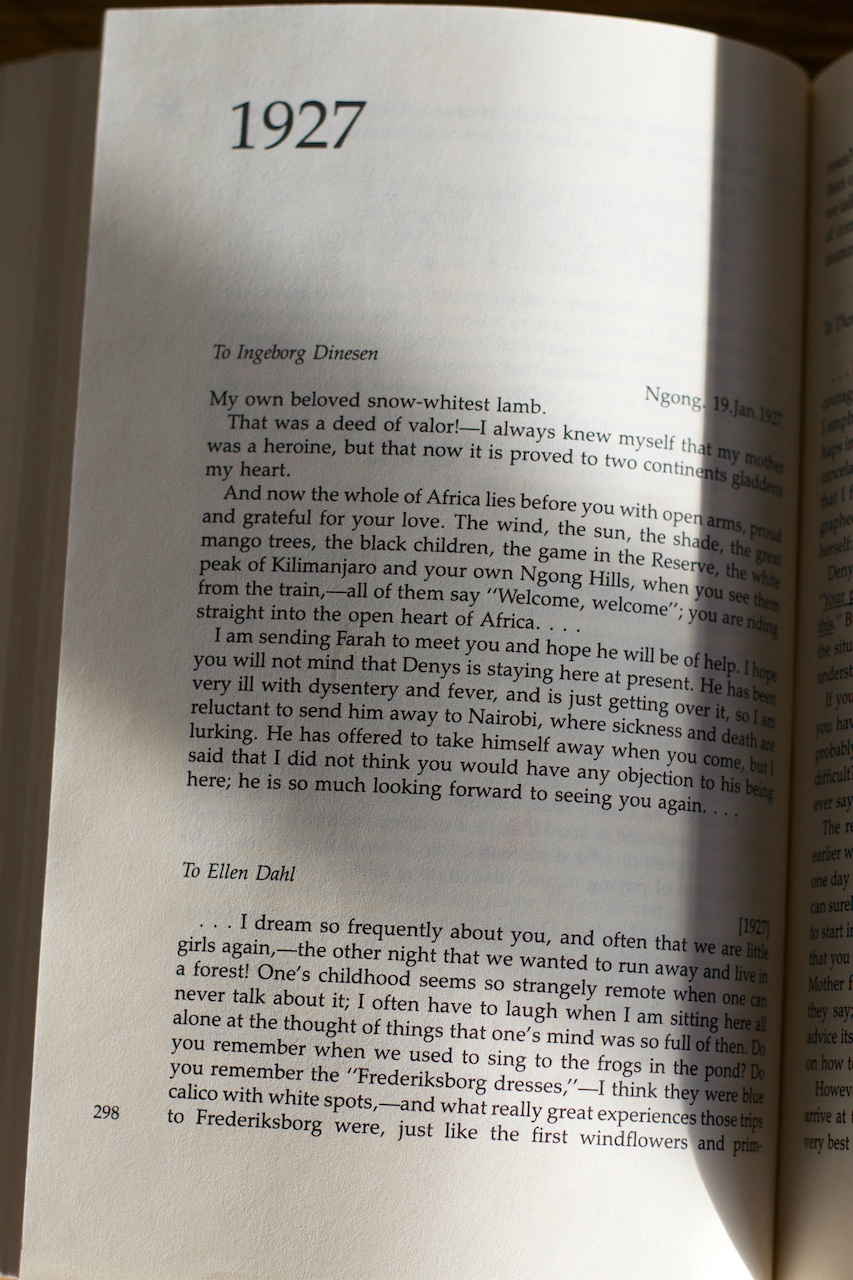
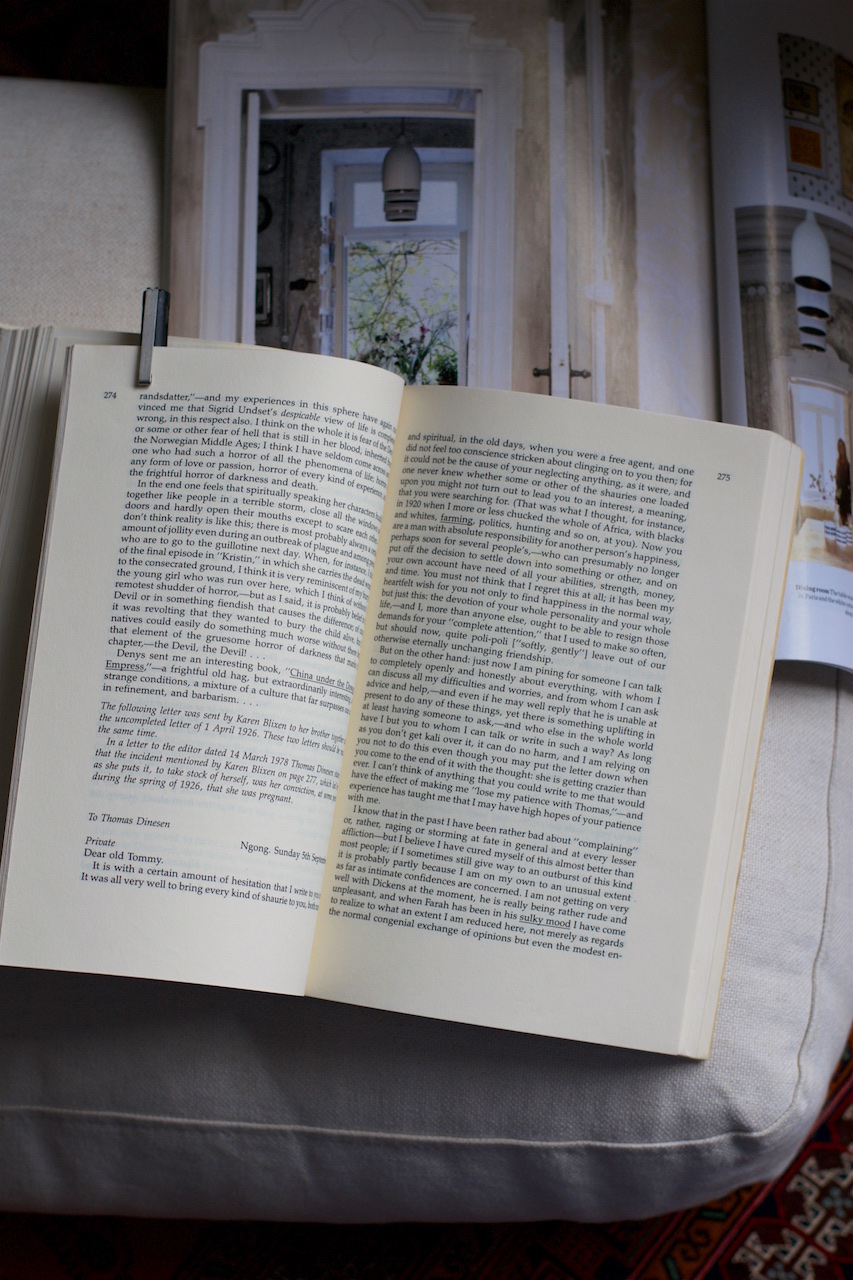
Karen Blixen's Letters from Africa 1914-1931


A page in Karen Blixen's Letters from Africa 1914-1931 · Lisa Stefan
Karen Blixen's letters from Africa 1914-1931 · Lisa Stefan


Recently I finished reading Letters from Africa 1914-1931, a collection of the letters which author Karen Blixen (pseudonym Isak Dinesen) wrote home to her family in Denmark during her years in Kenya. She arrived there at the beginning of 1914 (the first sentence in her memoir Out of Africa is: 'I had a farm in Africa, at the foot of the Ngong Hills') and this she wrote to her mother in 1919:
It is so beautiful here, a paradise on earth, when there is enough rain. And in a way, during the times of tribulation one comes to love this intractable country still more; I have a feeling that wherever I may be in the future, I will be wondering whether there is rain at Ngong. (26 Feb.)
The Letters were edited by Frans Lasson for the Rungstedlund Foundation. I believe reading someone's letter collection requires a keen interest in the person in question and patience, as things will be repeated. (Coffee also helps!) If you are already familiar with Blixen's life there isn't much that will startle you, but for me the surprise was realising how hard she really struggled to keep her farm going. In Out of Africa she spares the reader the distressing details. In her letters, however, all the struggles are there but Lasson also left parts of the financial troubles out. Sydney Pollack's film Out of Africa (1985) certainly touches upon the subject of hardship but Blixen endured greater difficulties than it could ever depict and, unsurprisingly, the film romanticises her life in Africa, which of course had its pleasurable moments.
Isak Dinesen: Letters from Africa 1914-1931 (Karen Blixen) · Lisa Stefan


For those who haven't read Out of Africa (published in 1937), it's a memoir of her Kenya years but it has no chronological order and Blixen leaves many things out. In the director's comments on the DVD, Pollack says: 'What's beguiling about Out of Africa isn't what she wrote on the page . . . but in a way what isn't on the page' (Out of Africa, 1985, 6:50). I quite agree with him and now her letters have helped me fill in the gaps. What strikes me in her letters is that she never stops seeing the beauty of her surroundings despite the hardships - droughts, failed crops, and constant financial pressures.
You must not think that I feel, in spite of it having ended in such defeat, that my "life has been wasted" here, or that I would exchange it with that of anyone I know. . . . A great world of poetry has revealed itself to me and taken me to itself here, and I have loved it. . . . I have been the friend of Somali, Kikuyu, and Masai, I have flown over the Ngong Hills,—"I plucked the best rose of life, and Freja be praised,"—I believe that my house here has been a kind of refuge for wayfarers and the sick, . . . (Letter to her mother, 17 March 1931)
Karen Blixen and coffee · Lisa Stefan


Having read the Letters there is a scene in Pollack's film that breaks my heart every time but now also has a new meaning for me. It happens towards the end of the film when the coffee mill has burned down and she is bankrupt (in reality there actually was a fire but it happened earlier and they had insurance). Blixen [Meryl Streep] is having a conversation with Denys Finch Hatton [Robert Redford] when she gets into her car, puts her hand on her abdomen and fiddles with her jacket (Out of Africa, 1985, 2:12:06). In these few seconds, Streep's gesture marks for me Blixen's utter defeat. (The scene is in this clip on YouTube, at 3:15.)

Blixen put her heart and soul into keeping the coffee plantation going but eventually, the shareholders in Denmark (her family) decided to sell the farm, which never turned into the profitable investment that she had envisioned. I think every reader of the Letters roots for Blixen and hopes for that long-awaited, good coffee crop that will turn everything around, yet knows it isn't about to happen.
But you must not think that I am frightfully depressed and see everything in a tragic light. That is not at all the case; on the contrary, I think that these difficult times have helped me to understand better than before how infinitely rich and beautiful life is in every way and that so many things that one goes around worrying over are of no importance whatsoever. (Letter to her brother Thomas, 10 April 1931)

Isak Dinesen: Letters from Africa 1914-1931 (Karen Blixen) · Lisa Stefan
In her book, Shadows on the Grass, Blixen explains the importance of a letter she received from
the King of Denmark. I shared the story of the letter in an earlier blog post

Another factor that kept me reading the Letters was witnessing the birth of a writer, understanding Blixen's transition from being a coffee farmer in Africa to becoming a published author after the move back to Denmark. Despite the many natives that worked on her farm, the coffee plantation was an isolated place, in the sense that it was isolated from the arts. Literature, poetry and music were part of Blixen's upbringing but in Africa she wasn't able to attend concerts or go to the theatre. She talks about certain works and authors in her letters and asks her family to send her books and music. The arts and the nature and wildlife of Africa, especially the Ngong Hills, were key topics in her letters. I find it fitting to end this with a beautiful quote from her memoir:
If I know a song of Africa - I thought - of the giraffe, and the African new moon lying on her back, of the ploughs in the fields, and the sweaty faces of the coffee-pickers, does Africa know a song of me? Would the air over the plain quiver with a colour that I had had on, or the children invent a game in which my name was, or the full moon throw a shadow over the gravel of the drive that was like me, or would the eagles of Ngong look out for me? (Out of Africa)

Blixen and coffee · Lisa Stefan
One of the many cups of coffee I drank during the reading


Wednesday, 27 January 2016

A time well spent

A time well spent: coffee & Karen Blixen · Lisa Stefan


I have a confession to make. This morning was rainy and dull and with time on my hands I thought it best to finish organising the rest of our clothes. A chest of drawers in our bedroom is still empty after the move and there are still clothes in boxes. It all started well but then I longed for a cup of coffee and probably made the mistake of bringing it upstairs. Before I knew it I was sitting on the rug with books and magazines, and the film Out Of Africa (1985) running in player. I have no excuse. Most of the drawers are still empty but I believe my time was well spent. In my opinion it cannot be a waste of time if it leaves you inspired.

Lately I have been watching Out of Africa a lot. I don't sit with my eyes fixed on the screen, I just let it run in the player and watch it with one eye or listen while I'm doing something else. I often keep the director Sidney Pollack's commentary on because I never grow tired of what he has to say about Karen Blixen, Kenya and how they shot the film. He doesn't only talk about particular scenes, as most directors do, he goes deeper and I love his way of storytelling. Maybe this is just my way of holding on to his voice after his death. Anyway, it's a film I have watched so many times that I can no longer keep track, but each time I do I'm drawn to different scenes. This morning it was the relationship between Blixen [Meryl Streep] and her Somali servant Farah [Malick Bowens], who was with her the entire time she lived on the farm in Kenya. Their conversations aren't long but the scenes are delightful and often witty. In her book Shadows on the Grass she refers to him as her "servant by the grace of God" and I think Pollack's film captures the meaning of it beautifully.
Out of Africa by Karen Blixen · Lisa Stefan


About my rereading. Karen Blixen's Out of Africa is one of the books I have been reading again. I was thinking about it the other day that the more I see of the stuff people share on social media - selfies and pointless websites, dare I say stupidity? - the more I feel the need to take a step back and revisit either quality books or films. They help to cleanse the mind of rubbish articles and unwanted images out there.

A note on my photos: Top photo shows page 133 in the Dec. 2015 issue of The World of Interiors (taken by Andreas von Einsiedel). The article 'Window on the World' is about the late Julian Barrow, an artist and world traveller, who had a studio in Chelsea. The patterns are from V&A Pattern: Indian Florals. The bottom photo shows a page in the same issue of WoI. The article, 'Bauhaus Below the Border' which starts on page 66, is about Josef and Anni Albers. The exhibition A Beautiful Confluence: Anni and Josef Albers and the Latin American World runs at the Museo delle Culture in Milan until 21 Feb.


Friday, 26 July 2013

Seven Gothic Tales by Isak Dinesen

Seven Gothic Tales by Isak Dinesen (Karen Blixen) · Lisa Stefan


I woke up this morning to thunders and lightning and the rain has been pouring down. It feels refreshing; I like the darkness accompanying it. Well, the sky is slowly brightening up so maybe today will be yet another sunny day.

Yesterday we celebrated our boy's birthday (the living room floor is a Playmo Knights battlefield) and I also went into the city to go to the library. I so enjoyed revisiting Karen Blixen's book Out of Africa earlier this month and I wanted to read more by Blixen and about her life. I was telling my parents on the phone the other day that I don't know why Blixen fascinated me from a young age. Maybe it was the Danish vibe that I felt in the home of my paternal grandparents, who were both part Danish.

I wanted to borrow - and did - Seven Gothic Tales, which Blixen wrote in English under the nom de plume Isak Dinesen after returning to Denmark from Kenya (Out of Africa came later). Then I got a few books that Sidney Pollack's film Out of Africa (1985) was based on: Shadows on the Grass, where Blixen continues with stories about her life in Kenya, Isak Dinesen: The Life of Karen Blixen by Judith Thurman, and Silence Will Speak by Errol Trzebinski. The last one is about the life of Denys Finch Hatton and his relationship with Blixen (played by Robert Redford in the film).

Maybe I should have warned you that this post was about books, but I guess the photo gave it away. Have a wonderful weekend!